

The creator’s code is dead. It’s time to replace moral outrage with something more permanent.
They cooked. With your work. They scraped. With your work.
I’ve been designing for over 30 years, and I’ve never been angrier about how things are currently.
We’ve spent years perfecting our craft, only to watch the last couple of years turn our industry into an open buffet.
‘Inspiration’ has been replaced by scraping. ‘Style’ has been reduced to a prompt.
As designers, we’ve been told to embrace the future. Nobody mentioned that the future would be built on the backs of our un-credited, un-notarised, and unprotected work.
I’m tired of seeing the world’s best creators leave their doors unlocked in a neighbourhood full of scavengers. It’s time we stop treating our intellectual property like a footnote and start treating it like the high-value asset it actually is.
The Creator’s Code Is Gone
We used to rely on an unwritten rule — you don’t just lift someone’s layout, tweak a border-radius, shift the HEX value a little, and call it your own. In the last 18 months, that code hasn’t just been broken. It’s been shattered.
Hands up, who’s seen the socials go absolutely wild with blatant plagiarism of other creatives’ work? Morals have gone down. Truly original work has plummeted. Theft has skyrocketed like never before.
And it’s not just the ethically challenged folks on the socials. The training models powering AI tools are doing more than drawing inspiration from our work too. They’re ingesting it wholesale, without credit, without consent, without compensation.
Standing on the moral high ground isn’t enough anymore. You need something more permanent. You need a record that says: “I was here first, and here’s the math to prove it.”
The “Did I Cook?” Cover
This culture of “Did I cook?” has, on many occasions now, become a convenient cover for what used to be called plain old theft.
We’ve all seen the cycle. Someone drops a post with a slightly tweaked layout or a borrowed icon set, waits for the likes to roll in, and carefully omits any mention of where those ideas actually came from. If they get away with it, they’re a visionary. If they get called out, they immediately pivot to: “I was just sharing what inspired me.”
It’s a masterclass in backpedalling. The blatant pass-off suddenly becomes a ‘study’ or a ‘tribute’ they just conveniently forgot to tag you in. Standardisation is being used as a shield for laziness — copy a single source, hope the algorithm moves fast enough that nobody notices. Just another Tuesday on X right?
The Law Is Finally Catching Up
What’s happening on X is just the visible layer. The more damaging theft is happening quietly, industrially, at scale, inside the training data of AI models that have ingested our work without a word of credit or a penny of compensation.
Time for some good news though. The legal landscape is shifting.
The EU AI Act — now moving toward full enforcement in August 2026 is forcing AI developers to disclose what they trained on and publish transparency reports on the copyrighted content they used. The EU Parliament’s Legal Affairs Committee went further in March 2026, calling for a full European register of every copyrighted work used to train AI models, and mandatory opt-out rights for creators.
But here’s the critical part that nobody’s talking about loudly enough: those transparency obligations only help you if you can prove your work existed first. If you don’t have a verifiable, timestamped, third-party record of your authorship, you’re essentially invisible when these companies publish their reports. You need a smoking gun that predates the scrape.
The Human Authorship Premium
We’re moving into an era where ‘Human-Made’ isn’t just a badge of pride, it’s becoming a legal necessity.
As AI models continue to ingest everything in their path, the burden of proof has shifted onto us. It’s no longer enough to say you designed something. You need to prove that a human was in the loop before the machines got involved.
By creating a mathematical fingerprint of your work the moment it’s finished, you aren’t just timestamping a file. You’re creating an immutable record of your creative DNA, one that stands outside of any AI training set, permanently, and sticks a middle finger up to those copycats on X for good.
Why Most IP Tools Weren’t Built for Designers
Most IP platforms feel like they were designed in a legal office back in 2016. Heavy, expensive, and deeply boring. I wanted to create the opposite, something that sits quietly in the background, anchors your work to the blockchain for next to nothing, and lets you get back to the craft.
Something that respects my time, stays out of the way, and didn’t make my head spin with talk of crypto, blockchains, and ERC-1155, but protected my work in one of the strongest ways possible.
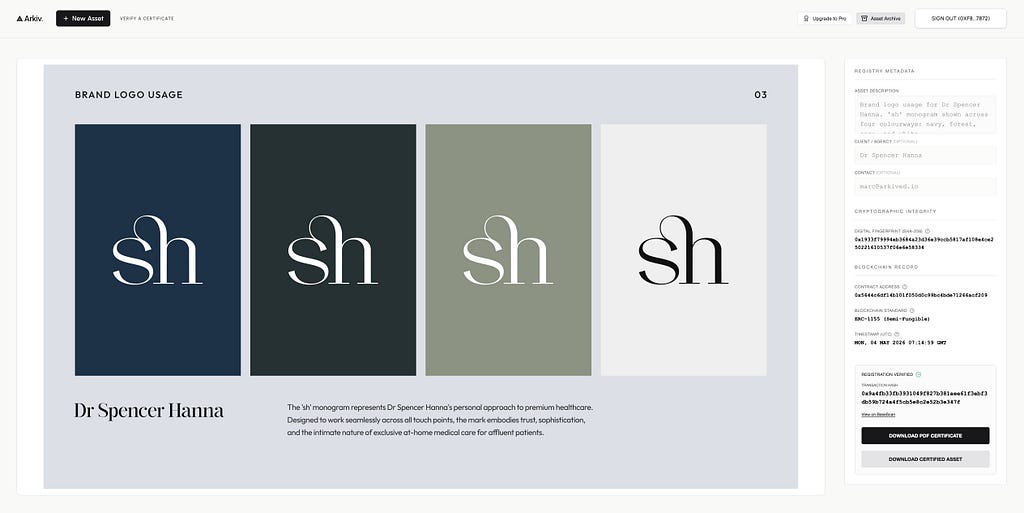
I wanted to protect my best work from training models, and social copycats moving forward, and that’s exactly what I built Arkiv for.
I’m Eating My Own Dog Food
I’m minting my own work as we speak. Not just because of IP theft concerns down the line, but for the simple peace of mind that comes from knowing I created this original piece of work, and it’s there on record for all time. Like an Egyptian hieroglyphic. Or something like that.
Your work, like mine, deserves protecting, and posterity.
Some great links if you want to dive a little deeper…
https://scalevise.com/resources/eu-ai-act-2026-changes/
https://en.wikipedia.org/wiki/Generative_AI_Copyright_Disclosure_Act
https://hyscaler.com/insights/blockchain-in-intellectual-property/
https://www.goodwinlaw.com/en/insights/publications/2025/04/insights-otherindustries-france-takes-pioneering-step
Thanks for reading,
Marc
Founder of Arkiv
Why you need to protect your work more than ever was originally published in UX Collective on Medium, where people are continuing the conversation by highlighting and responding to this story.


