

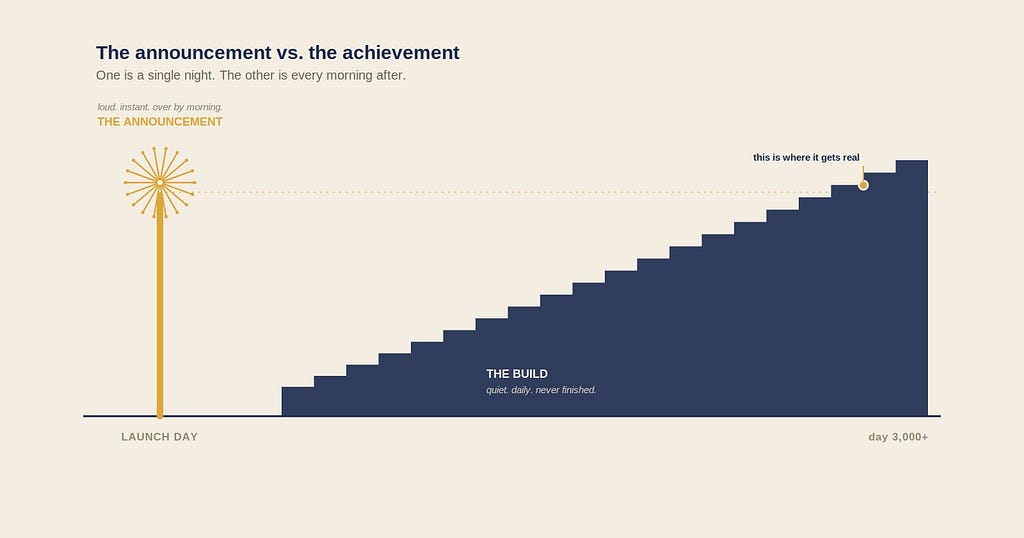
The announcement is one loud night. The evolution, the slow build starts the morning after, is the whole job.

I recently asked Spotify for a Fourth of July playlist. Specifically, a rock one.
It came back with big drums and big choruses: “Born in the USA,” “Fortunate Son,” “For What It’s Worth,” “Rockin’ in the Free World.” The kind of songs you crank over a grill without really hearing the words and the fascinating thing to me was that every single one is a protest song.
“Born in the USA” is Springsteen screaming about a Vietnam vet the country used up and threw away, which didn’t stop the Reagan campaign from grabbing it, because nobody on that staff made it to verse two. “Fortunate Son” torches the rich kids who watched other people’s sons get shipped off to die. “For What It’s Worth” watches the streets curdle, and we honored it by making it the chillest track at the cookout. “Rockin’ in the Free World” lists everything rotting behind the flag over a hook so big you sing along and miss the indictment.
Four songs about how ugly and unfinished the American experiment is, turned into barbecue background music. That is a national habit, and we do it worst with revolutions.
July 4th celebrates the declaration, the announcement, the, if you will, launch party. The actual country showed up later, and ugly: a confederation too broke to pay its own soldiers, an armed revolt of unpaid war veterans the government was too broke to put down, a do-over convention nobody will admit was a do-over, and a Constitution shipped as an emergency patch on a v1 that was already on fire. Then two centuries of amendments, because the founders, powdered wigs and all, got an embarrassing amount wrong on the first pass. Founders always do.
Here’s the quip nobody wants on a mug: revolutions don’t build things. A revolution hands you a new way of seeing, a great story, and a merch table. The building happens after, and it’s slow and unglamorous and done entirely by the people willing to raise a hand and say this isn’t right yet. That’s evolution and that’s where the actual work lives. And here’s the part worth saying out loud: it worked.
That broke, burning, half-built country grew into something genuinely beautiful, flawed the way the best things are flawed, more perfect than the day before and then the day after that. Two and a half centuries of people quietly refusing to leave it the way they found it.
Which brings me to AI, currently throwing the loudest launch party in the history of technology.
We’re deep in the declaration phase, and man, is it a party. Do you remember Google’s Gemini reveal back in 2023? The six-minute video where Gemini watches a guy sketch a duck and reacts in real time, tracks a ball under shuffling cups, calls his rock-paper-scissors move off nothing but silent hand gestures. A million views in a day. Then the press pulled the thread: none of it happened that way. No live video, no voice. Google fed it still frames and typed prompts, trimmed the latency, and stitched it together until it looked like a machine thinking on its feet. The only honest part was one line of fine print nobody was meant to read.
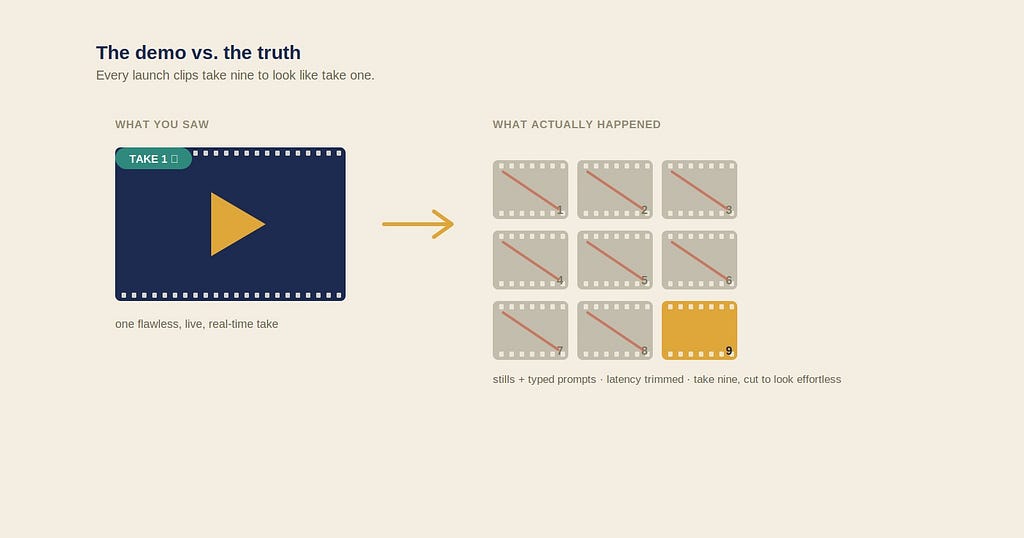
That’s the whole AI genre right now. The keynote demo that worked on take nine, clipped to look like take one. The founder onstage holding a chatbot like he chiseled it out of marble himself. The launch post about how everything’s different now that forgets to name a single thing that shipped. Gorgeous fireworks.
An alarming number of companies have confused the show for the country. They think the demo was the product and the announcement was the finish line.
It wasn’t and it never is. The real work starts the next day, when the beautiful demo meets real edge cases and real people raising a hand to say this isn’t right yet. That’s evolution, and it’s the part I get to watch for a living, because I spend my days as a product leader inside companies building real things with this stuff. A front-row seat to who’s quietly doing the fixing and who just keeps reaching for another firework.
Let me be fair to the revolution first, though, because I’m not here to tell you AI is cheap sleight-of-hand. A revolution, at its core, is a new way of seeing. It walks in, rearranges what you thought was possible, and hands you a blank page. Jakob Nielsen frames AI as the fourth great economic revolution, after tools, agriculture, and industry. Each one took something scarce and made it stupidly abundant: muscle, then food, then power, now cognition. He’s right, and I won’t pretend otherwise.
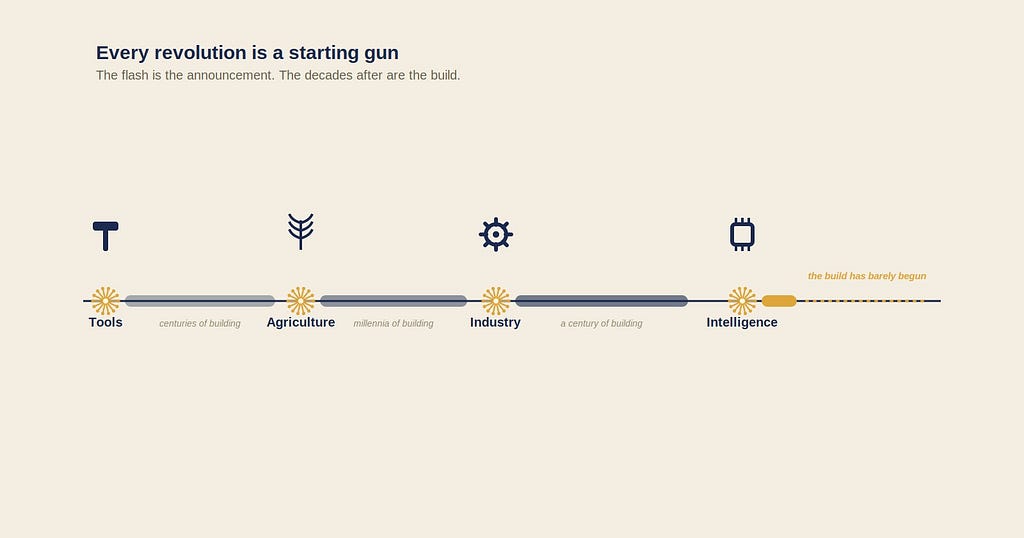
But notice what every one of those revolutions has in common. Not one was finished on announcement day. The plow didn’t grow the crops. The steam engine didn’t build the railroads, the timetables, the labor laws, or the towns that grew around them. The revolution was the starting gun. Everything that mattered came after, from people doing the boring, contested, decade-long work of making the new thing function. That’s evolution. And it is profoundly unsexy.
Evolution, up close
I get to watch it happen for a living. I work as a fractional product leader: a part-time chief product officer, embedded with a few companies at once rather than all-in on one. Which means I’m parked inside a rotating set of companies actually building with this stuff instead of just posting about it, and most of my week is a series of meetings where somebody says the four most important words in product development: this isn’t right yet.
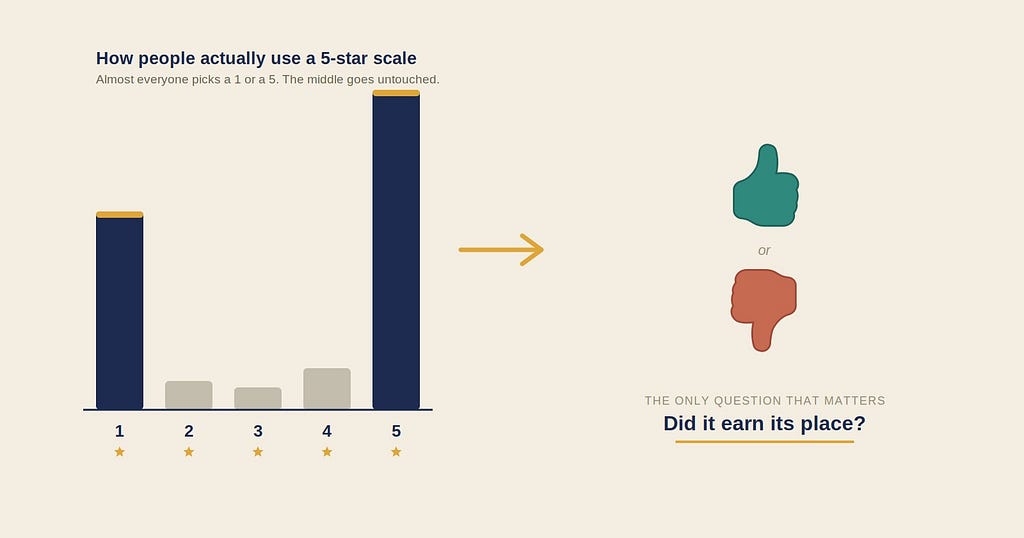
It almost never sounds like a breakthrough. On one product, we’d shipped a tidy little five-star rating so readers could grade a set of AI-written summaries. It looked fine. Then somebody on the team brought in a simple observation: nobody agrees on what a star means. My three is your four is somebody else’s “eh.” Five stars feels like data and it’s mostly noise. YouTube killed its five-star ratings back in 2009 after its own numbers showed people almost only ever gave a one or a five, with the whole middle sitting untouched. So we switched it to a thumbs up or thumbs down, because the only question worth asking the reader is whether the summary earned its place. A small, unglamorous, deeply correct decision that no keynote will ever mention.
Here’s a bigger one. We handed an engineer a gorgeous AI-generated prototype and he said, more or less, I can’t build from this, I’d have to start over. That stung, because the prototype was the fireworks, and it had come together in an afternoon. Part of his reaction was a misunderstanding: he hadn’t clocked that the thing was already real, working code, not a picture to redraw. But under the friction was a fair point: the handoff wasn’t shaped for the way his team actually works. So instead of defending the demo, we spent the next two weeks doing the evolution. We dug into what he was missing, moved the component library into the tools he lives in, and reshaped the process around him.
Sen Lin calls that scaffolding a harness: bolt the design system on as a hard constraint so the model builds inside your rules instead of around them. Every process is different, and bending it to the engineering team is the whole job.
I’m not here to sell you magic. Half of that same job is a designer quietly fighting the model to keep the component library current: tell it to update the thing, watch it not update the thing, tell it again.
The model spins up a gorgeous prototype in an afternoon, and then the upkeep is yours, forever, by hand.
Nobody demos the upkeep. But Fanny makes the case that once iteration gets this cheap, the only thing left setting the ceiling on quality is your judgment, not the model’s speed. The deciding and the maintaining are the job.
So how do you demo the upkeep? You mostly don’t, and that’s exactly the problem. There’s nothing exciting about saying “aaaand we kept it working” to an audience, so it never gets the budget the launch gets. The teams that survive anyway do it by making the invisible work legible, and the tool for that is evals. Hamel Husain, who has watched a lot of AI products live and die, says the ones that fail almost all share a single root cause: no real evaluation system, just vibe checks. An eval suite is how you prove the thing is a little more right this month than it was last month. It is the closest the upkeep ever comes to a demo.
Can you just hand the upkeep to AI and skip all this? Some of it, sure, with an asterisk the size of the Terminator. The model will draft the evals, write the migration you’ve been dreading, flag the design-system deltas, keep the docs in sync. What it will not do is decide what’s worth fixing, or notice when the fix quietly broke three things upstream.
Simon Willison, who has shipped more AI-assisted code than almost anyone and stays clear-eyed about it, put the line exactly where it belongs: the one thing you cannot hand to the machine is checking that the thing actually works. If you never watched it run, you don’t have a working system, you have a hope.
The AI does the doing, but you still do the deciding.
That is Nielsen’s whole point from earlier: the winners are the ones who make the checking ten times faster. The grunt work of the grunt work is finally getting automated.
Sometimes evolution is smaller than a feature, and sometimes it’s the whole engagement. Not long ago my team walked away from a product we’d spent weeks on. Discovery, research, strategy, prototyping, the entire thing. We’d done exactly what we were hired to do: listen hard, challenge the assumptions, turn what we heard into a real strategy. There was a path forward. It just wasn’t the one the founder had already decided on. When honest early thinking got called “juvenile” and real findings got waved off because they didn’t fit the fantasy, we knew. Marty Cagan has a name for that setup: a feature team, handed a solution to build instead of a problem to solve, measured on whether it ships and not on whether it works.
You cannot evolve a product for someone who only wants the launch party. Sometimes the most useful thing a product person does is refuse to hand somebody a nicer firework.
Last year, I gave a talk with Patrick Neeman about why people trust AI in some places and flinch at it in others, and we kept landing on the same line: we don’t need louder voices, we need clearer ones. That is the entire difference between a revolution and the evolution that has to follow it. The revolution is the loudest voice in the room. Evolution is the clear one, quietly asking whether the thing actually works.
We’ve done this before
We’ve actually been through this a few times now. Twice we botched it pretty epically. Once we actually pulled it off, and even that took the better part of a decade.
The dot-com boom was a revolution that mistook its own launch party for a business model. The web genuinely changed everything, and then a thousand companies decided that changing everything meant they no longer had to sweat anything as dull as revenue or retention. Patrick Neeman has made the point that slop at least used to be expensive to produce, and AI made it nearly free, so the party only gets louder while the building gets rarer. Carlota Perez mapped this rhythm across two centuries of bubbles: the wild installation frenzy, the crash, and then the long, boring deployment phase where the technology actually gets woven into everyday life. The companies that walked out of that crash alive were the ones still doing the evolution long after the confetti got swept up.
Web3 ran the same play with even less to show for it. All manifesto, no plumbing. A revolution so busy declaring a new world order that almost nobody stopped to build something a normal person could use without a seminar.
Then there’s mobile, and mobile is the one that actually worked, which is exactly why it’s the sharpest mirror for where AI is right now. We remember the ubiquitous phrase, “there’s an app for that,” and the App Store gold rush, but the part that rewired how everyone banks and dates and pays and hails a cab and kills ten minutes in a waiting room didn’t happen immediately. It happened over the next ten years, in a million unglamorous decisions.
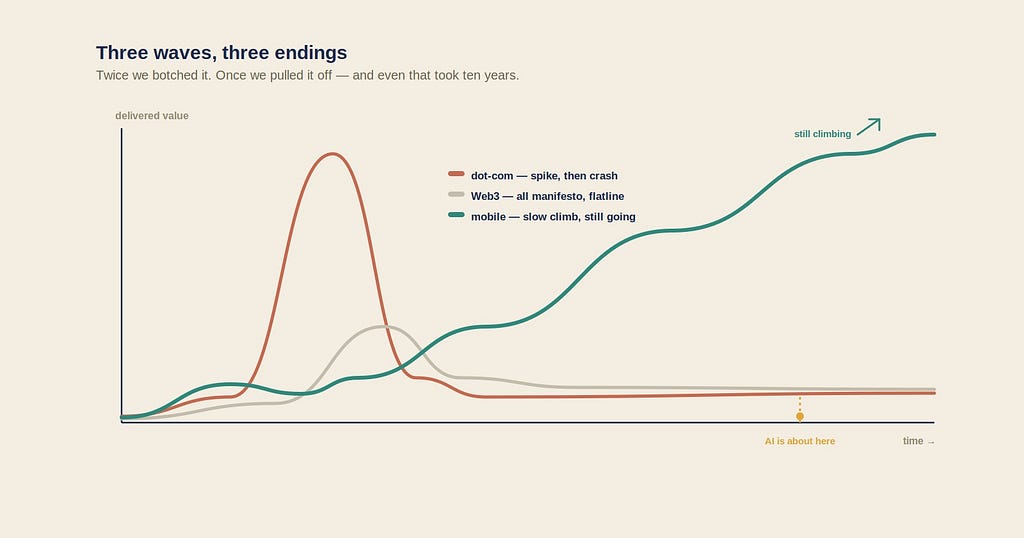
The companies that botched it did the obvious thing: shrank the desktop onto a phone, shipped a pinch-to-zoom mess and an app nobody opened, and called it a mobile strategy. The ones that won threw that out and rebuilt from the constraint up, what Luke Wroblewski named mobile first: start from the small screen, the one thumb, the lousy network, and strip the thing down to what actually matters. It worked.
It also took most of a decade before more of the world reached the internet from a phone than from a desktop. The revolution started on a stage in San Francisco, that Steve Jobs actually described as “three revolutionary products” in one. The evolution was ten years.
Why so many companies get AI wrong right now
This is roughly where an alarming share of AI initiatives are sitting. Remember that MIT number from the top, the ninety-five percent of pilots going nowhere? The researchers went out of their way to say the failure isn’t the technology. It’s what they call the learning gap: the distance between a model that demos beautifully and an organization willing to do the grinding integration work to make it real. The revolution showed up, but the evolution never got staffed.
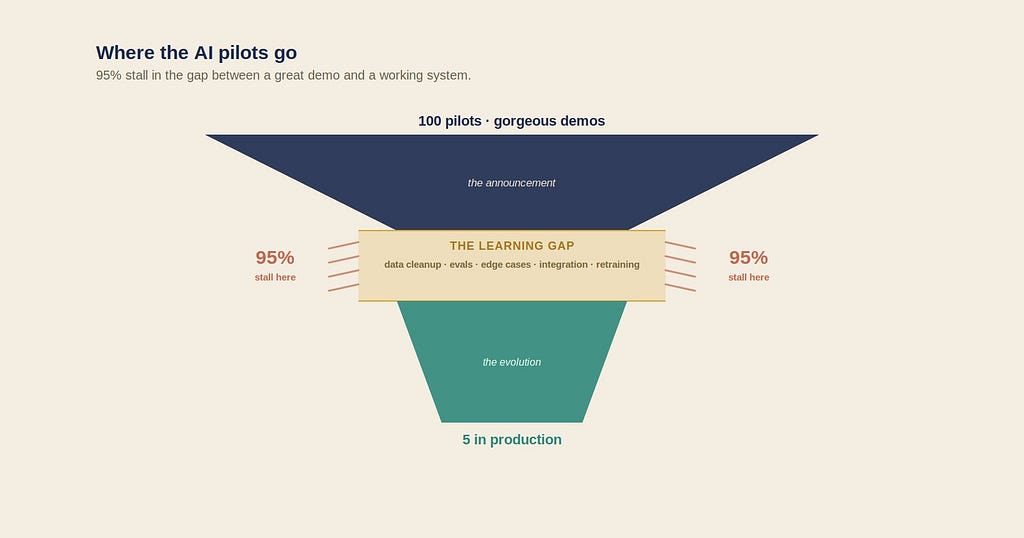
Let’s be honest, the evolution is grunt work: cleaning the data, wiring the model into a workflow that was built before it existed, writing the evals that catch it being confidently wrong, handling the edge cases the demo quietly skipped, retraining the people who now have to work differently. Patrick Neeman argues the deepest mistake companies are making right now is trying to automate work they never bothered to map, and that the real shift is a ten-year arc, not an eighteen-month sprint. None of that is sexy and public-facing, so none of it gets the budget. That MIT number took its own incoming, mostly for judging a pilot dead if it didn’t move the P&L inside six months. Which, if you think about it, proves the point: the six months after the party is exactly where the evolution was supposed to happen, and didn’t.
Nielsen, in his mid-year reckoning, names the tell exactly: the companies that win the agent era will be the ones that make checking the work ten times faster, not doing the work ten times faster.
Generation stopped being the hard part a while ago. Judgment is the whole game now.
Nate B. Jones keeps circling the same nerve, that once the cost of producing something collapses to nothing, the only thing left worth paying for is the taste to see what’s wrong and the spine to throw it out. Tom Scott and Vitor Amaral put the same shift in plain terms for anyone who builds: the job is moving from making the thing to deciding whether the thing is any good, and taste is the part that never automates.
I’ve said a version of this for years about hiring: I don’t care about the tools, we can teach the tools, what I need to know is whether you can be deductive and strategic, whether you can walk into a mess and find the thread worth pulling.
Kate Moran and Sarah Gibbons from Nielsen Norman Group land in the same spot from the research side: as the machines swallow the grunt work, taste and judgment become the differentiator, the line between the people who make it through the shakeout and the people who get automated. That instinct was always the job. AI just made it the only job.
Here’s the part the founders understood that we keep forgetting. They gave us the whole philosophy in three words: a more perfect union. More perfect. As in not there yet, never entirely will be, and the whole job is the getting-closer. They shipped a v1 they already knew was broken, and then built a machine for amending it forever.
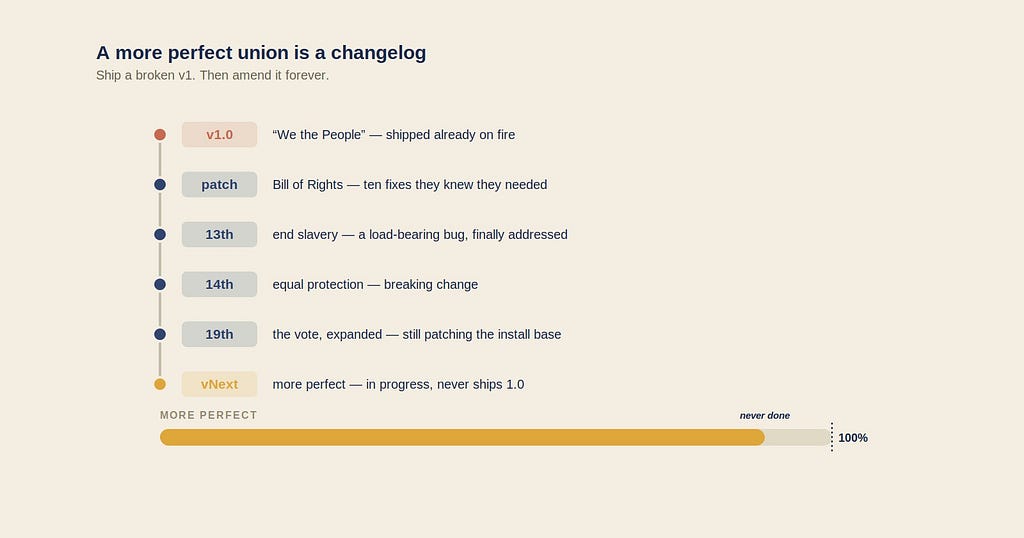
A product works the same way. The launch is a protest song we’ve decided to hear as an anthem: loud, thrilling, and completely misunderstood the second you stop at the chorus. The real story is down in the verses nobody plays at the barbecue, the fixing, the friction, the person with a hand up saying this isn’t right yet.
AI just had its revolution, and it was a hell of a good one. The only question left that’s worth anything is who is actually going to do the evolution.
Because nobody ever built a country, or a product, by throwing a better party. They built it the next morning, a little more perfect than the day before, and then they woke up and did it again.
References and further reading
On revolutions and what comes after the party:
- Carlota Perez, Technological Revolutions and Financial Capital
- Jakob Nielsen, How Big Is AI? Four Analogies
- Patrick Neeman, The Intelligence Revolution Won’t Be Televised — It Will Be Automated Over a Longer Arc
On the hype and the reckoning:
- Haritha Khandabattu, Hype Cycle for Artificial Intelligence
- Sheryl Estrada, The GenAI Divide: State of AI in Business 2025 (via Fortune)
- Devin Coldewey, Google’s Best Gemini Demo Was Faked
On the work up close:
- MG Siegler, YouTube Comes to a 5-Star Realization: Its Ratings Are Useless
- Sen Lin, How to Make Claude Code Follow Your Design System in Figma
On the waves before this one:
- Molly White, Web3 Is Going Just Great
- Patrick Neeman, The Bullshit Asymmetry Principle…
- Luke Wroblewski, Mobile First
- Rob Price, The iPhone Is 10 Years Old. Watch as Steve Jobs Unveils the Very First (World Economic Forum)
- Simon Willison, Here’s How I Use LLMs to Help Me Write Code
- Hamel Husain, Your AI Product Needs Evals
On judgment, taste, and what stays human:
- Jakob Nielsen, 2026 Predictions: A Mid-Year Reality Check
- Nate B. Jones, The Most Expensive AI Mistake Isn’t…
- Marty Cagan, Product vs. Feature Teams (SVPG)
- Fanny, What Claude Design Actually Changes for Designers
- Tom Scott and Vitor Amaral, Operating as an AI-Native Product Designer in 2026 (Verified Insider)
- Kate Moran and Sarah Gibbons, The UX Reckoning: Prepare for 2025 and Beyond (Nielsen Norman Group)
The revolution was the easy part was originally published in UX Collective on Medium, where people are continuing the conversation by highlighting and responding to this story.


