

What Pat Riley, Gregg Popovich, Phil Jackson, and Dawn Staley can teach us about building in the age of artificial intelligence, with Steve Kerr providing an assist
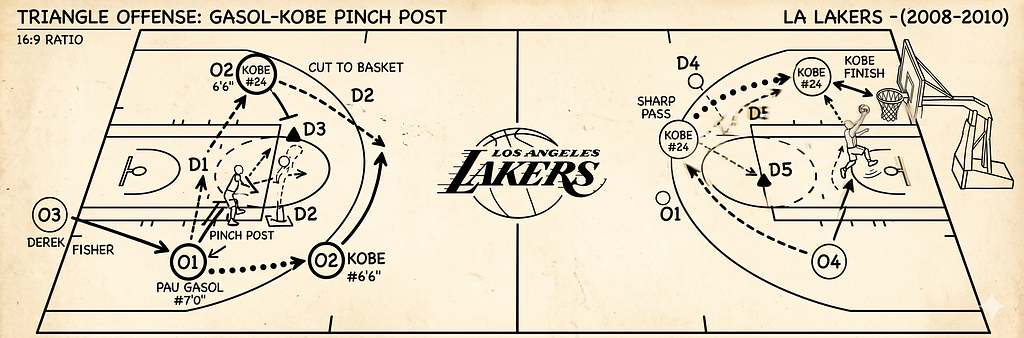
Basketball coaches solved your engineering problem decades ago. They just called it something different. Every methodology your team has ever argued about in a retro — waterfall, agile, kanban, whatever’s in the think piece this week that I read on Seattle’s light rail — is really just frameworks about how intelligent people coordinate under pressure and build trust.
Basketball coaches have been running that experiment in public, with scoreboards, for over a hundred years. Thank you James Naismith.
The ones who won figured out something (as well documented in books like Lean Software Development: An Agile Toolkit by Mary and Tom Poppendieck, written in 2003) the software industry keeps relearning the hard way: the system matters more than the talent until the talent is good enough and trusts each other enough that the system can get out of the way.
“History doesn’t repeat, but it often rhymes.” — Mark Twain
AI just made that lesson urgent, immediate and something we’re all relearning in real time.
The Binder: Pat Riley and Waterfall
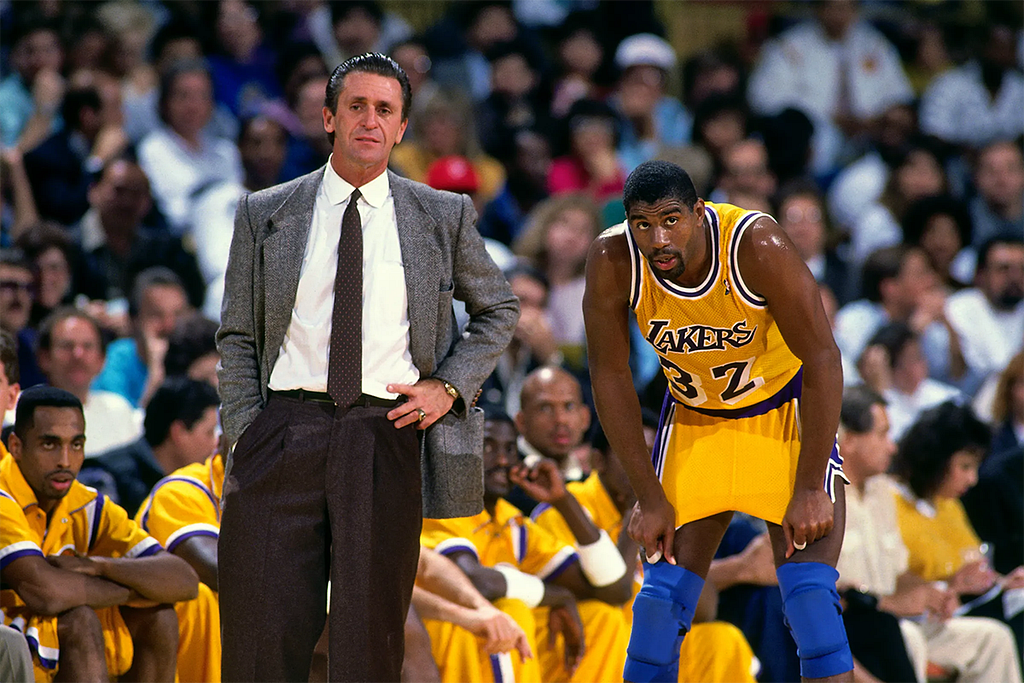
Pat Riley showed up to every season with a binder. Not metaphorically. An actual binder.
Comprehensive, laminated, reviewed by committee, covering everything from play design to travel protocol to how players were expected to talk to the press. Riley’s “Riles Rules” were a complete specification of how a basketball team should operate, documented upfront, enforced consistently, measured against explicit criteria that read like a software specification.
This is waterfall. For a while, it worked beautifully.
The 1980s Showtime Lakers were a marvel of systemic execution. Magic Johnson, James Worthy, Kareem Abdul-Jabbar running choreographed fast breaks that looked like improvisation but were deeply rehearsed. Riley didn’t leave things to chance. He introduced a statistical tracking system that measured every player against defined performance criteria.
Requirements. Acceptance testing. Delivery metrics. The binder. An actual binder. Riley had the binder. Smells like Waterfall Spirit with apologies to Nirvana.
Waterfall made sense in the era it was designed for: When building software was genuinely expensive — when requirements had to be carved in stone because change mid-project could sink the whole budget — planning everything upfront was rational.
You specified first. You built second. You tested third. You shipped once.
The problem is that software was never actually like concrete. It was always more malleable, more responsive to change, more dependent on what you learned while building it. And Riley’s Lakers eventually ran into the same problem.
The Detroit Pistons read the binder. They designed the Bad Boys defense specifically around what Riley’s system demanded, and for three years they exploited it.
This is the fundamental failure mode of waterfall: it optimizes for execution of a known plan in a stable environment. The moment either variable changes — and in software, both variables always change — the system produces something perfectly built for a world that no longer exists.
In the AI era, waterfall doesn’t just underperform. It becomes incoherent. When a prototype that used to take three weeks takes three hours, the entire economic argument for upfront planning collapses.
It’s no longer about execution, it’s about selection at a moment of time.
Writing a 200-page specification for an AI feature is an act of institutional self-deception. By the time you start the document, the document is already wrong.
Riley later evolved. The 1990s Knicks and Heat teams were grittier, more adaptive, less reliant on the binder. He learned. But his defining contribution to basketball — the comprehensive, disciplined, fully-specified system — belongs to a particular era.
The waterfall era in software is over.
The Sprint: Gregg Popovich and Agile
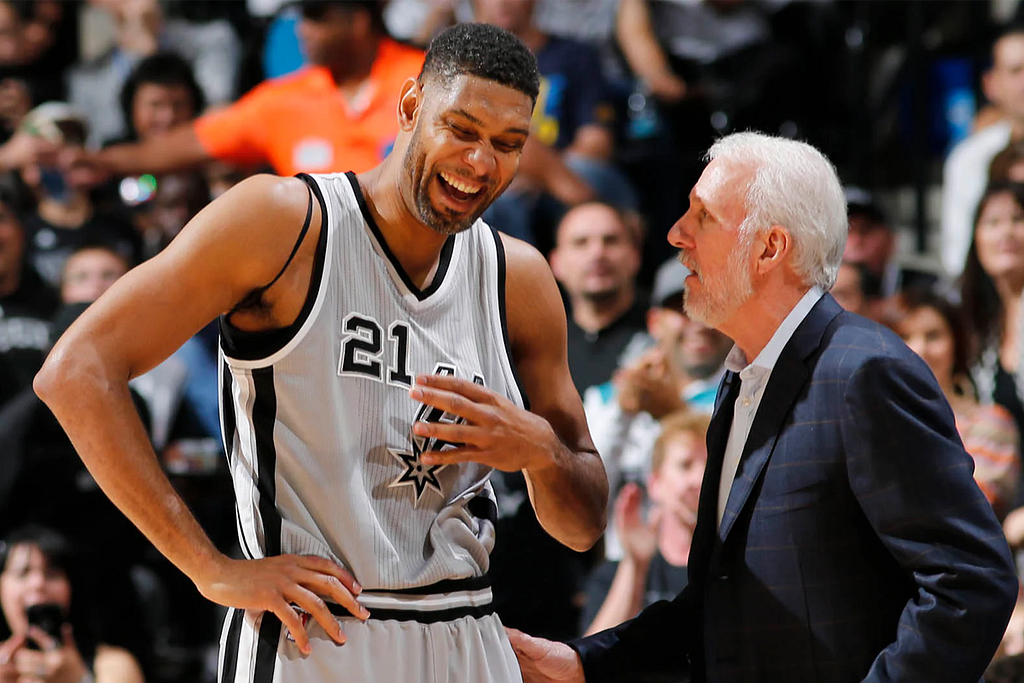
Gregg Popovich has won five championships with five different rosters and he has never once been the most talented team in the league. This is the argument for agile (and frankly, design systems) in one sentence.
The San Antonio Spurs dynasty — 1999 to 2016, give or take — was built not on superstar talent but on system, values, and continuous improvement. Popovich recruited globally before it was fashionable. He developed second-round picks into contributors. He took players other teams gave up on and made them functional within a coherent whole.
Popovich ran the same disciplined ball movement whether Tim Duncan was in his prime or injured, whether Tony Parker was healthy or not, whether the roster was stable or in flux.
This is agile at its best. Short feedback loops. Team over individuals. Continuous delivery of value. Strong onboarding. The Spurs were famous for how quickly new players learned the system — not because the system was simple, but because it was well-documented, well-taught, and consistently reinforced.
A player could arrive from Europe with no NBA experience and be running the offense fluently within a season. That’s what good infrastructure looks like.
That’s a CLAUDE.md file that actually works.
Popovich also ran the best retrospectives in basketball. The Spurs’ film sessions were legendary — detailed, honest, psychologically safe enough that Tim Duncan could be criticized by his coach in front of his teammates without it becoming a political event.
Pop created an environment where examining failure was normal and changing course was expected. He didn’t defend last season’s decisions. He asked what the data said and adjusted.
The problem with agile — and Popovich would recognize this immediately — is what happens when the process becomes the point.
Somewhere between the 2001 Agile Manifesto and today, a lot of organizations confused the ceremonies for the principles. The manifesto said working software over comprehensive documentation. The enterprise said: what if we had comprehensive documentation about our working software process?
The manifesto said responding to change over following a plan. The enterprise said: what if we planned our responses to change in a framework that required eighteen months to implement?
Even well-run agile has friction points in the AI era.
- Story points — the unitless unit of measurement that was supposed to free teams from hourly estimates — don’t map cleanly onto AI-assisted work or a token count.
- A feature that was a 13-point story last quarter might be a 2-point story this quarter because the AI writes the boilerplate now.
- It might still be 13 points because the hard part was never the code.
What mattered was the judgment about what to build. Velocity as a metric becomes stranger when half your team’s output is prompt engineering, eval design, and output evaluation rather than lines of code committed.
The standup, designed to be 15 minutes of standing synchronization, has become in many organizations a seated 40 minute recitation of Jira tickets with one designer or engineer taking up 20 minutes because that’s how they determine impact by taking up all the air in the room. That’s output over outcome, which happens in agile. A lot.
“Any blockers?” “I’ll take that offline.” Nothing resolved.
In the AI world, the real standup happened in a Slack thread between two people who actually knew what was going on and shipped it later that afternoon. That works more because the teams are now so small.
Popovich himself would tell you: don’t worship the system. Worship the outcomes the system produces. When the system stops producing outcomes, change the system.
Agile’s principles survive the AI era. Agile’s ceremonies need surgery.
The Triangle: Phil Jackson and the Mature Team
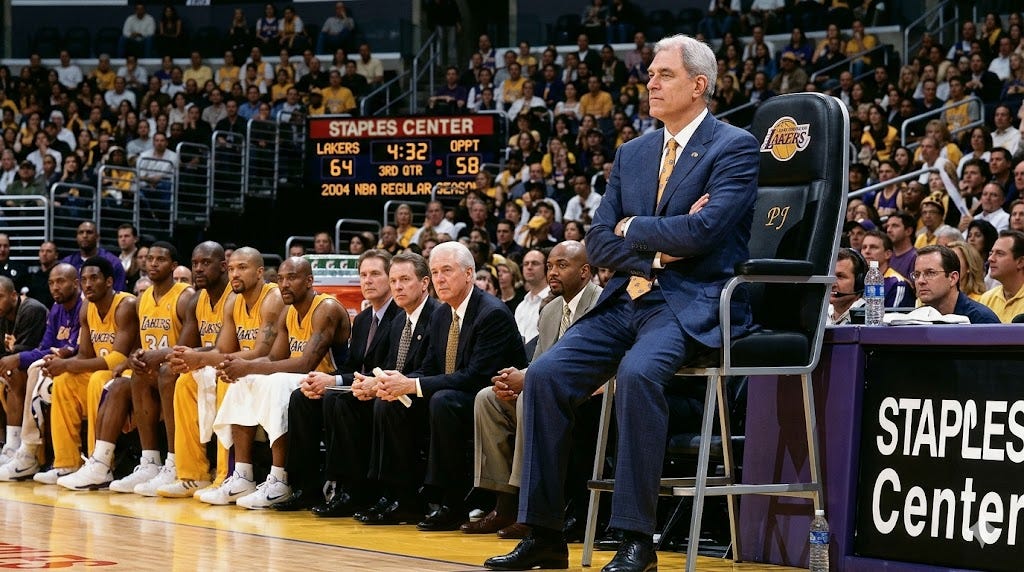
Phil Jackson sat down during possessions. This sounds like a small thing. It is not.
Pat Riley called plays. Gregg Popovich called plays. Every other coach in the league called plays. Jackson sat down, crossed his arms, and watched his players run a system like he was watching a very well rehearsed Fourth of July parade in Seal Beach, California.
The triangle offense — developed by Tex Winter, adopted and evangelized by Jackson —was a set of principles about spacing, reads, and flow that generated the right action from the situation rather than from a script.
There were no set plays in the triangle. There were reads. If the defense does this, you do that. If the help side collapses, the weak corner is open. If the post player gets doubled, the skip pass is available.
The system contained the answer to every defensive problem, but you had to read the situation to find it and now AI can do that for you as a first draft.
This required something that neither waterfall nor agile could manufacture: distributed intelligence. Every player had to be a threat. Every player had to understand the principles deeply enough to make the right read in real time without being told.
The triangle failed if even one player needed to be directed rather than trusted.
Jackson built this through relentless repetition in practice, through psychological preparation that most coaches considered exotic — he introduced meditation, gave players books, used Native American ritual and Zen philosophy to build team cohesion — and through a management philosophy that was fundamentally about getting out of the way.
He also managed egos that would have broken most coaches. Dennis Rodman. Scottie Pippen’s contract fury. Shaquille O’Neal and Kobe Bryant’s mutual contempt. Pau Gasol’s “effort.”
Jackson didn’t resolve these tensions through authority. He resolved them through empathy — understanding what each player needed, communicating individually, building trust that the collective goal stayed visible through the personal grievances.
He gave Rodman different guidelines than he gave Pippen. He gave Kobe different treatment than he gave Shaq. The system was consistent but the interface was personalized.
And he did it with two different rosters, which is exactly the point.
Phil Jackson won three rings with Shaq and Kobe Bryant, and then won two more with Kobe and Pau Gasol. Same coach, same triangle, completely different rosters. The system didn’t care whether the center was a 325-pound force of nature or a Spaniard with a soft touch.
The principles held.
The talent adapted.
This is design systems thinking applied to human beings. The component library is stable and shared. The implementation varies by context.
In software terms, the triangle is what agile looks like after years of investment in context infrastructure. Not “we iterate in short cycles with structured ceremonies” but “we have internalized the system so completely that we generate the right action from first principles in real time.”
That‘s trust.
Jackson didn’t hand the Bulls the triangle on day one. He spent years teaching the principles, running the reads in practice, building a shared vocabulary so granular that players could communicate entire sequences with a glance. What didn’t need to be said matter more than anything else.
You cannot skip the work and claim the result because there needs to be a shared vision.
Most teams that think they’re running the triangle are running something closer to “we cancelled standups and now everything is vibes.” That is not the triangle.
That is five people standing around waiting for the best engineer to do something. It works if you have Michael Jordan. It does not work if Michael Jordan is surrounded by people who are unclear on the rotation.
The other failure mode is talent without system. The triangle requires everyone to be a threat. If the defense can ignore your weak-side players, the spacing collapses and the whole offense dies.
In software, this means the triangle only works when every team member has enough context and judgment to make good autonomous decisions.
One person who needs heavy direction breaks the read-and-react flow for everyone around them — not because they’re bad, but because the system requires distributed intelligence to function.
Jackson’s staff engineer equivalent is the person who wrote the architectural principles document the whole organization runs on, who rarely attends standups, is never blocked, and when they do show up to a meeting, everyone stops talking because something important is about to be said.
Those tiger teams or factory pods you’re building as center of excellences? They might work now but they don’t scale in the age of AI because not everyone is Kobe Bryant. Organizations have to learn that — the hard way.
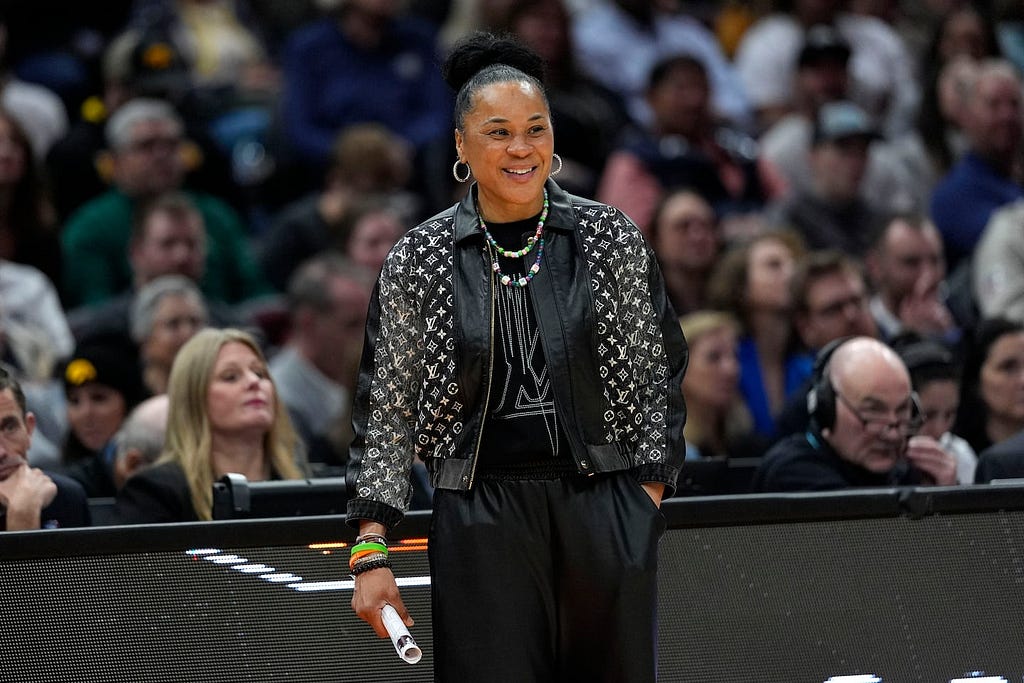
The AI Era: Dawn Staley and the Adaptive System
Dawn Staley doesn’t have a signature system.
This is the point.
The South Carolina women’s basketball program under Staley has won multiple national championships with rosters that looked different every year. She doesn’t recruit for a system. She recruits talent, assesses what that talent actually is, and builds the system around the players she has.
This sounds obvious. It is extremely rare.
Most coaches have a system and find players to fit it. Staley has principles and builds the system fresh each season from the material available. This is prompt engineering.
This is working with what the model is actually good at rather than fighting its tendencies toward what you wish it could do. The coach who understands her players’ actual capabilities — not their recruiting ranking, not their theoretical upside, their actual current capabilities — and designs around those capabilities is doing exactly what the best AI-era teams do.
You don’t fight the model. You understand it, extend it, and direct it toward problems it can solve.
Staley is also the best talent evaluator in college basketball right now. She sees players that other programs miss. She develops players that other coaches gave up on. She extracts value from the roster she has rather than waiting for the roster she wishes she had.
In the AI era, this is the critical skill. When AI can execute, the human’s job is knowing what to ask for and evaluating whether the output is right. Taste. Judgment. The ability to look at fifty generated variations and know immediately which one is correct and why.
Her 2024 undefeated championship run wasn’t built on having the most talented players on paper — though Paige Bueckers might argue otherwise — it was built on the best context integration in the sport.
Every player knew the system. Every player knew their role within the system. The team was greater than the sum of its parts because the architecture was sound and the context was shared.
Staley also recruits globally and integrates players from different basketball traditions into a coherent whole. This is exactly what AI-era teams do. You’re integrating human judgment, AI execution, existing systems, new capabilities, and institutional knowledge into something coherent and fast. The coach who can only work with one kind of player is limited. The leader who can only work with one kind of contributor — human or AI — is limited in the same way.
The AI era doesn’t reward the best executor. It rewards the best evaluator. The person who can generate a hundred options in an afternoon — using AI as the instrument — and identify the three worth pursuing.
The person who can write the principles document that guides not just human teammates but AI systems toward coherent output. The person whose taste is so well-developed and so well-documented that it can be encoded, referenced, and scaled.
Staley doesn’t shoot threes. She doesn’t need to. She builds systems where the right person shoots the right three at the right moment because the context is so clear that the decision makes itself.
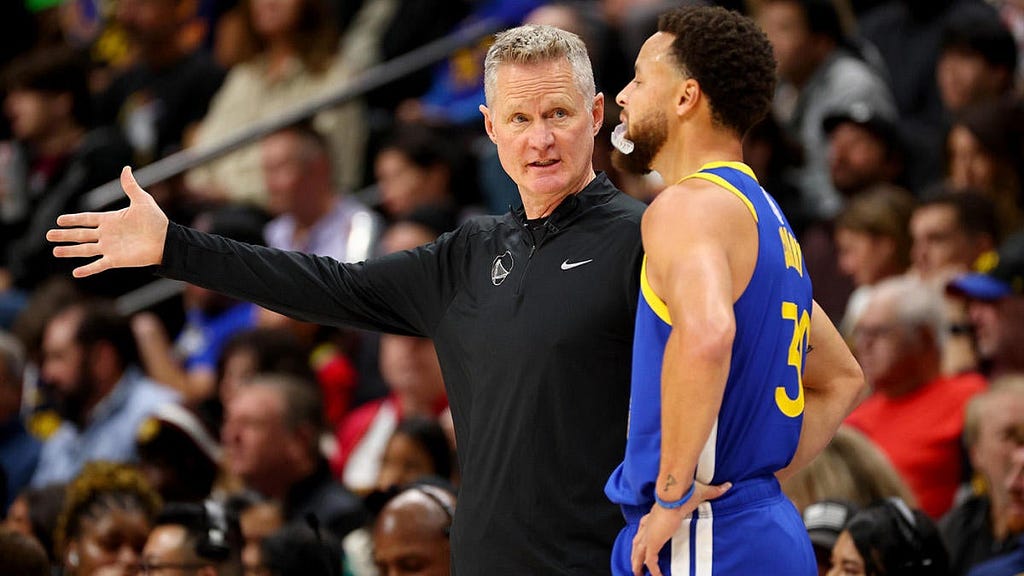
The Transition Coach: Steve Kerr
One more coach deserves mention because he represents the moment we’re actually in.
Steve Kerr played in Jackson’s triangle. He absorbed the principles as a player — the spacing, the reads, the trust, the psychological preparation. Then he became a head coach and built something new: the Golden State Warriors motion offense, which is triangle-influenced but adapted for a different era, different talent, and different basketball.
The Warriors offense has structure — the dribble handoffs, the corner threes, Draymond Green as point center — but within that structure there’s enormous freedom. Steph Curry does things that weren’t in any playbook because no playbook says shoot from half court. And it works.
The system doesn’t tell Curry what to do. It creates the conditions in which Curry can do what only Curry can do.
Kerr also adjusted constantly. He adjusted during COVID. He adjusted when Kevin Durant arrived and when Durant left. He adjusted when Klay Thompson came back from injury different than he left.
Kerr doesn’t have one system. He has a philosophy that generates systems appropriate to the current context.
This is where most senior technology leaders are right now. You came up through agile. You absorbed design systems thinking. You built context infrastructure before anyone called it that. And now AI has walked onto your floor and you’re figuring out where to put it in the rotation — not by throwing out everything you know, but by understanding why the principles you believe in are actually more true now than they were before.
Kerr’s software equivalent is the tech lead building the context infrastructure for AI-assisted development. Not following a playbook. Understanding why the playbooks exist well enough to write a new one.
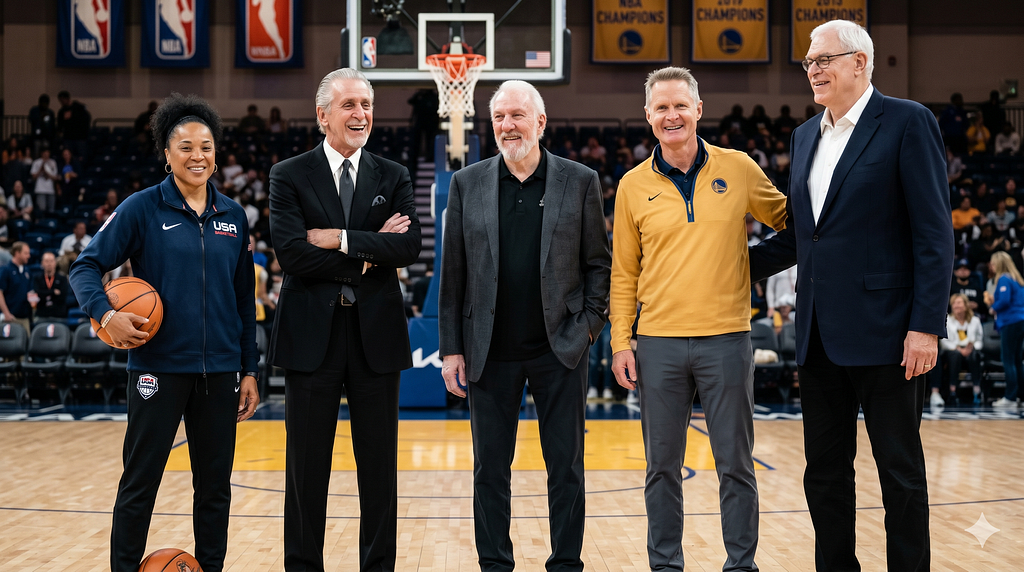
What AI Actually Changes
Here is the uncomfortable truth that all four coaching philosophies point toward.
AI doesn’t change what good teams are trying to do. It changes who does what to get there and how we curate the outcome. That requires collaboration and not competition.
When AI handles first-draft execution — the code, the copy, the component variations, the documentation — the human role shifts from doing to directing, evaluating, and deciding. The bottleneck is now well structured judgment. The scarce resource stops being the person who can write the code fastest and becomes the person who knows which code (and design) is right.
This has three concrete implications.
Taste becomes infrastructure
When AI can generate a hundred UI variations in an afternoon, the critical system is the one that tells you which variation is correct. That’s your design system. That’s your CLAUDE.md. That’s your documented architectural principles and your encoded brand values and your shared vocabulary for what good looks like.
Teams that invest in taste infrastructure i.e. user experience frameworks aided by AI that are integrated in the tools get like Jakob Nielsen’s 10 Heuristics dramatically more leverage than teams that treat every prompt and project as a fresh start.
Context compounds, especially as you build knowledge over time. Prompts without context are just noise.
The sprint has compressed
If AI is handling first-draft execution, two weeks may be too long. The sprint length was always somewhat arbitrary — a human-paced heartbeat calibrated to human cognitive bandwidth.
Our UX processes that slowed things down — or as Jenny Wen says, the design process is dead, and I agree — are now gone for an outlet pass.
AI-assisted teams may find the natural rhythm is shorter and less ceremonial. Four-day cycles. Continuous flow with async review.
The ceremony that made sense for human coordination may create drag in a system where execution is no longer the bottleneck.
A schedule isn’t the outcome; a great result is.
The triangle works, but the roster changes with Pau shooting the three
The principles of the triangle — spacing, shared context, autonomous reads, no single point of failure — are more relevant now than ever.
But the roster now includes AI agents alongside humans. The senior engineer isn’t just writing code. They’re writing the principles that guide the AI that writes the code. That’s a different skill.
In the world of the three legged stool, who does what dramatically changes, and that means sometimes everyone might be a product manager, engineer, or designer — sometimes at the same time. And that’s good.
That’s the way it should have always been.
It’s closer to coaching than playing. It’s closer to Jackson on the bench than Jordan on the floor.
The Conclusion Phil Jackson Would Recognize
Jackson didn’t win six championships because he was smarter than other coaches about basketball. He won because he understood something deeper: that his job was to build a system so good that he didn’t need to intervene in it.
The binder guys intervene constantly. The agile guys intervene on a schedule. Jackson built something that ran itself — not because it was simple, but because it was so thoroughly understood by everyone inside it that the right action emerged naturally from the situation.
That is the goal in the AI era. Not a faster binder. Not a shorter sprint. A system so well-designed, so thoroughly contextualized, so clearly principled that the right action — from your human teammates and your AI systems alike — emerges from the situation without requiring constant direction.
Staley doesn’t call plays in real time. She builds the team, installs the context, and watches it operate.
That’s the whole job now. Build the system. Install the context. Get out of the way. The scoreboard doesn’t care what methodology you call it, they just want it to work.
The basketball playbook for AI builder teams was originally published in UX Collective on Medium, where people are continuing the conversation by highlighting and responding to this story.


