


The people buying AI are blunt about the fact that the future is intelligence that disappears into existing platforms. Everyone wants it invisible and under their total control at the same time.
We are all racing to build AI apps that nobody wants to open.
Specifically, the standalone AI app, the thing you download, log into, and go to, is a worse idea than almost anyone building in the space wants to admit.
The numbers are brutal. According to RevenueCat’s analysis of more than 115,000 apps, AI apps are fantastic at getting you to sign up and terrible at getting you to stay. They convert free users to paid faster than regular apps, then lose them roughly a third faster.
A year in, only about one in five subscribers is still paying.
The pattern is simple and a little embarrassing. People try the AI app, get their “wow,” and then just stop opening it, because, often, it was just a novelty experience. Venture firm Bessemer has started warning that even business AI tools are heading for the same cliff unless they get themselves embedded into something people already use every day.
This is basically the same problem people had with Google+ (remember that?). Google got hundreds of millions of people to sign up, and then 90 percent of sessions lasted under five seconds.
You can build a gorgeous destination, pour a fortune into it, and get everyone to sign up once, and it still dies if nobody comes back.
Nir Eyal called what these app are missing the Hook Model, that products become habits through a loop of trigger, action, reward, and investment, each pass making the next one more likely. A novelty AI app nails the middle of that loop, you act, you get your clever reward, once, but there’s nothing pulling you back tomorrow and nothing that costs you to simply walk away from it. The loop never closes, so a habit never forms.
On the enterprise side, the rejection is blunter and faster. I’ve lost count of how many times I’ve heard large companies insist they are not taking on yet another tool. At this point, they often already have their own internal AI product and don’t want a new destination, a new login, a new thing for their people to remember to visit.
They want the capability dropped inside the systems they already use, where the work already happens. Snyk, a security firm, studied more than 3,000 enterprise environments and found exactly that. Companies are stitching AI into their existing stack, not buying standalone products to use in parallel.
This is bigger than a retention problem.
The destination is dying. Not AI, AI is everywhere and growing. The app is dying.
The idea that you deliver intelligence by building a place for people to come get it is over. The future is no app at all, intelligence woven invisibly into the tools people already live in, surfacing when it’s useful and getting out of the way when it isn’t.
While that may sound clean, it isn’t. The same companies that want the AI invisible also want it completely under their control. They want it to disappear into the workflow and they want a dashboard, an audit trail, a record of every time it ran and what it touched.
Invisible to the user, totally visible to the owner.
Those two desires are at war, and whoever satisfies both at once is going to win the next decade of AI products.
We need to take stock of why the app model is collapsing, what the people buying AI actually want instead, why “invisible” is so much harder than it sounds, and where the real work, and the real careers, are moving.
The companies still pouring money into beautiful standalone AI apps are building tollbooths on a road people have already started to abandon.

The app everyone downloaded and nobody kept
Surprise, it’s not Quibi!
Malika Aubakirova and Anjney Midha at a16z, working with OpenRouter, analyzed more than 100 trillion tokens of real-world AI usage. Stickiness, they found, doesn’t depend on your product’s interface or features, but rather on the capabilities of the underlying model.
The same study found that fewer than one in ten weekly ChatGPT users ever bothers to try a competing assistant, despite there being zero cost to do it. People plant themselves in one big AI and stay.
They will not leave ChatGPT. They will drop your ChatGPT wrapper in a week. Stickiness lives with the model and churn lives with the destination you built on it.
People aren’t loyal to your app. They’re loyal to the intelligence inside it, and that intelligence is for rent, to everyone, including you.
This is why the AI app graveyard is filling up so fast. Character.AI lost roughly 60 percent of its user base in a year.
Jasper, one of the early AI-writing darlings, watched more than half its revenue evaporate.
Google+ had hundreds of millions of accounts and almost no one who came back. A gorgeous destination nobody had a reason to visit twice.
Yupp, an AI startup that raised thirty-three million dollars and signed up 1.3 million users, shut down anyway, with its founders explaining that the models underneath improved so fast that they never found a durable reason for anyone to keep coming back.
Over a million people used the product and it still wasn’t a business..
If that pattern feels familiar, it should. This is basically the MoviePass story with better branding (and I worked on MoviePass!).
Millions signed up overnight. There was no durable business underneath, and it collapsed in a heap. A lot of AI apps are basically following this same model.
MoviePass got millions of people to sign up almost overnight for something that felt like a cheat code, and the spectacular sign-up numbers meant nothing once it turned out there was no durable business underneath. Massive adoption, a value proposition that dissolved on contact with reality, and a collapse that happened faster than anyone expected.
A lot of today’s AI apps are doing the exact same thing.
Brian Balfour, the founder of Reforge and former head of growth at HubSpot, calls this “product-market fit collapse.” In normal software, customer expectations rise slowly, so a product that nails its market can coast for a while. In AI, he points out, expectations reset almost instantly.
Every time a new model drops, users recalibrate what “good” even means, and dropping your app for whatever is newer, or for the raw model underneath it, costs them nothing. You are not building toward a stable finish line because the finish line keeps moving away from you every few months.
We have a category with astonishing sign-up rates, near-zero switching costs, expectations that reset on a monthly basis, and no loyalty to anything except the model you don’t own.
That same body of research points, almost accidentally, at the way out. The a16z study describes what it calls a “glass slipper” effect. When a user’s actual workflow fits a particular model so precisely that it creates real inertia, a cost, finally, to leaving. The apps that retain are the ones that have wedged themselves so deeply into something a person does every day that walking away would actually hurt.
The answer is quite simple. Stop building a place for people to visit and start building something they can’t easily remove.

What the people buying AI actually want
Larger companies say they aren’t adding another AI tool the way someone declines a second helping at a dinner they’re already full from. These are organizations that have spent two years drowning in AI pilots, logins, dashboards, and Chrome extensions, and they have hit a wall.
Companies do not want another destination. They want the capability, the actual intelligence, dropped inside the systems their people already use, where the work already happens.
The most striking version of it I’ve heard is that you shouldn’t even have to know you’re using a different product. You should just know that the thing you were doing got better.
That is a remarkable thing for a company to say about a product it is paying for, and it is becoming the default expectation rather than the exception. The same instinct shows up outside the enterprise too. A news organization I talked with recently had no interest in building another app for people to download. They wanted their journalism to show up where people already are, in a text message, inside the AI assistant someone is already talking to, with no new place to go.
This is where the measurable center of gravity has already moved, and the infrastructure numbers show it.
The Model Context Protocol (MCP), the open standard that lets AI reach into the tools and data a company already uses, went from a developer curiosity to something closer to 97 million downloads a month and production use inside roughly 40 percent of technical organizations. Gartner expects that by the end of the 2026, 40 percent of enterprise applications will ship with task-specific AI agents built in.
The designers paying attention have already clocked what this does to the job. Patrick Neeman puts it bluntly, that chat was only ever an interface, and agents are something else entirely.
The design work, he argues, has moved to the contract underneath the product, the rules and handshakes that let one system quietly hand a task to another and get a trustworthy answer back. When the interface disappears, the thing you’re actually designing is the behavior.
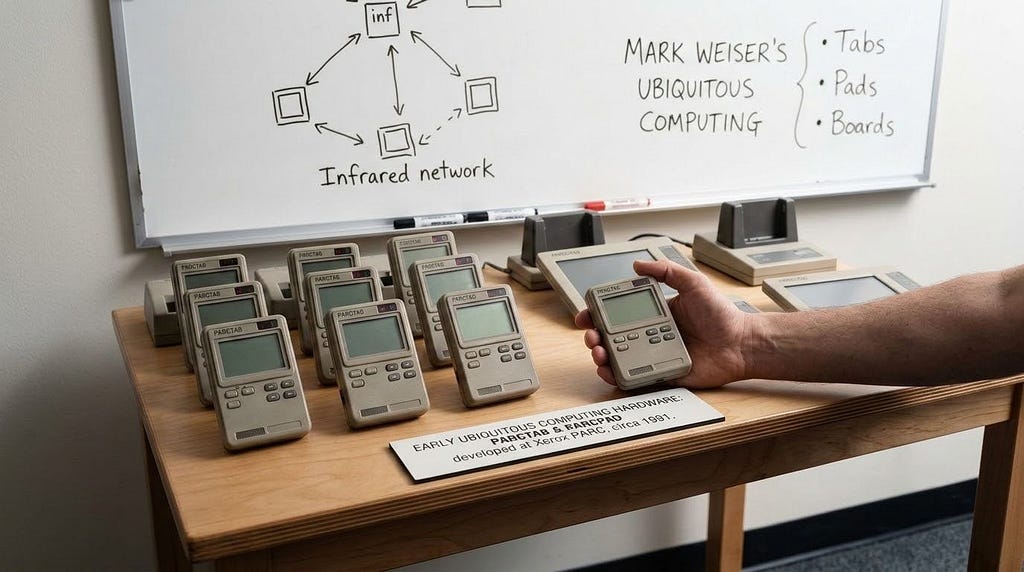
Think about what “invisible utility” has always looked like once a technology matures. Mark Weiser, the Xerox PARC scientist who coined the term “ubiquitous computing,” put it in a line that has aged remarkably well. “The most profound technologies are those that disappear. They weave themselves into the fabric of everyday life until they are indistinguishable from it.”
Mark Weiser called it in 1991. “The most profound technologies are those that disappear.” He was describing the future of the interface before most of us had one. AI is finally proving him right.
Nobody opens an app to use electricity. You don’t launch a program to get water out of the tap. The most important technologies succeeded precisely by disappearing, by becoming something simply present in the walls, available the instant you need it and invisible the rest of the time.
That is the shape AI is racing toward, and the companies building beautiful standalone AI destinations are, in a sense, trying to sell you a generator and a trip to the well at the exact moment everyone else is wiring the building.
The holy grail is a world where one AI simply calls another. Google’s Agent-to-Agent protocol, now governed by the Linux Foundation and adopted across more than 150 organizations, exists precisely so that one company’s AI can hand a task to a specialized capability elsewhere and get a usable answer back, with no human opening a separate product to make it happen.
The interface vanishes completely into the workflow. It’s genuinely hard to build well, and the infrastructure is still young, but the direction is set. The companies that understand it are to disappear.
That sounds like a potential answer. Make the intelligence invisible, embed it in the workflow, and, BOOM, you win. The problem is that the people who want it invisible want something else at the very same time, something that pulls in the exact opposite direction, and that contradiction is where most of this is going to get stuck.
Nobody has figured out invisible, but watched
The answer seems to be to make AI invisible. Embed it, dissolve it into the workflow, let it work without anyone having to go anywhere. Simple.
Except it isn’t, and the reason is entirely stuck in humanity. The same companies that demand the AI be invisible to their employees demand that it be completely visible to them.
They want it to disappear into the workflow, and they want a dashboard showing every time it ran. They want it to act without being summoned, and they want an audit trail of everything it touched. They want it woven invisibly into the fabric of everyday life, to borrow Weiser’s phrase, and they want a kill switch they can reach in half a second, a demand that turns out to be mostly aspirational.
In a Writer’s enterprise survey, more than a third of employees said they couldn’t immediately pull the plug on a rogue AI agent even if they needed to. Invisible to the user, yet totally visible to the owner.
The same leaders who tell me they want our capability to vanish into their systems will, ten minutes later, ask how they’ll track exactly who used it, how often, and what it returned, so they can prove the ROI to their own bosses. One large company essentially wanted the product to be invisible to its workforce and fully instrumented for its executives at the same time.
A recurring, hard stop in these conversations is data. More than one major brand has told me, flatly, that they will not feed their proprietary information into an outside tool, no matter how good it is, and that any vendor has to guarantee the model underneath isn’t quietly learning from what they put in.
Invisible is fine. Ungoverned is a non-starter.
Security researchers now treat this as table stakes.
Becky Brooks describes how organizations need to be able to answer basic questions about every AI action, which tools it called, what data passed through, whether any of it was proprietary, and most of them can’t.
The data behind that fear is genuinely alarming. The Verizon 2026 Data Breach Investigations Report, the most-cited study in enterprise security, found that employee use of unapproved AI tools tripled in a single year, to 45 percent of the workforce, with two-thirds of those people using personal accounts outside any corporate control.
Cyberhaven’s analysis found the average employee now feeds sensitive data into an AI tool about once every three days.
IBM’s Cost of a Data Breach report found that a growing majority of breached companies had no governance in place to manage AI or even detect its unapproved use.
The AI already has disappeared into the workflow.
It gets starker when you look at the actual network traffic. Infrastructure company Kong examined enterprise AI usage running through its systems and found that fewer than 1 percent of organizations had any AI-specific governance controls in place.
Meanwhile, almost 98 percent of their AI requests were flowing out to third-party proprietary services, every one of them carrying prompts, context, and often sensitive data outside the company’s own walls.
OutSystems found 94 percent of organizations worried that AI sprawl is piling up complexity, technical debt, and security risk, while only around 12 percent have any centralized way to manage it. Everyone feels the car accelerating. Almost nobody has their hands on the wheel.
There’s an old piece of political wisdom that fits this moment better than it has any right to. “Trust, but verify.” The companies buying AI have landed in exactly that posture, except the technology has made the two halves nearly impossible to hold at once.
The whole appeal of invisible AI is that you don’t have to watch it. The whole fear of invisible AI is that you can’t.
A thing designed to operate without your attention is, by definition, a thing operating outside your attention, and that is a terrifying property to hand a system that can touch your data, your customers, and your decisions.
This is the actual product problem of the next decade. The winning AI products will be the ones that pull off the paradox of being genuinely invisible to the person doing the work, and genuinely transparent to the person who owns the risk.
Disappear for the user. Light up like a control room for the owner. The teams that treat “invisible” as the whole goal are going to build things no serious company will deploy, because they solved for elegance and ignored accountability. The teams that bury everything in dashboards and approval gates will build something so visible and so clunky that it’s just another tool nobody opens, which puts us right back where we started.
Enterprises want the AI invisible to their people and lit up like this for themselves: every action logged, every data path visible. Invisible to the user, accountable to the owner. Almost nobody has built both.
Getting both right is brutally hard. It’s also the only version of this that actually wins.

Move Up the Stack or Get Buried in It
If you design or build products for a living, this could read like a eulogy for your job. It isn’t. The app dying is not the same as the work dying.
The work moved, and the people who notice where it went are going to be fine. The people who keep polishing the thing that’s going away are the ones who should be nervous.
Nielsen Norman Group has been studying how people actually use software since before most AI founders could type, put it about as plainly as it can be put, AI didn’t kill UX, it moved where the value lives.
The interface, the screen, the thing we used to spend all our time perfecting, is becoming a commodity. You can generate a competent one in an afternoon now. What you cannot generate in an afternoon is the judgment about what the system should do, when it should speak up, when it should stay quiet, what it’s allowed to touch, and how a human stays in control of something built to run without them.
Patrick Neeman has a sharp way of framing the trap we have to design our way out of. The reason everyone reached for chat, he argues, is that conversation is good enough at standing in for everything that it can hide the real product rather than reveal it.
The thing that feels like the answer, a text box you talk to, is often the thing keeping you from building what the moment actually needs.
The designer’s job used to be drawing the screen. Now it’s deciding the behavior, the rules and handshakes underneath, the contract between systems that no user will ever see but every user will feel.
The hardest, highest-value version of that work is the paradox from a minute ago, made real.
Mangus Eriksen lands on the exact tension this whole piece has been circling. Invisible AI only works if people trust it, and trust requires transparency and real control, without burying that control three menus deep. Read that next to the governance data from earlier and you have the entire job description for the next decade of product work.
Make it disappear for the person using it. Make it accountable to the person who owns it. Hide the machinery, surface the controls. That is a genuinely hard design problem, and it is nothing like designing a prettier chat window.
Think about what happened to the switchboard operator. In the early 20th century, connecting phone calls by hand was one of the most common jobs for young women in America. Then AT&T automated it, and the economists James Feigenbaum and Daniel Gross documented what followed. Once a city switched to dial, the operator jobs didn’t shrink, they vanished, dropping 50 to 80 percent and never coming back.
The need underneath, connecting people reliably, didn’t vanish at all. It moved up the stack, into switching systems and the engineers who design them, and it got more valuable. The part that matters is this: the women who were operators mostly didn’t make that jump.
The function moved up, and a lot of the people defined by the old version of it got left behind. The ones who thrived were the ones who moved to the layer underneath before they were forced to.
This connects to something that’s becoming ubiquitous in AI. Nobody is coming to hand you the next version of your job. Not in the broad economy, and not in our corner of it.
The people who make it through every one of these shifts are the ones who stop defending the thing they were good at and start building the thing the new world actually needs, before they’re forced to. In this case, that means letting go of the beautiful destination and getting good at the invisible, accountable system underneath it.
The future of AI is the intelligence woven so completely into the tools people already use that they stop noticing it’s there, with a clean pane of glass that lets whoever is responsible see exactly what it’s doing. Invisible to the user. Accountable to the owner. Almost nobody is building for both yet, which is precisely why it’s the opportunity.
The companies still pouring money into gorgeous standalone AI apps are building elegant tollbooths on a road people have already started to leave. The winners are somewhere else entirely, down in the plumbing, making the intelligence disappear into the work and handing the owner the keys to watch it.
The destination is dead. The infrastructure is where everything now lives.
References and further reading
Why the app model is collapsing
Malika Aubakirova, Anjney Midha, Alex Atallah, Chris Clark, Justin Summerville, State of AI: An Empirical 100 Trillion Token Study. Stickiness depends on the underlying model, not your interface; fewer than 10% of users switch despite zero cost.
RevenueCat, 2026 State of Subscription Apps Report. AI apps churn 30 to 36 percent faster than non-AI apps; only about 1 in 5 subscribers remains after a year.
Bessemer Venture Partners, Seven Product Strategies to Prevent Churn for B2B AI App Leaders. Even B2B AI tools face the churn cliff unless embedded in a daily workflow.
Brian Balfour (Reforge), on product-market fit collapse. In AI, customer expectations reset almost instantly and switching is trivial.
Google+ (Wikipedia). The destination that signed up hundreds of millions and became a ghost town, with 90 percent of sessions under five seconds.
MoviePass (Wikipedia). Spectacular sign-ups, no durable business underneath, fast collapse.
What the buyers actually want
Snyk, State of Agentic AI Adoption. Across 3,000-plus enterprise environments, organizations are embedding AI into their existing stack rather than buying standalone tools; the real AI footprint is roughly 3x the model list.
The Enterprise MCP Guide. The Model Context Protocol’s near-vertical adoption, roughly 97 million monthly downloads and production use in about 40 percent of technical organizations.
Gartner, via OutSystems research. 40 percent of enterprise applications will ship with task-specific AI agents by the end of the year.
Patrick Neeman, Headless AI Will Make Every Product a Platform. The design work has moved to the contract underneath the product.
Mark Weiser (Wikipedia). The father of ubiquitous computing: “The most profound technologies are those that disappear.”
Google’s Agent-to-Agent protocol (via FifthRow). The Linux Foundation standard that lets one AI hand a task to another, adopted across 150-plus organizations.
Invisible, but watched
Writer, 2026 Enterprise AI Adoption Report. A third of employees say they couldn’t immediately pull the plug on a rogue AI agent.
The MCP and AI Governance Gap (Techstrong). Enterprises need to answer basic questions about every AI action, and most can’t.
Verizon, 2026 Data Breach Investigations Report. Employee use of unapproved AI tools tripled in a year to 45 percent of the workforce, two-thirds via personal accounts.
Cyberhaven, shadow AI analysis. The average employee feeds sensitive data into an AI tool about once every three days.
IBM, Cost of a Data Breach Report. A growing majority of breached companies had no governance to manage or detect AI use.
Kong, enterprise AI governance research. Fewer than 1 percent of organizations have AI-specific governance controls; almost 98 percent of AI requests go to third-party services.
OutSystems, State of AI Development. 94 percent worry about AI sprawl; only about 12 percent have centralized management.
Where the work goes
Nielsen Norman Group, on AI-native UX. AI didn’t kill UX, it moved where the value lives; the interface is becoming a commodity.
Patrick Neeman, Designing for AI Means Designing Like It’s 1999. Conversation is good enough at standing in for everything that it can hide the real product.
UXmatters, The Era of the Invisible User Interface. Invisible AI works only if people trust it, which requires transparency and real control.
James Feigenbaum and Daniel Gross, Answering the Call of Automation (Quarterly Journal of Economics). When switchboards automated, the job vanished and the incumbents mostly did not move up with the work.
Nobody wants your AI app was originally published in UX Collective on Medium, where people are continuing the conversation by highlighting and responding to this story.


