

A data-backed investigation into one of console gaming’s most debated design patterns. Where it came from, who kept using it, and what ten years of releases actually show.

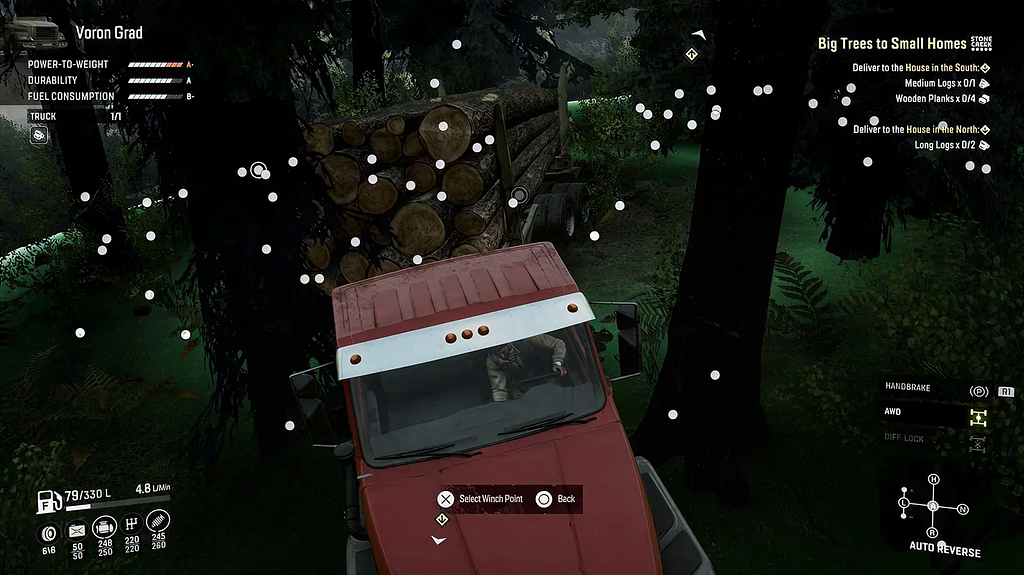
There’s a specific kind of frustration that comes from navigating a console menu with an analog stick cursor. You know exactly what you want. The item is right there. And still, you’re nudging a small circle across the screen, overshooting, correcting, nudging again.
It feels like the wrong tool for the job.
This is something I’ve been thinking about for a while, not just as a gamer, but as a UX designer who does research on how games handle input and navigation. The free cursor on consoles is one of those patterns that generates controversy way out of proportion to how common it actually is. Players complain loudly. Studios defend it or quietly patch it out. And the conversation almost never has real numbers behind it. So I went looking for them.
Over the course of this project, I reviewed 235 major console releases from 2015 to 2025, tracking navigation type by genre, year, studio origin, and multiplayer model. I also went through 507 player comments from Reddit and game-specific forums covering discussions across 15+ titles.
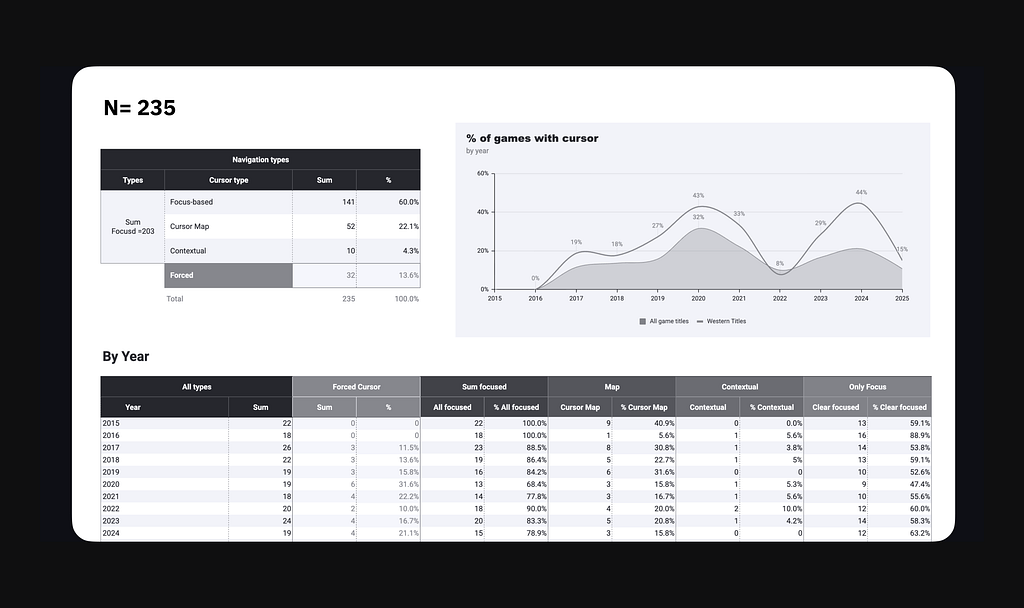
A note on how I built the sample: titles were selected from IMDb and Metacritic lists sorted by review volume and audience score. Each year I went through the top 100 and selected AAA releases, roughly 10 AAA, 2 AA, and occasionally a high-profile indie like Hollow Knight (Team Cherry, 2017) where the UI complexity makes the comparison meaningful.
Most indie games don’t have complex enough menu systems to make this comparison useful, so they’re largely excluded. All selected titles had to release on both console and PC, even if some were initially console exclusives before eventually coming to PC.
For titles I didn’t have direct access to, screenshots were sourced from the Game UI Database.
First, let’s be precise about what I mean
“Cursor navigation” is not one thing. A lot of the frustration in this conversation comes from treating it as if it is.
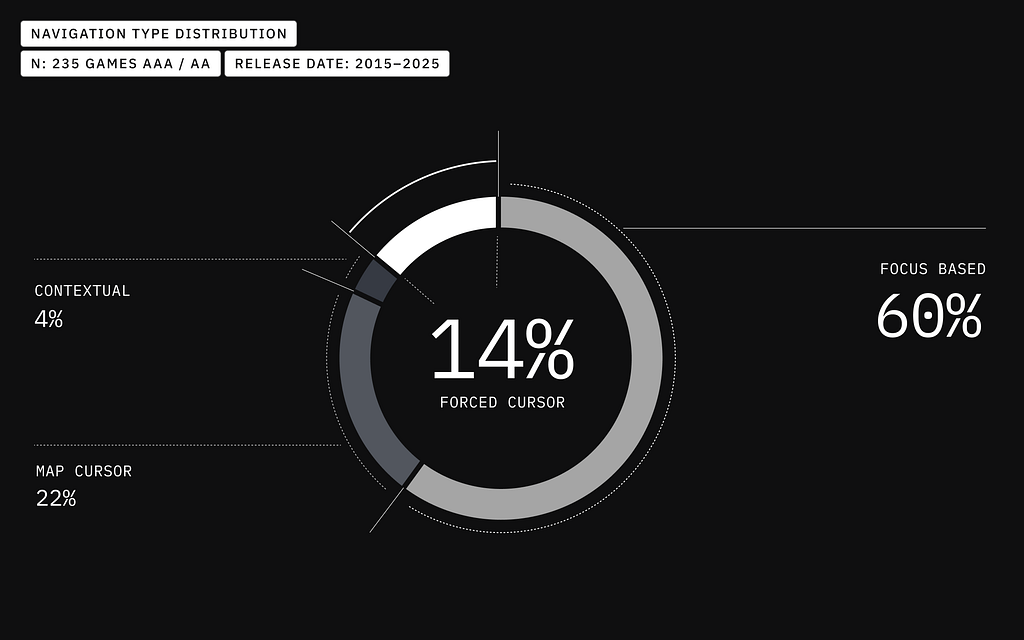
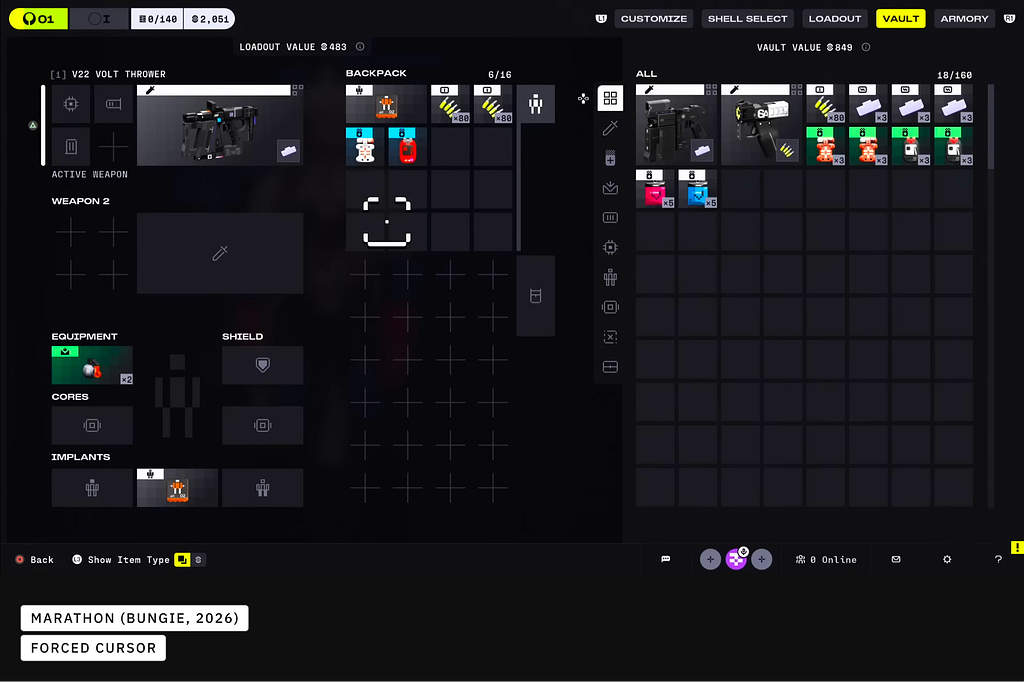
Forced cursor pattern is what actually generates friction in navigation menus and is the main source of player complaints. The cursor becomes the default navigation method across core gameplay interactions: inventories, skill trees, and main menus. The analog stick moves a pointer as the primary input. That’s mostly what this article is about.
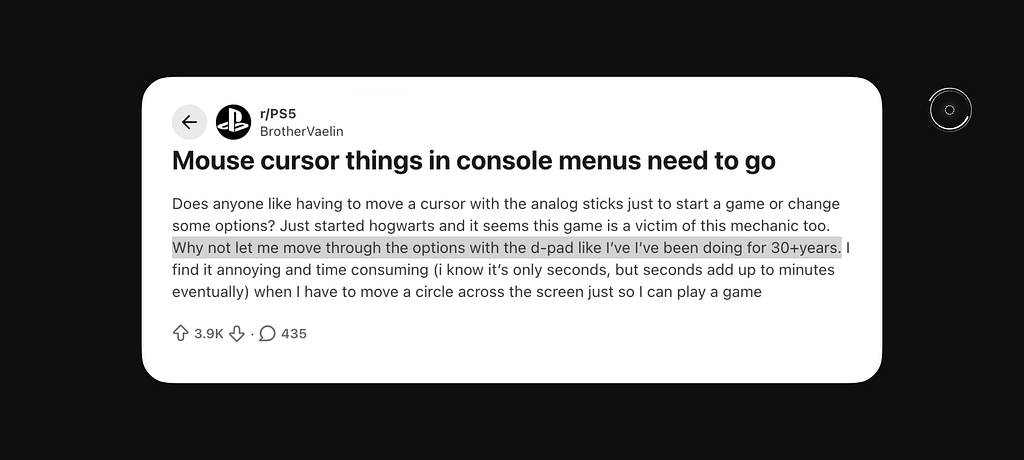
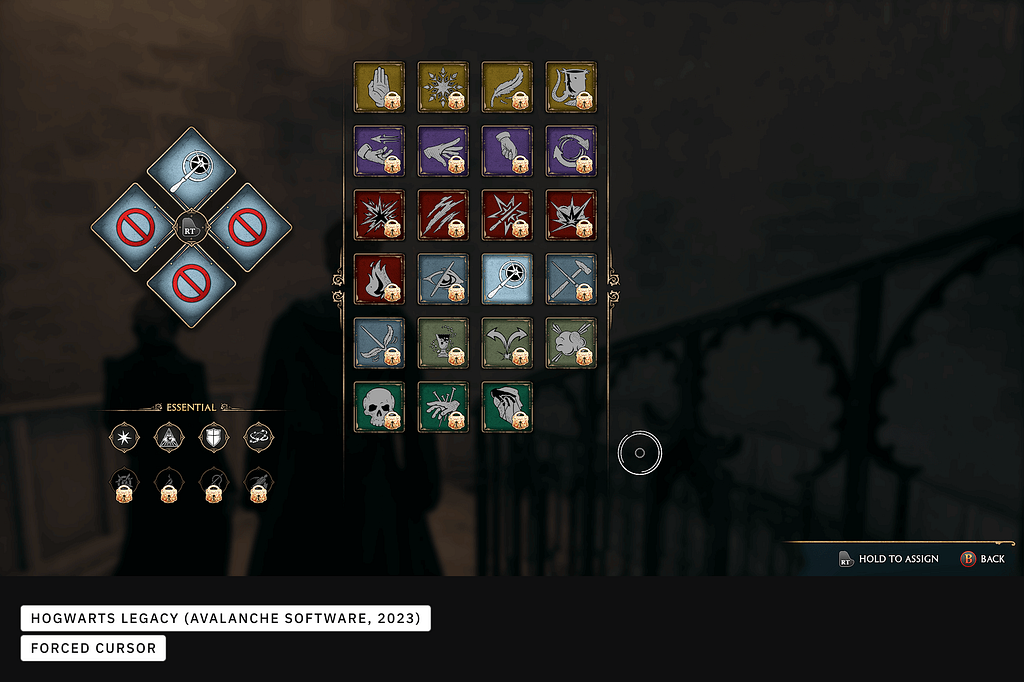
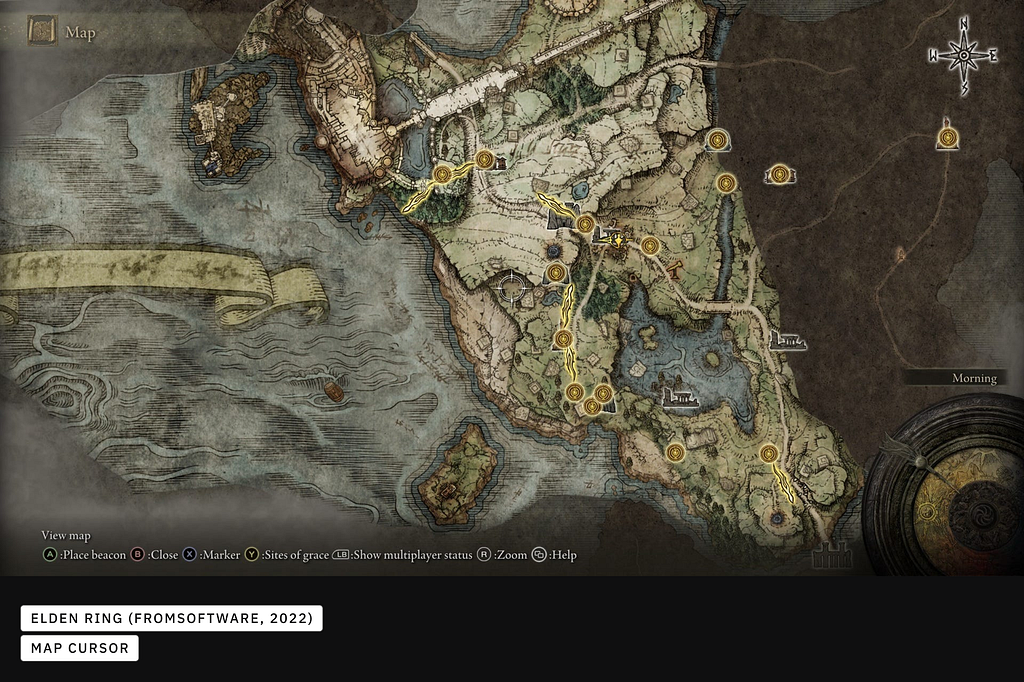
Map cursor is when the game is otherwise fully focus-based, but one specific surface uses cursor interaction because its spatial layout genuinely calls for it.
This distinction matters more than I expected. For example, initially action-adventure games in my dataset show ~56% general cursor usage, which looks alarming until I notice that significant amount of games use cursors only on their world maps and keep everything else fully gamepad-driven. Such games are:
- Ghost of Tsushima (Sucker Punch Productions, 2020)
- The Legend of Zelda: Breath of the Wild (Nintendo EPD, 2017)
- Batman: Arkham Knight (Rocksteady Studios, 2015)
- NieR: Automata (PlatinumGames, 2017) etc.
That’s appropriate tool selection, not a UX failure because a map genuinely is a big canvas, and focused navigation would make players spend a significant amount of time to select needed points of interest. That’s why I separated map cursor from other cursor usage. Once I did, the action-adventure number dropped to 22% which is a meaningful difference that changes the interpretation entirely.
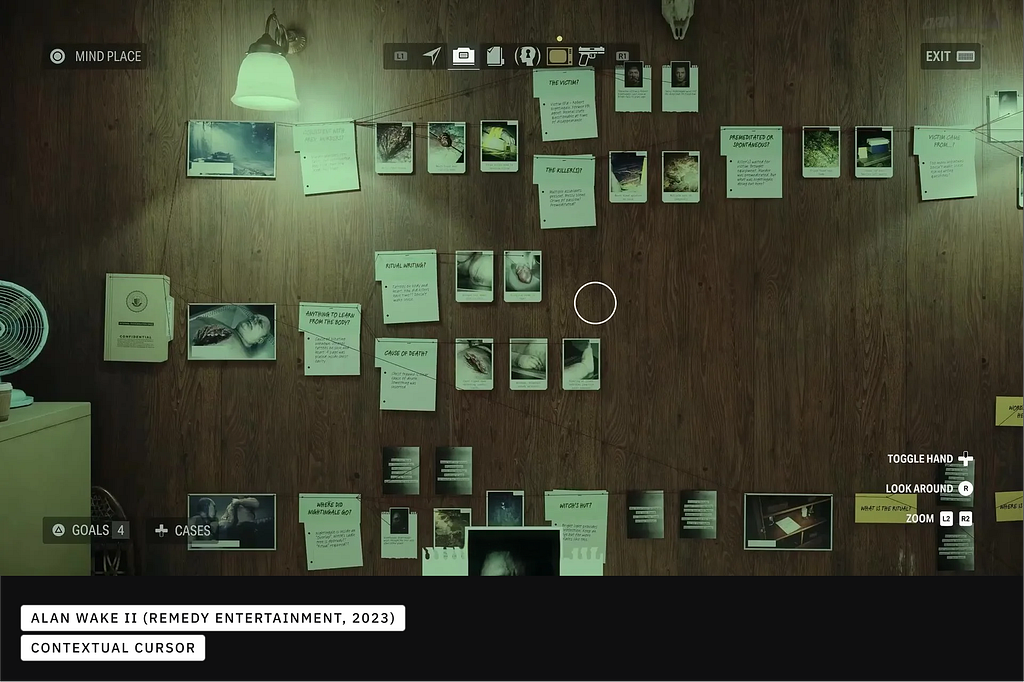
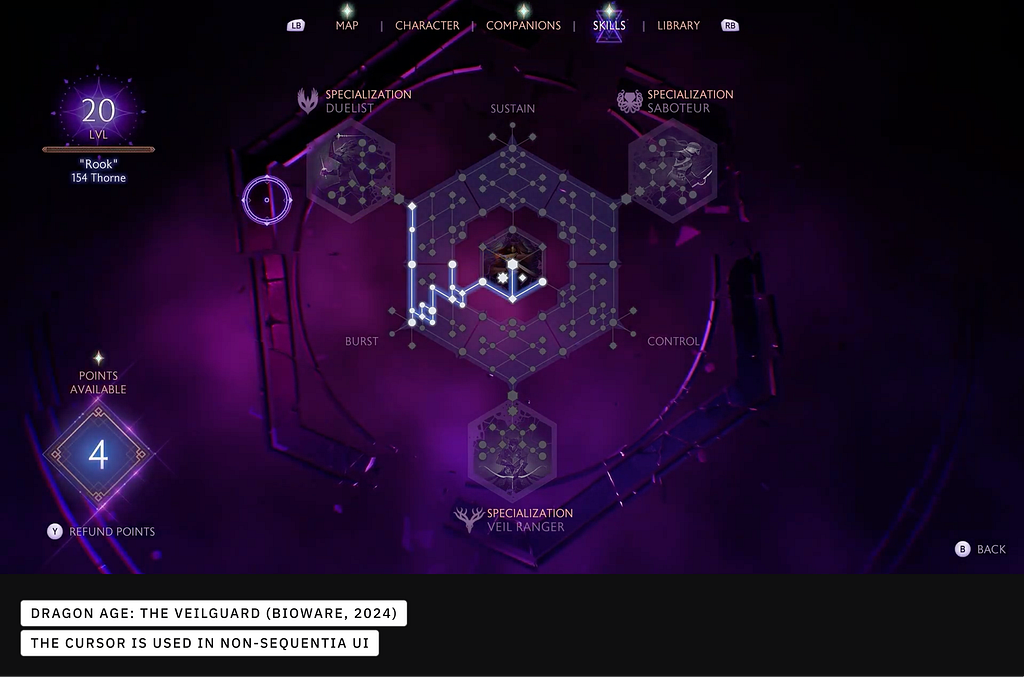
Contextual cursor appears only in bounded, narratively motivated moments or spatial layouts: an in-game terminal, a detective case board, skill trees, affinity maps, and something that’s part of the fiction, not a menu layer. But I have to note that this is the smallest category in the dataset, even though it features the most creative cursor usage.
The numbers are less dramatic than the discourse
32 titles out of 235 (~14%) use forced cursor across core gameplay interactions. Most players I’ve spoken to put the number much higher. The titles that do use cursors tend to be large, visible, and loudly criticized, shaping perception far beyond their actual share of releases.
Here’s the first surprise:
Forced Cursor is much less common than it feels
The player comments tell a similar story. Across 507 forum posts, automated sentiment scoring initially classified ~71% as neutral. But rule-based analysis struggles with the way people actually talk. Phrases like “I don’t like it,” “no reason for this,” or “why does this even exist” carry clear frustration without triggering any negative keywords, so they land in the neutral bucket.
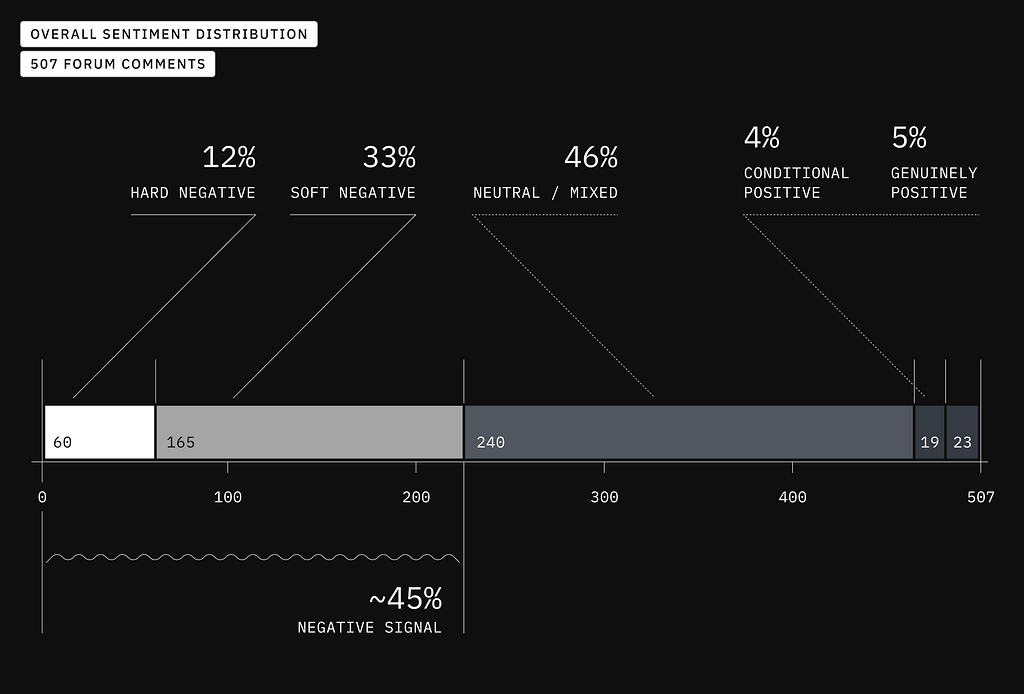
As a result, ~45% of comments carry negative signal — but only 12% use strong negative language. The majority of dissatisfaction is measured, analytical frustration: “I don’t get why this is the default.” A meaningful minority (9% combined) express genuine or conditional appreciation, concentrated in Destiny (Bungie, 2014) and dense spatial menu scenarios.
Speed is the central complaint, not confusion.
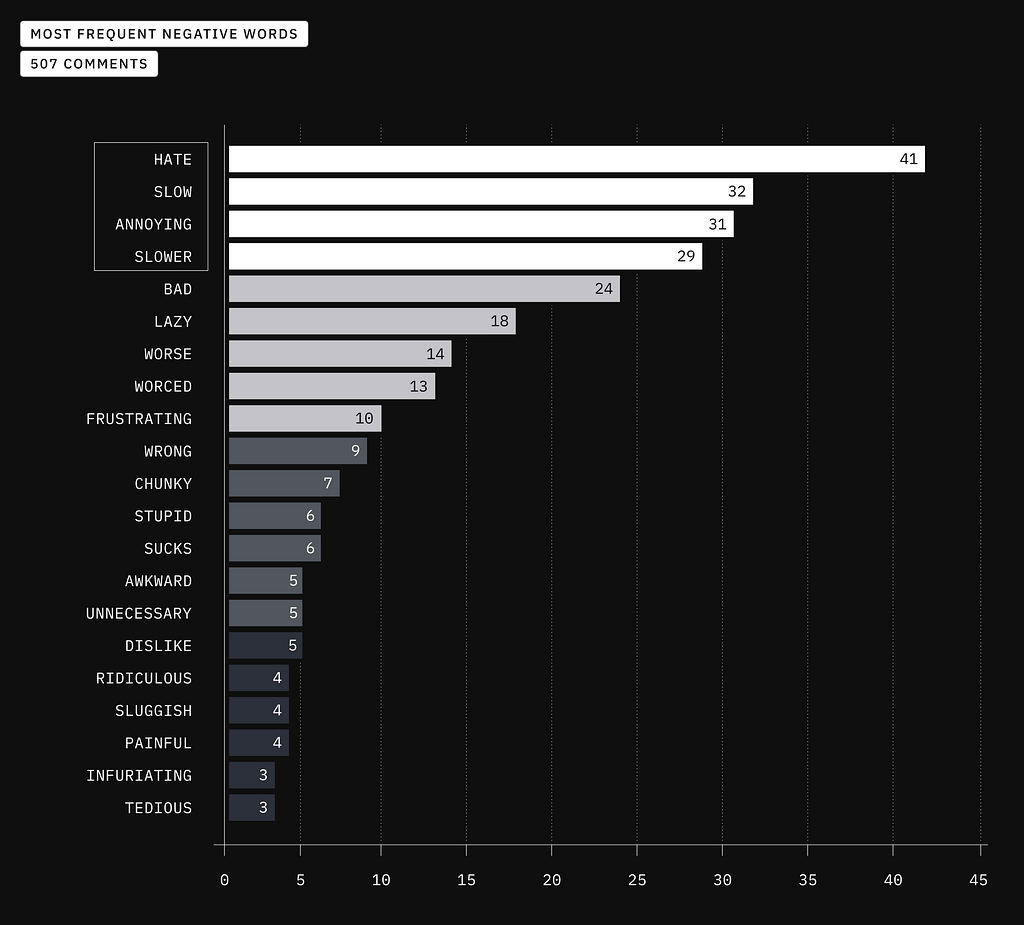
The three most frequent negative words in the dataset: hate (41 mentions), slow (32) and annoying (31). And the most common request, appearing 95 times in various forms, wasn’t “remove the cursor.” It was “make it optional.” Players aren’t asking for a full redesign. They want a fallback.
The Destiny Effect
The cursor story on consoles starts in 2014, but not quite for the reason most discussions assume.
Bungie’s UI team responsible for Destiny (2014) described cursor at GDC as a deliberate break from “Excel-like” list navigation. It wasn’t a porting shortcut but a design statement. Instead of D-Pad steps through menus, players moved a small white circle with the analog stick, free to drift across the screen. At the time, it felt like something new.
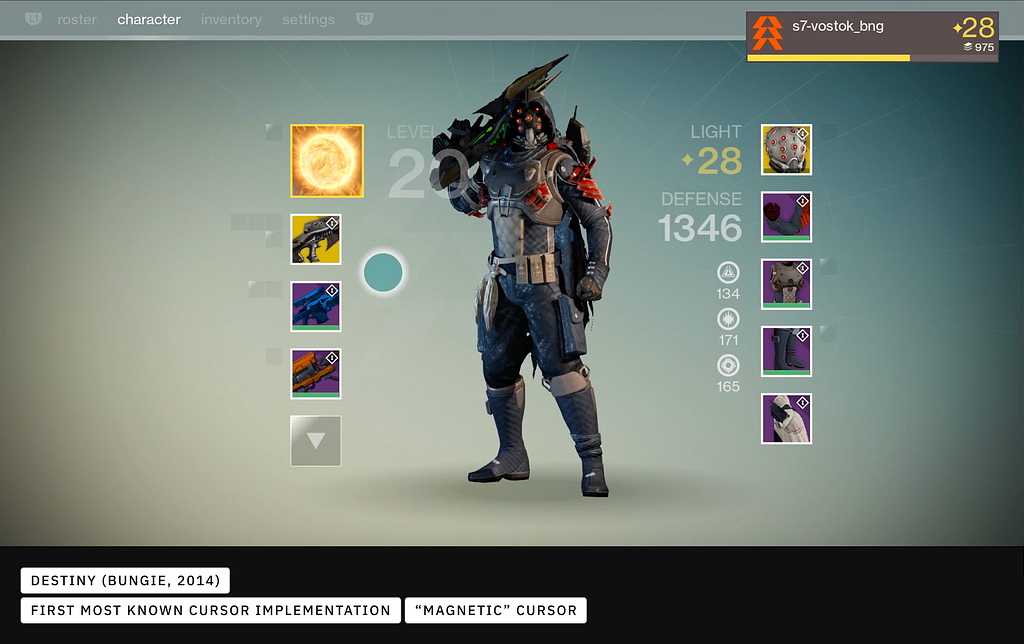
Bungie didn’t port a PC interface to a controller but put a lot of effort into making it feel like it belongs on consoles. The core engineering problem is what some call the Heisenberg Effect of analog input: when a player presses A or X to confirm a selection, their thumb naturally jitters the stick slightly in the process. In cursor UIs, that jitter translates directly into selection errors.
Later research found that the Heisenberg effect (Wolf, Gugenheimer, Combosch & Rukzio 2020) is responsible for approximately 30% of all selection mistakes in cursor interfaces.
Destiny’s team spent significant time tuning cursor speed, target sizing, and its behavior. The solution: elements magnetize toward the cursor when it gets close, movement is smoothed to absorb the natural instability of a thumbstick during button presses, and selection stays discrete. This is close to what researchers describe as Magnetic Cursor principles (Mäkelä, Heimonen & Turunen, 2014), adapted for analog input. The result is a 25% improvement in small-target accuracy compared to unassisted cursor movement. It’s why Destiny’s cursor felt better than almost everything that came after it.
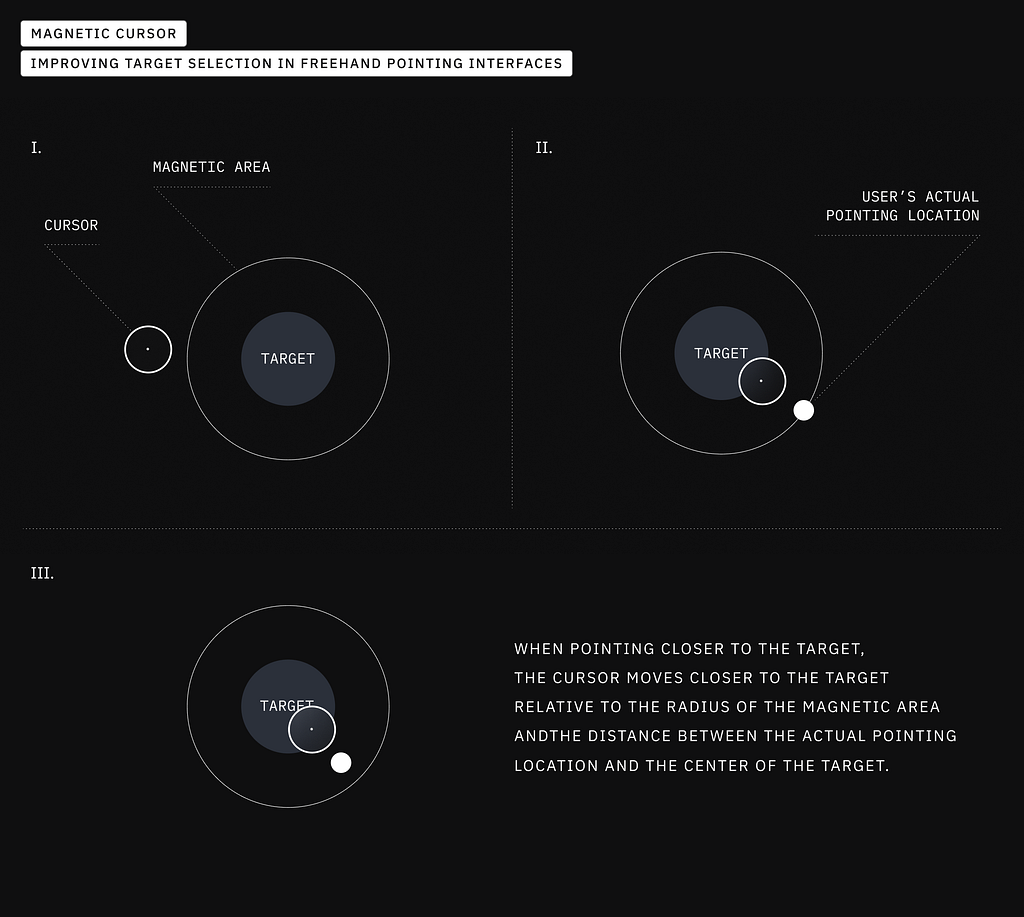
Most later console cursor implementations ship without any of this. The cursor moves, the player aims, the thumb presses but the selection lands somewhere adjacent to where they intended.
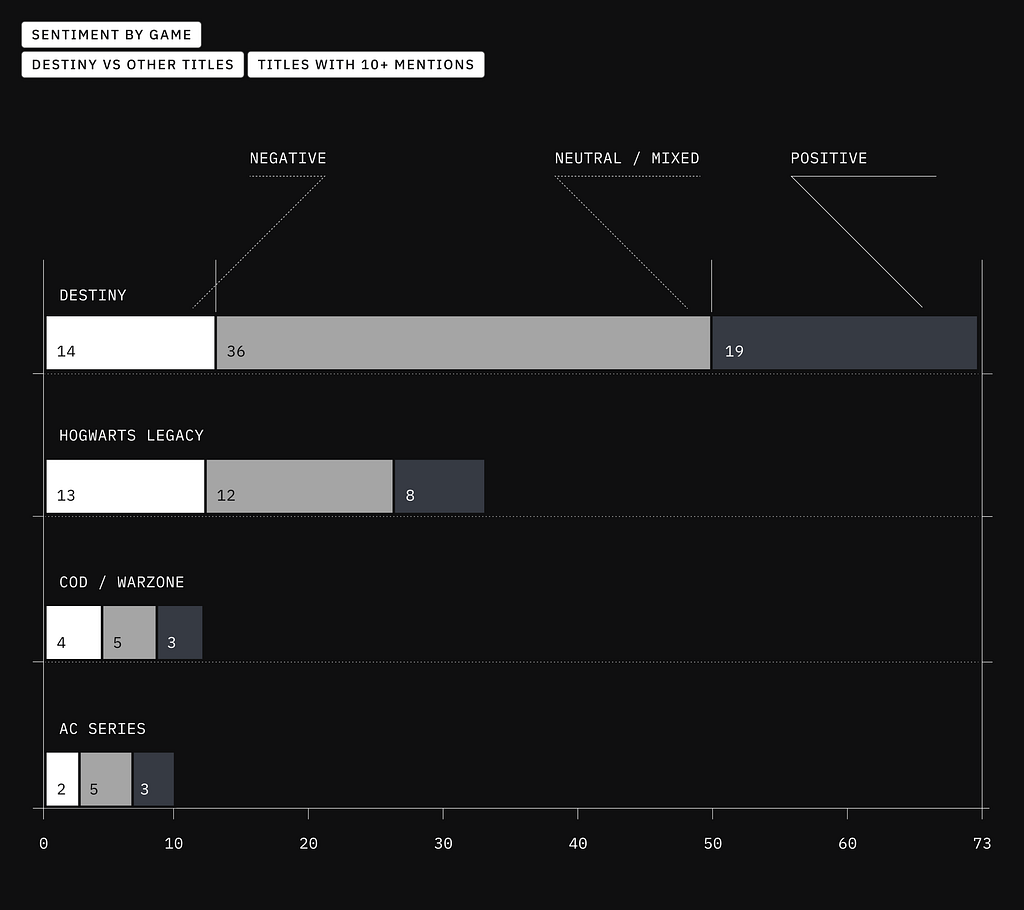
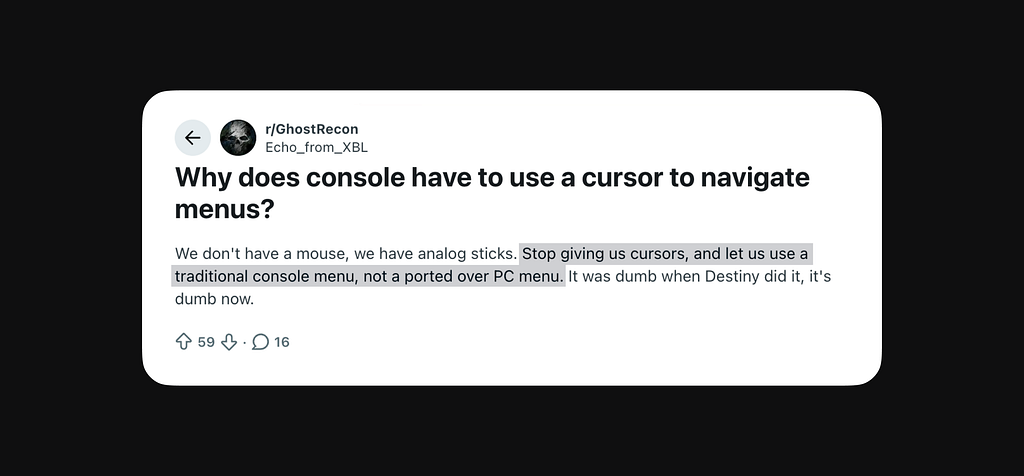
Destiny’s net-positive status is consistent with the research claim. In the sample discussions data, Destiny is the only game where positive comments outnumber negative ones. 19 positive vs 14 negative out of 69 total mentions. Players who criticized every other implementation often carved out a specific exception for this one:
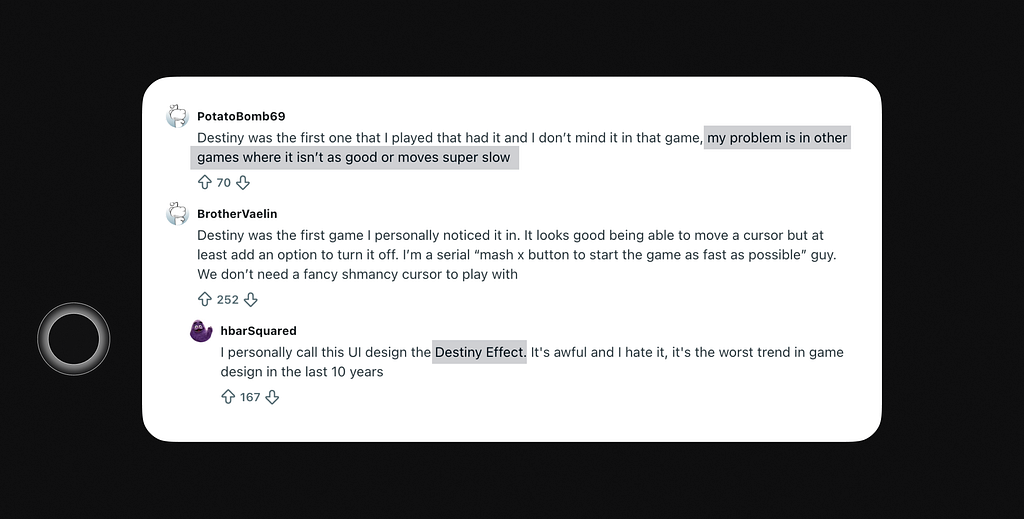
“Destiny was the first one that I played that had it and I don’t mind it in that game. My problem is in other games where it isn’t as good or moves super slow.”
That comment captures exactly what happened next. Studios saw the cursor, saw the success, and copied the aesthetic without the engineering.
A forced cursor menu is faster to port from PC than to rebuild for gamepad. When cross-platform development accelerated through the late 2010s, the cursor came with it, usually without any of the tuning that made the original tolerable.
Players even named this themselves. The term “the Destiny Effect” appears organically across threads in the comment data not as a compliment, but as a diagnosis for what went wrong in every imitation.
There’s also an honest explanation from the Bungie side, paraphrased in one thread by someone who’d spoken with a UI developer there directly:
“We made the decision because of the amount of navigation required on the weapon and skill trees. In testing, it was impractical and [the cursor] was the better solution.” ²
Context matters here. The cursor was a reasoned response to a specific layout problem, dense, spatially connected skill data that D-Pad sequencing would make awkward. The problem is that studios adopted the forced cursor for menus that don’t have this problem at all.
Two spikes, not one trend
Looking at the data year by year, the pattern isn’t a gradual rise and fall.
It’s spikes.
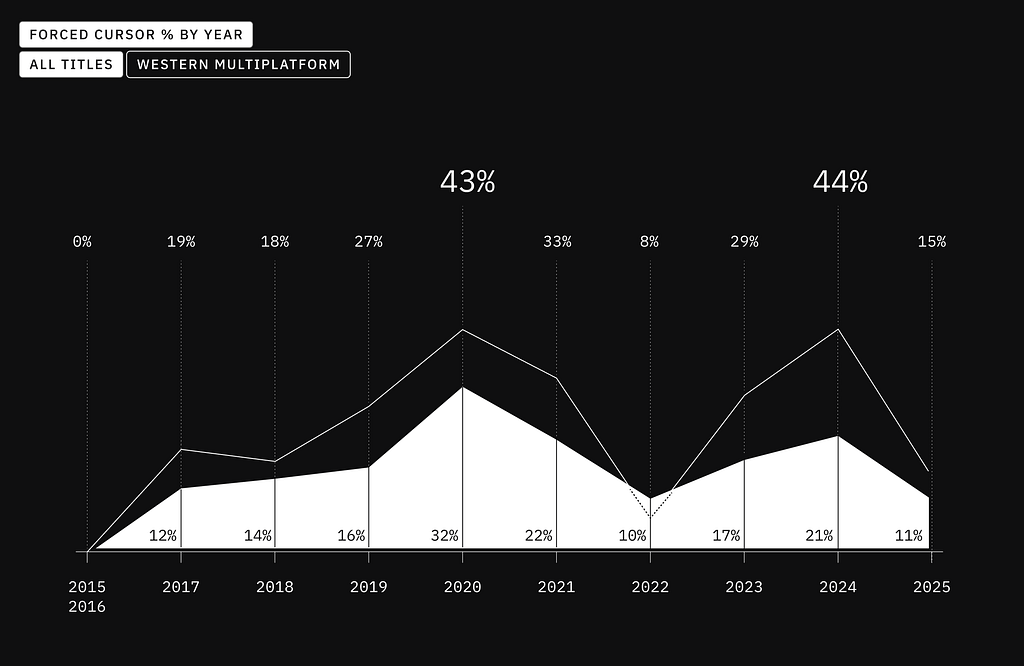
- The first peak: 2020, at ~32% of all games implemented cursor.
- The second peak occurred in 2024, at ~21% of all releases, which may suggest a positive trend toward reducing forced cursor usage overall.
What changed? A growing number of Eastern games began releasing worldwide, and their share of the dataset increased considerably by 2024. So, considering this as a possible reason for the change, I tried separating out only Western releases, and this changes the picture quite a bit:
- In 2020, 43% of Western games used forced cursor navigation.
- In 2024, that number was 44%. More than twice the overall sample rate of 21%.
Two nearly equal peaks suggest the trend still holds within Western studios. Digging deeper into which games these were makes the picture clearer.
In 2020, four large titles explain most of it:
- Cyberpunk 2077 (CD Projekt Red),
- Assassin’s Creed: Valhalla (Ubisoft Montreal),
- Call of Duty: Warzone (Infinity Ward / Raven Software), and
- Immortals Fenyx Rising (Ubisoft Quebec).
All released within months of each other, all from studios with heavy PC infrastructure. In 2024:
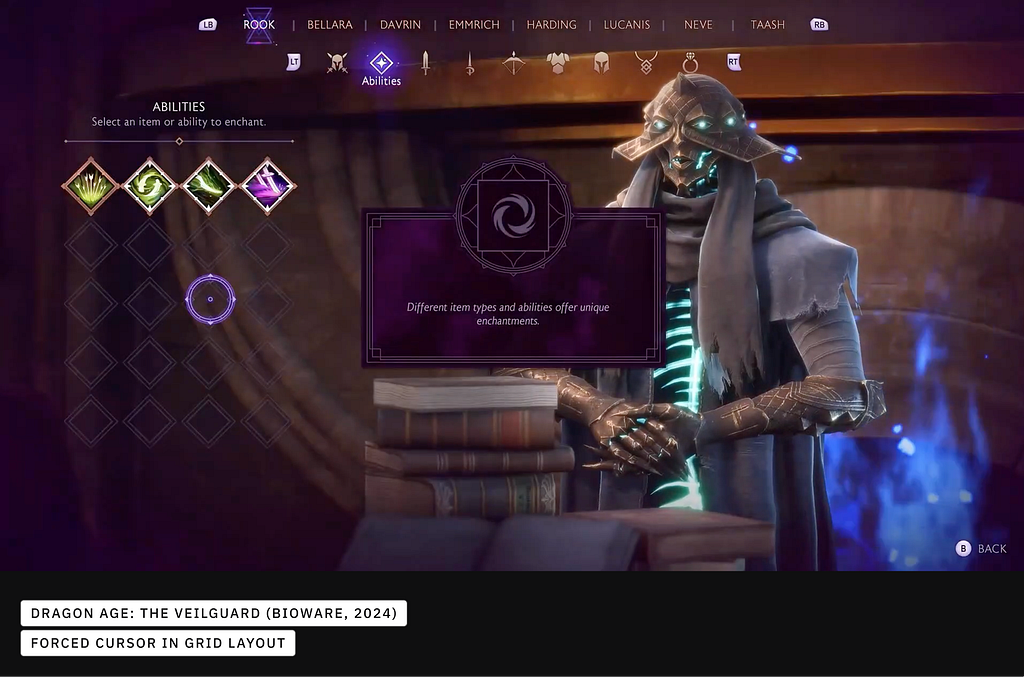
- Dragon Age: The Veilguard (BioWare),
- Warhammer 40,000: Space Marine 2 (Saber Interactive),
- Skull and Bones (Ubisoft Singapore), and
- Banishers: Ghosts of New Eden (Don’t Nod).
This looks like studio-level clustering with a few large teams shipping cursor-heavy products in the same window. Western rates then recovered to much lower numbers within 12–18 months in both cases. So what else could explain this pattern?
For the 2024 peak, there’s another hypothesis worth sitting with. Games have long production cycles, typically three to four years from pre-production to launch. A title that entered development in 2019 or 2020 was being designed at exactly the moment when forced cursor products like Call of Duty: Warzone (Infinity Ward / Raven Software, 2020) were defining what a successful cross-platform console UI looked like. If teams made cursor decisions early in that cycle, often as a shared codebase call, not a screen-by-screen decision, they could carry those decisions forward to ship regardless of how the conversation had evolved in the meantime.
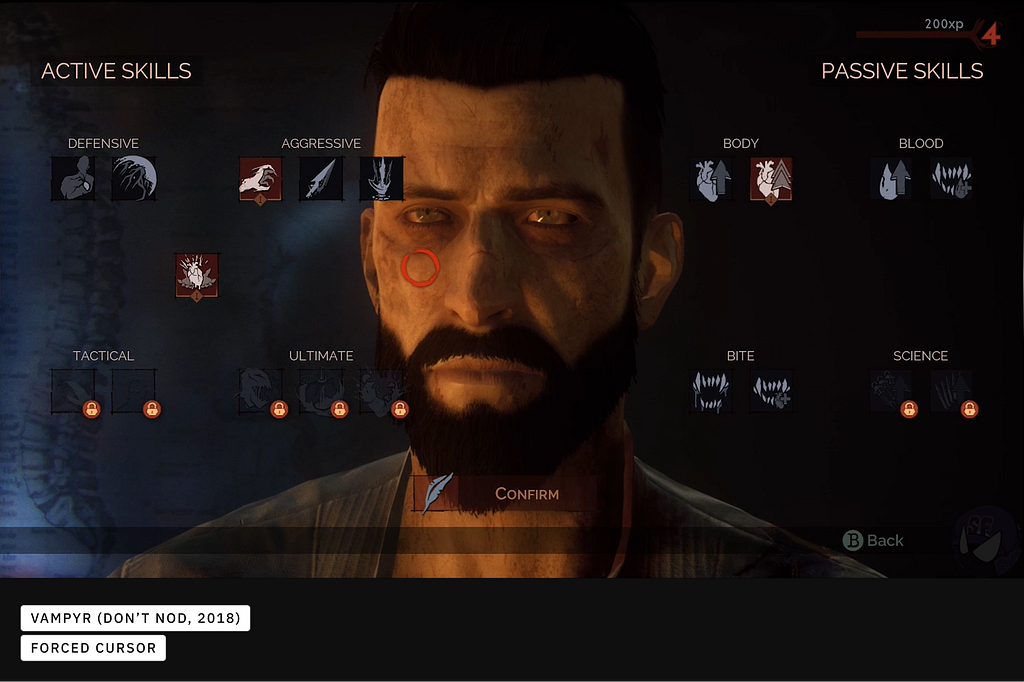
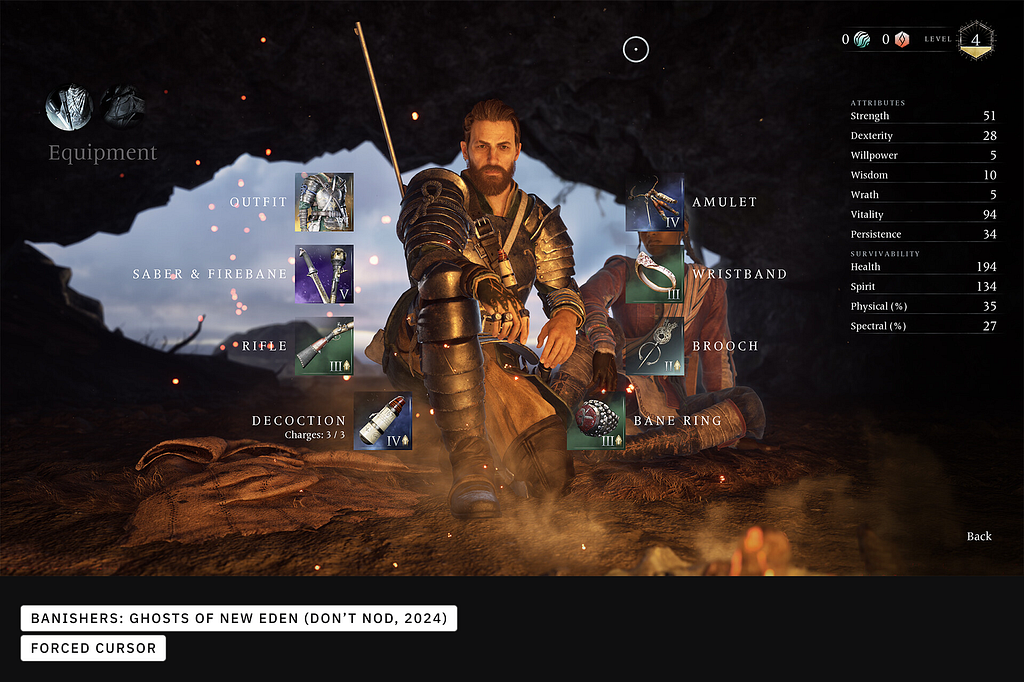
Let’s take Skull and Bones (Ubisoft Singapore, 2024) as an example. Development stretched close to a decade. The cursor navigation in its final release looks exactly like something decided very early and never revisited. The game shipped in 2024. The navigation model was probably settled around 2016.
This is a hypothesis, not a proven conclusion. But the timeline fits, and it points to something worth keeping in mind: the games releasing today were largely designed three or four years ago. Present discourse doesn’t automatically change present releases.
Genre specifics
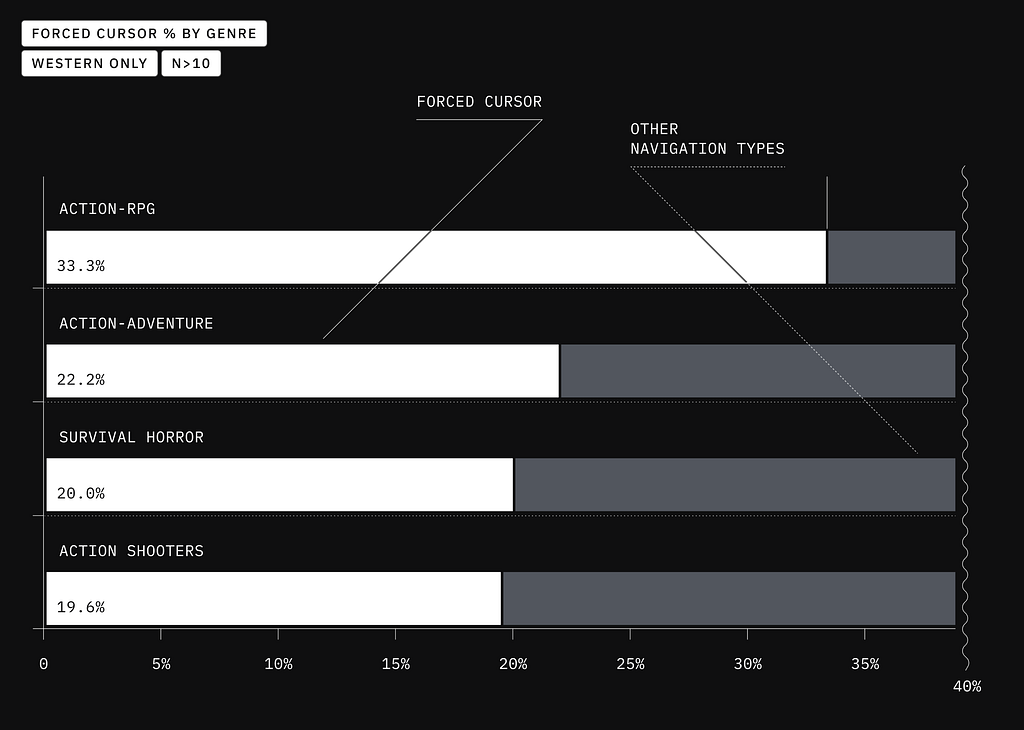
Genre segmentation is much more consistent data across all games. As I said earlier, action-adventure games implement forced cursor in 22% of releases. But this is not the highest number. Action RPGs use a cursor in every third game due to complex menus, inventories, etc. This is a possible explanation, but it does not survive the critique that it cannot work with focus-based navigation, but I will return to this later.
Almost the same proportion applies to survival horror and action shooters, at around 20–22%, meaning they are broadly comparable to action-adventure games. However, other unlisted genres also use cursor-based interaction, but calculating percentages for them is not meaningful due to the small sample size (n < 10).
Live Service is a multiplier
This is the finding I wasn’t expecting, and I think it’s the most practically useful one. It became clear when I separated live service titles from single-player releases:
- Live Service shows ~31% of games with the forced cursor.
Nearly every third title. - Single-player shows only ~11%.
That’s a three-times difference.
And I don’t think that it’s mainly a design philosophy thing.
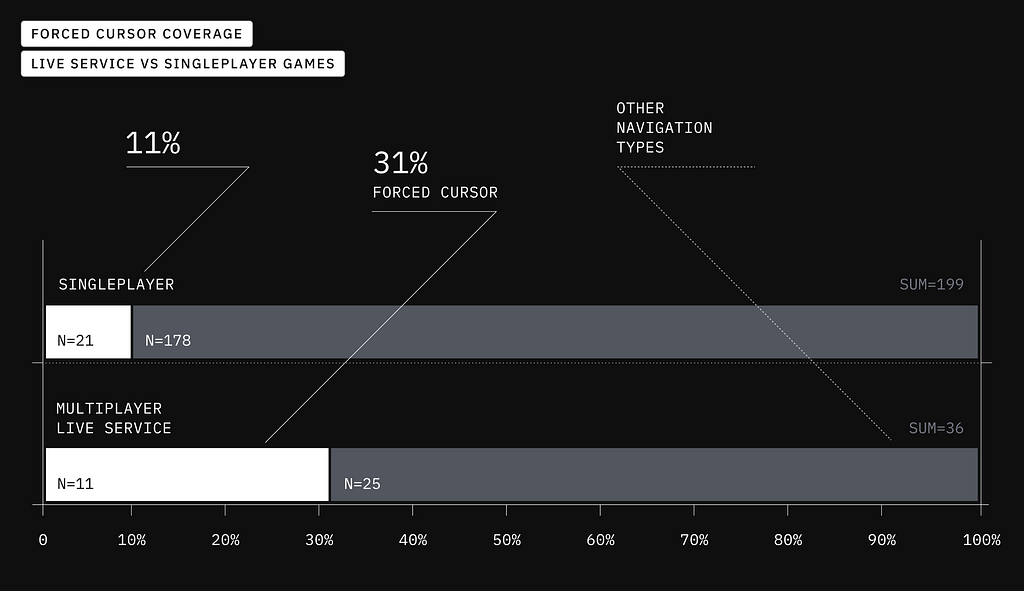
Live service games carry a UI burden that single-player games don’t: storefronts, battle passes, seasonal menus, and lobby interfaces. These parts of the UX often come from PC or web-adjacent tooling and are rarely rebuilt specifically for console input.
The cursor doesn’t appear because someone decided the inventory should work that way. It appears because the Live Service infrastructure made it the default across all surfaces. It’s faster and cheaper to remap controller input to cursor movement than to design a parallel focus navigation system for in-game menus. In a Live Service context where the storefront, lobby, and seasonal hub all run on PC-origin UI frameworks, that shortcut compounds across every new surface added.
East vs West: the most consistent finding
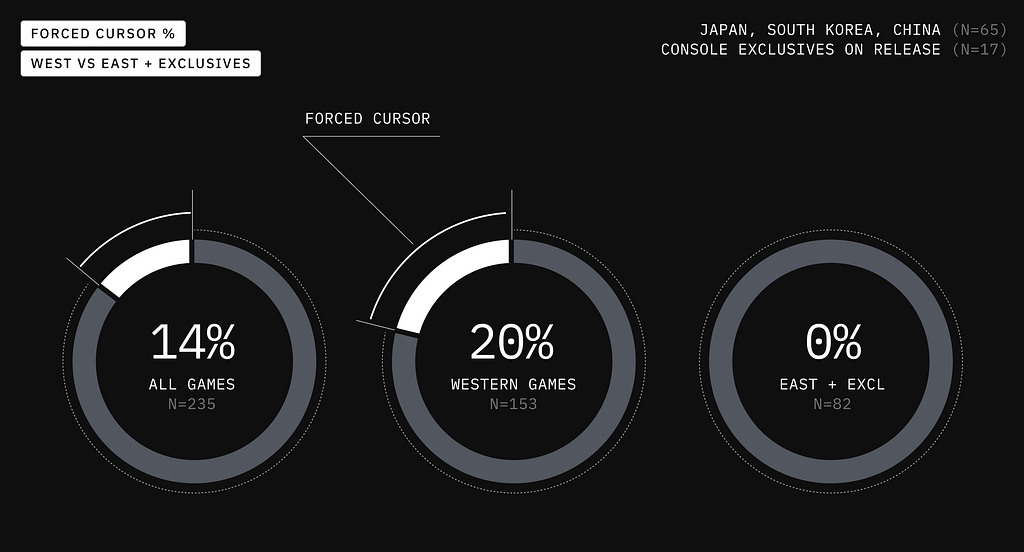
While I was reviewing games, I started noticing an interesting pattern. To validate it, I separated all non-Western studio titles from Japan, South Korea, and China, as well as console exclusives, which follow the same logic: built for controller-first from the start of production rather than adapted to it later. What remained was a specific, clean dataset:
Zero Eastern games used forced cursor navigation.
Among all non-Western studio titles in the dataset, forced cursor appears 0% of the time. Across ten years, across every genre group, with no exceptions anywhere in the sample.
- Elden Ring (FromSoftware, 2022)
- Resident Evil Village (Capcom, 2021)
- Monster Hunter: World (Capcom, 2018)
- Final Fantasy VII Remake (Square Enix, 2020)
- Black Myth: Wukong (Game Science, 2024)
- Stellar Blade (Shift Up, 2024), and many more.
All these games eventually became multiplatform. Some of them have extraordinarily complex, layered menu systems. None of them default to forced cursor navigation across the game UI on console versions.
So, when I filtered the game data to separate the two groups, the picture shifted considerably:
- Across all 235 games for 10 years ~14% uses forced cursor
- Non-western + exclusives: 0%
- Western multiplatform games: ~20% across all genres
There may be a genuine preference for refinement over disruption, improving what works rather than replacing it with something experimental. Asian studios have historically treated the controller as the primary input device from early in production.
Nintendo’s influence across Japanese game development runs deep: its home consoles defined the “10-foot experience” standard, and its decades of dominance in portable hardware meant an entire industry learned to design for thumbs and buttons first, not mouse and keyboard.
But I want to be careful not to collapse this into a simple cultural story, because I think that misses something more structural.
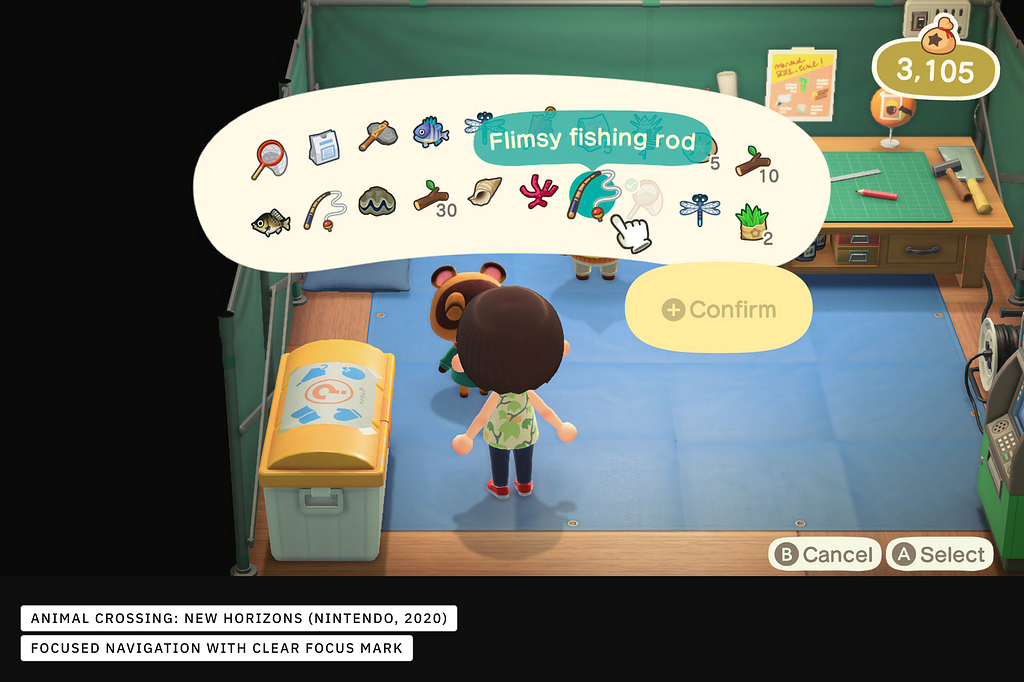
The explanation that feels most honest to me is simpler than that. The cursor problem is a late-stage adaptation problem. It appears when a UI designed for one input context gets ported to another without a rebuild. Studios that start controller-first never create the conditions for it to emerge in the first place, not because of design philosophy, but because the problem has no opportunity to appear.
Not that simple
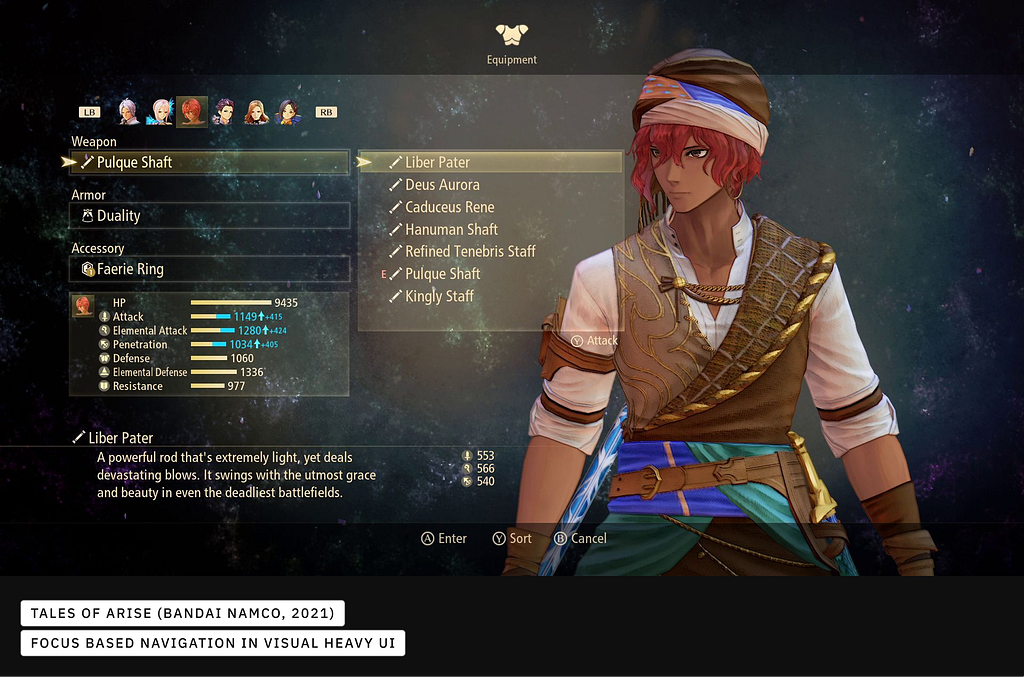
The Trails series known in Japan as Kiseki (Nihon Falcom, since 2004) is worth pausing on here, because it removes the easy justification. These games have strong PC roots: early entries in the series originated on Windows, and the franchise has maintained a PC presence throughout its history alongside console releases.
They also represent some of the most menu-dense RPGs in the genre: equipment loadouts, party management, orbment customisation, encyclopaedic in-game lore systems, crafting trees. The kind of layered interface that, in a Western studio, as the data shows, would almost certainly be cited as a reason a cursor is necessary.
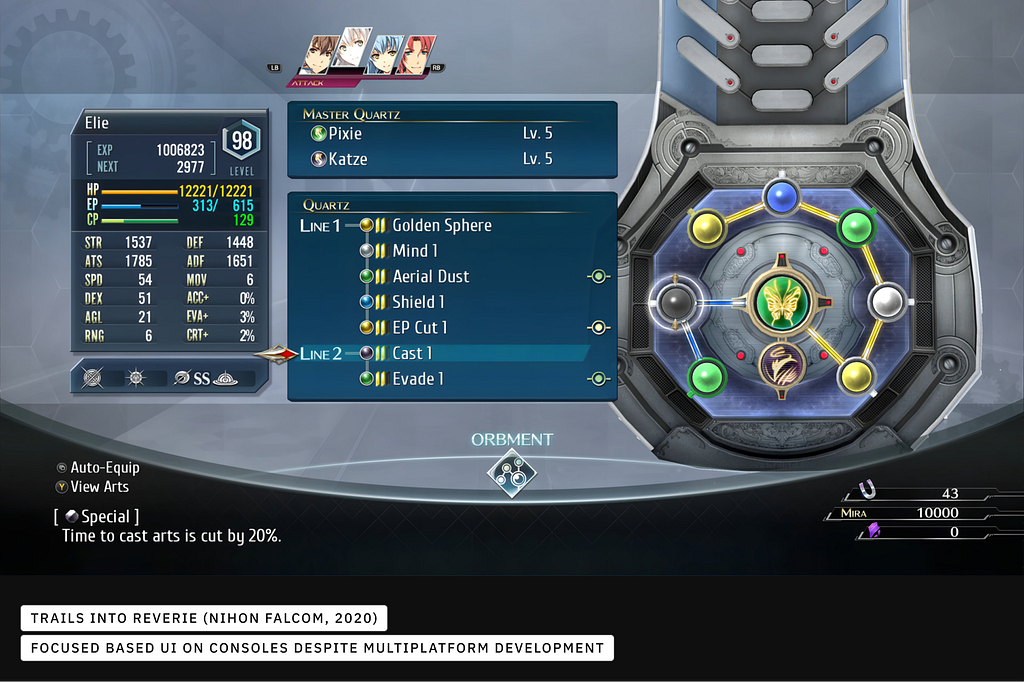
And yet, when Falcom ported these titles to PlayStation and Switch, and now when they release them simultaneously across PC and Switch, the focus-based navigation is complete and thoughtfully designed throughout. D-pad movement is mapped carefully.
The constraint is whether console navigation gets treated as a real deliverable or something to sort out in the last few months.
If Falcom can build that level of menu complexity PC-first and still deliver clean gamepad navigation on every platform, then “our game is too complex for focus navigation” doesn’t hold up as a reason.
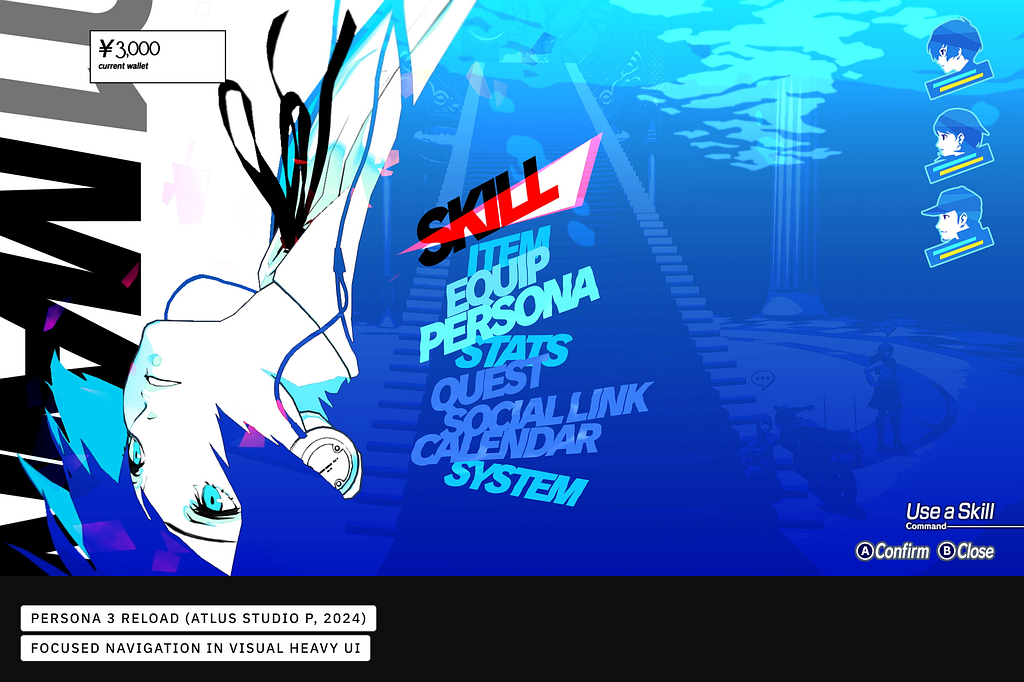
This also applies to visual complexity. Take games like Metaphor: ReFantazio (Studio Zero / Atlus, 2024) or Tales of Arise (Bandai Namco Studios, 2021). These multiplatform titles push UI aesthetics as far as almost any Western AAA game — through typography, layered motion, and dense information design.
And none of them rely on a cursor to make it work. So the idea that highly stylized or visually complex menus require cursor-based navigation isn’t really supported by what these studios have actually shipped.
Where cursors actually earn their place
After everything above, it would be easy to read this as a case against cursors on consoles. That’s not what the data says.
Cursors earn their place in genuinely spatial layouts where elements are distributed in two-dimensional space without a natural reading order, and free selection is more efficient than trying to sequence through them with D-Pad.
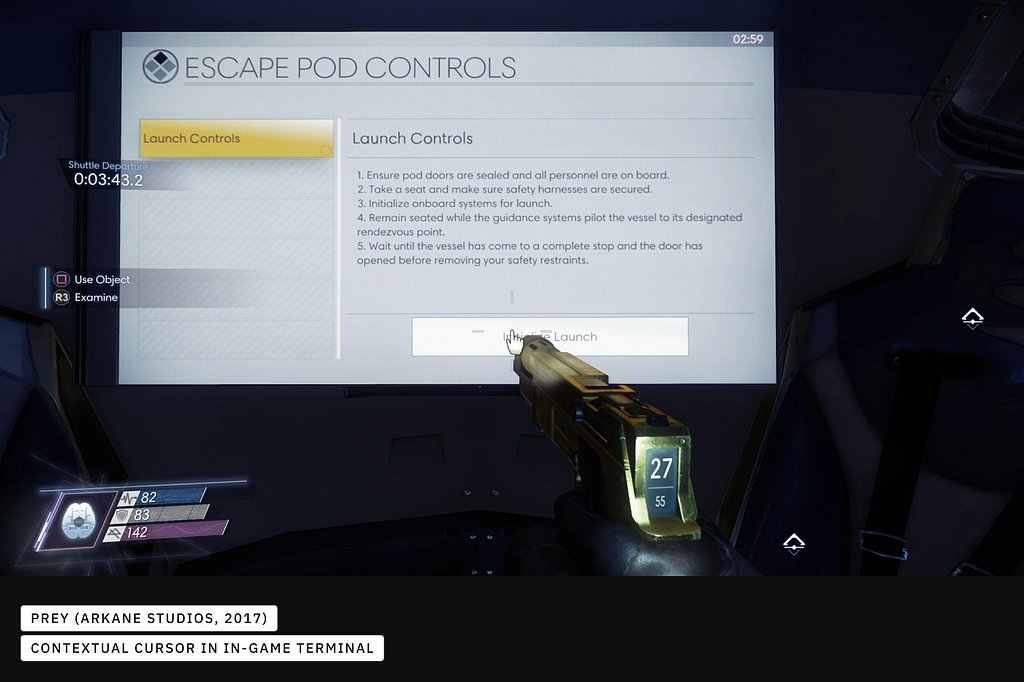
Prey (Arkane Studios, 2017) uses cursor navigation on in-game terminals inside the space station. That’s as much a fiction decision as a UX one — the cursor reinforces that you’re interacting with a machine inside the world, while still being vulnerable. Pausing the game to navigate a traditional menu would break exactly the tension the whole thing is built on.
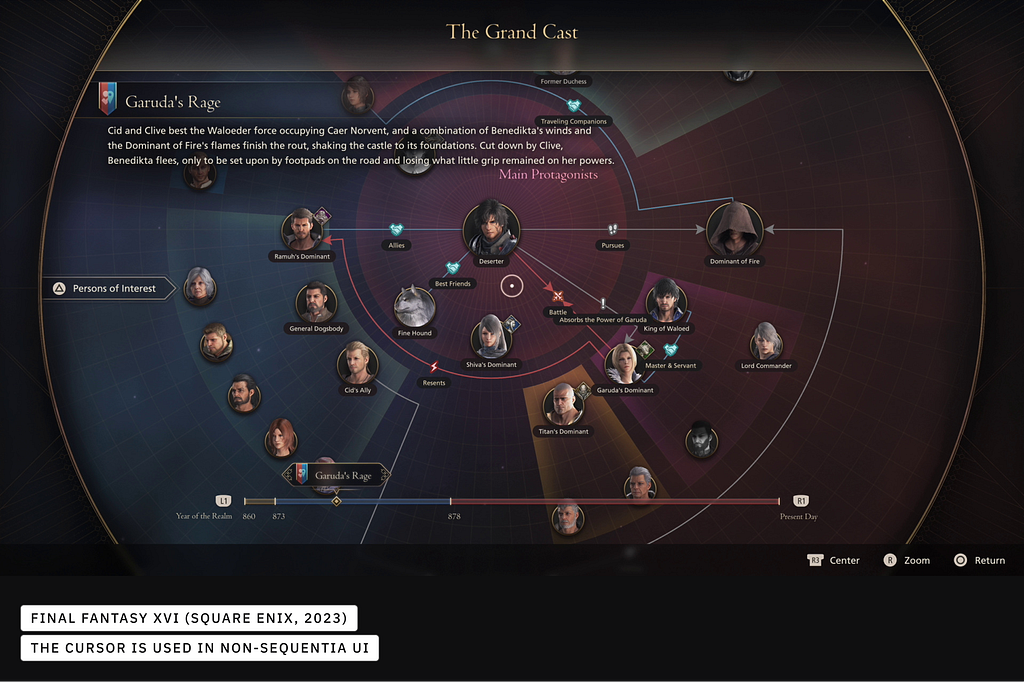
Final Fantasy XVI (Square Enix, 2023) uses a cursor in its affinity map, where focus-based navigation could significantly increase the time required to find information about a specific character.
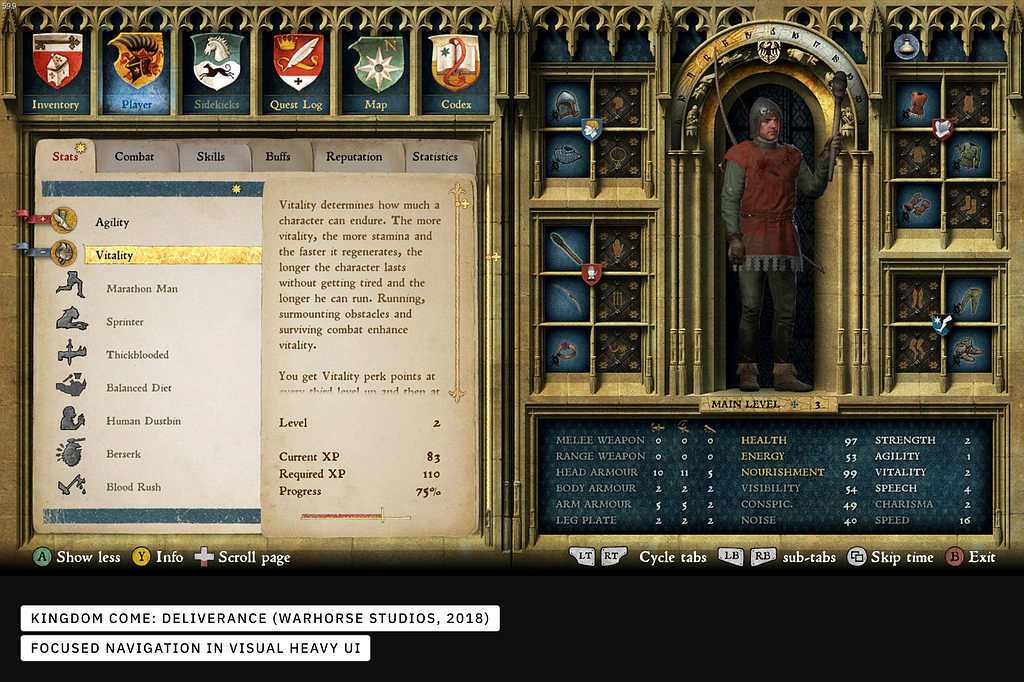
Dragon Age: The Veilguard uses a cursor in grid-based layouts, which appears to be a questionable UX choice that players have complained about. At the same time, it applies the cursor appropriately in the non-linear skill tree. This is interesting, because the skill tree itself might have influenced why the cursor persists in other parts of the UI.
Or previously mentioned Alan Wake II (Remedy Entertainment, 2023) puts a cursor on the detective case board where evidence distributed spatially, selection exploratory and non-sequential. It earns its place because the layout demands it and the fiction supports it.
All are examples of contextual cursor. It’ bounded, motivated, sitting alongside focus-based navigation everywhere else in the game.
What players think
The player data adds something important here. While the dominant tone across the 507 comments is frustration, there are consistent voices that say specific interfaces should have cursors — and point to places where the absence is actually a problem:
“FF16 does it right with both options; but I feel like certain games need it like Baldur’s Gate 3 on PS5. I was telling myself how I wish I had a menu cursor.
Baldur’s Gate 3 (Larian Studios, 2023) console port is widely praised for its thoughtful controller adaptation. And yet even players who appreciate the work note that certain interactions would genuinely benefit from cursor input. That’s not a criticism of the port. It’s players accurately identifying where the cursor is the right tool.
“I feel like a menu cursor would work really well on the console version of BG3. It would be nice to be able to drag and drop items, especially when trying to equip gear.”
A similar conversation came up around ARC Raiders’ perk tree (Embark Studios, 2025), where players on console noted that the branching, spatially distributed layout would work better with a cursor even though the rest of the game navigates well with focus. The point isn’t that focus navigation failed. It’s that the specific multi-directional layout is exactly the kind of problem the cursor solves naturally.
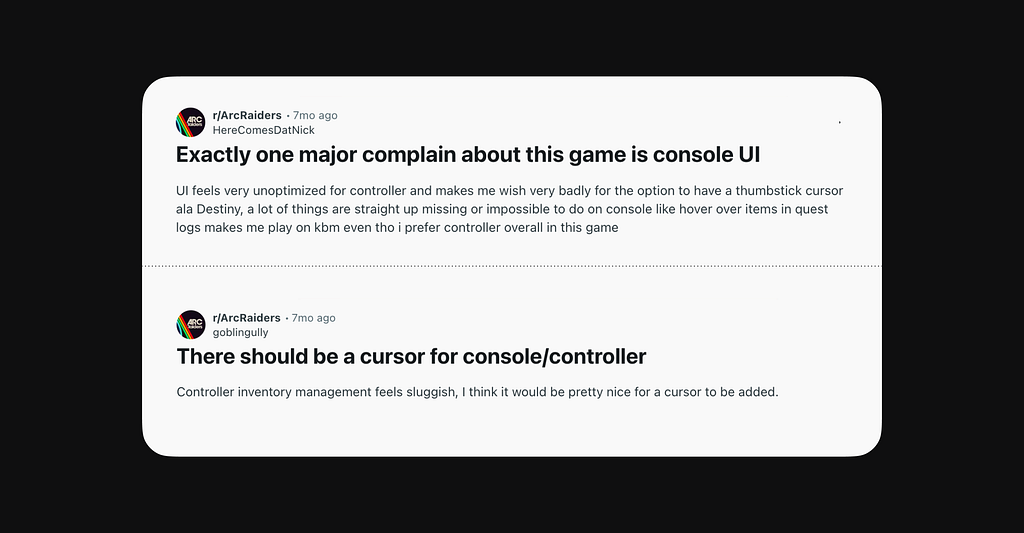
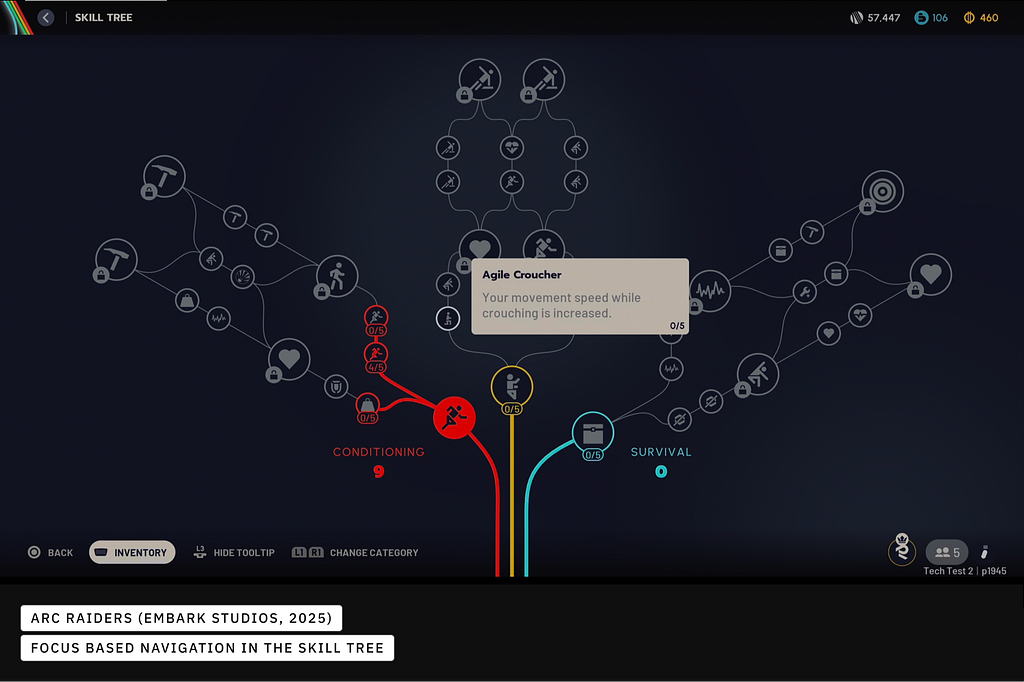
The problem was never the cursor itself. It was applying a tool designed for spatial, freeform selection to structured, sequential menus where it has no advantage and doing so as a default. One comment in the dataset said it better than most design documentation could:
“Abstract complicated menus, cursor works better.
Anything that’s just scrolling, D-pad. Some stuff in between is subjective.”
Example when the problem were acknowledged
The correction is real, and you can see it clearly in one of the biggest titles from the peak years for forced cursor navigation. Ubisoft had been building cursor-heavy interfaces across the Assassin’s Creed RPG trilogy since Origins, and internally had been aware of the problem for years.
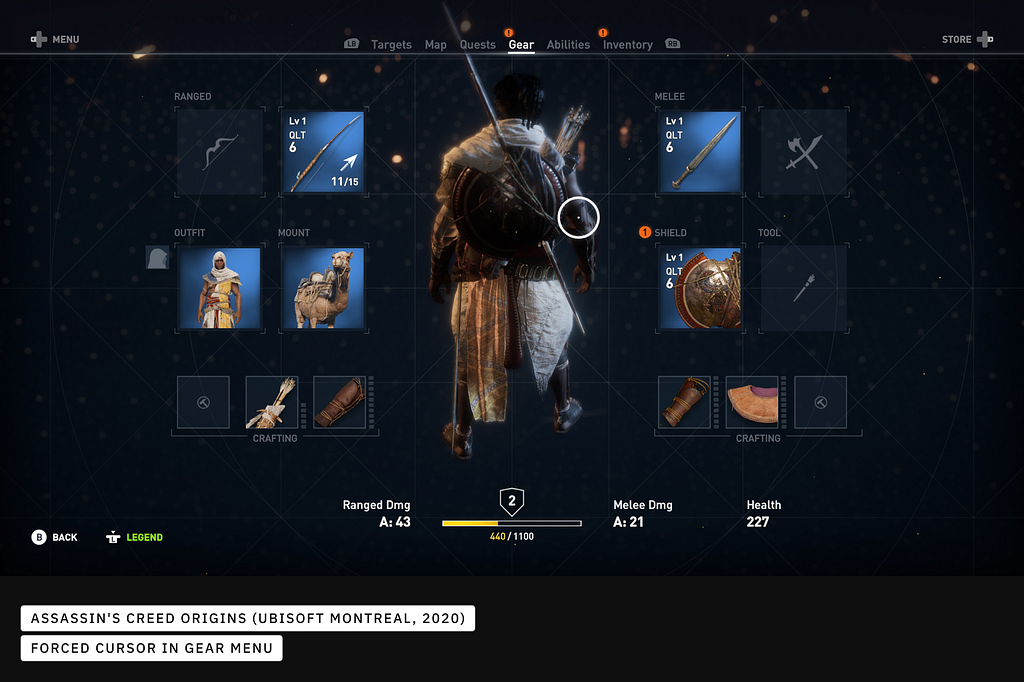
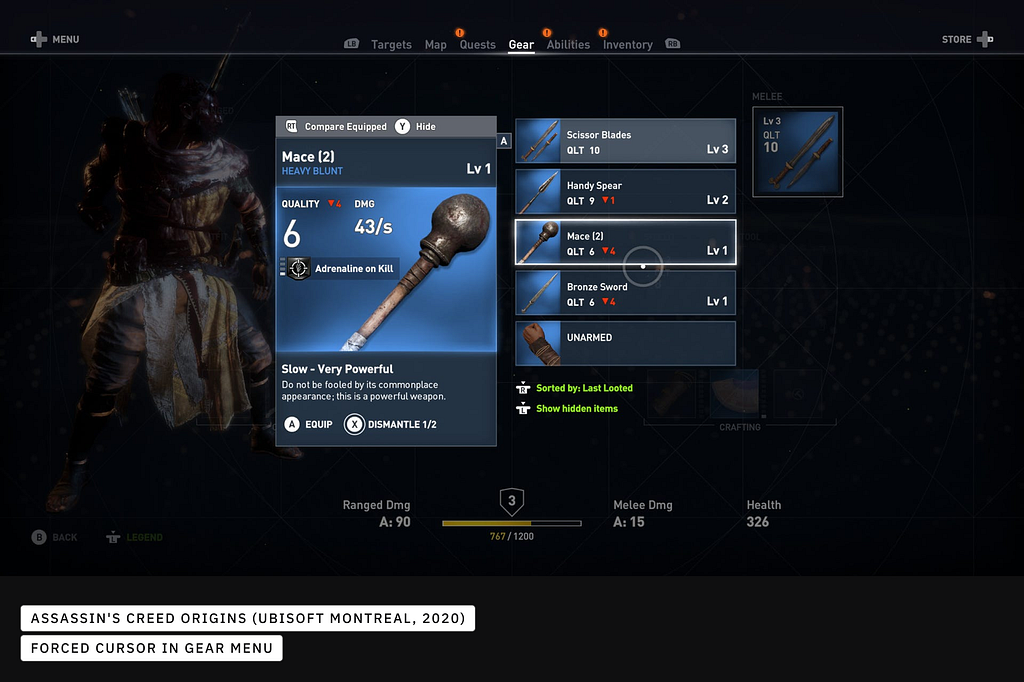
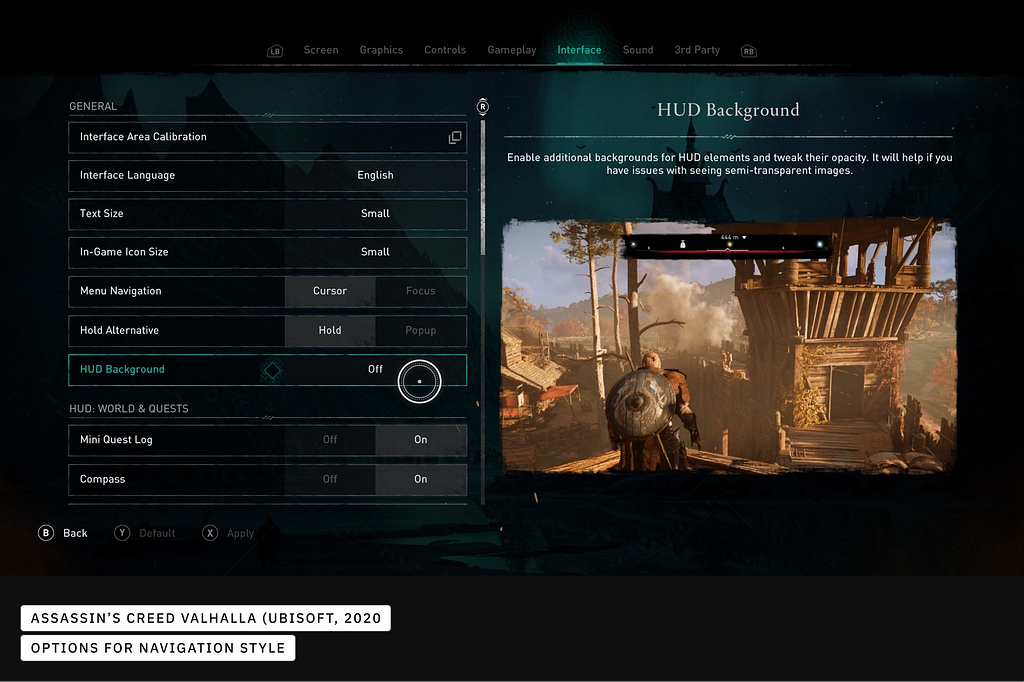
Valhalla introduced Focus Mode — a snap-based system where D-Pad moves cleanly between elements while cursor navigation stays available as an option. David Brownrigg from the team put it plainly:
“Even as developers, we realized how the free cursor was frustrating in some menus. We’ve been thinking about this since Assassin’s Creed Origins, so we’re pleased that we’ve been able to achieve this. But just having several ways for users to navigate ultimately benefits everyone.”
The admission in the middle of that quote, that the developers themselves found it frustrating, says more than any forum thread. Assassin’s Creed Mirage (2023) and Assassin’s Creed Shadows (2025) continued in the same direction, expanding input options and reducing cursor dependency in structured screens.
Studio not removed the cursor entirely. They made focus navigation real, and gave players the choice. The correction was about removing it as a default, not eliminating it as an option.
Is the industry shifting back?
The data shows a some decline in forced cursor since the 2020 peak in general. A few things are driving it, and they vary in how durable they feel.
While Japan largely stayed consistent, Western AAA went through a longer cycle: adoption, backlash, and gradual correction. In recent years, more studios that previously used cursor-based navigation have moved back to focus-based systems. They are consciously avoiding heavy reliance on free cursors.
Accessibility
Free cursors increase interaction effort in ways that affect far more players than accessibility discussions usually acknowledge. I’m talking about the everyday friction that touches everyone at some point like finger injury or even something simple like laying from an awkward angle on the couch. For players with motor tremors or stick drift on aging hardware, continuous cursor correction is genuinely exhausting. The industry took notice, and what followed reshaped the standards entirely.
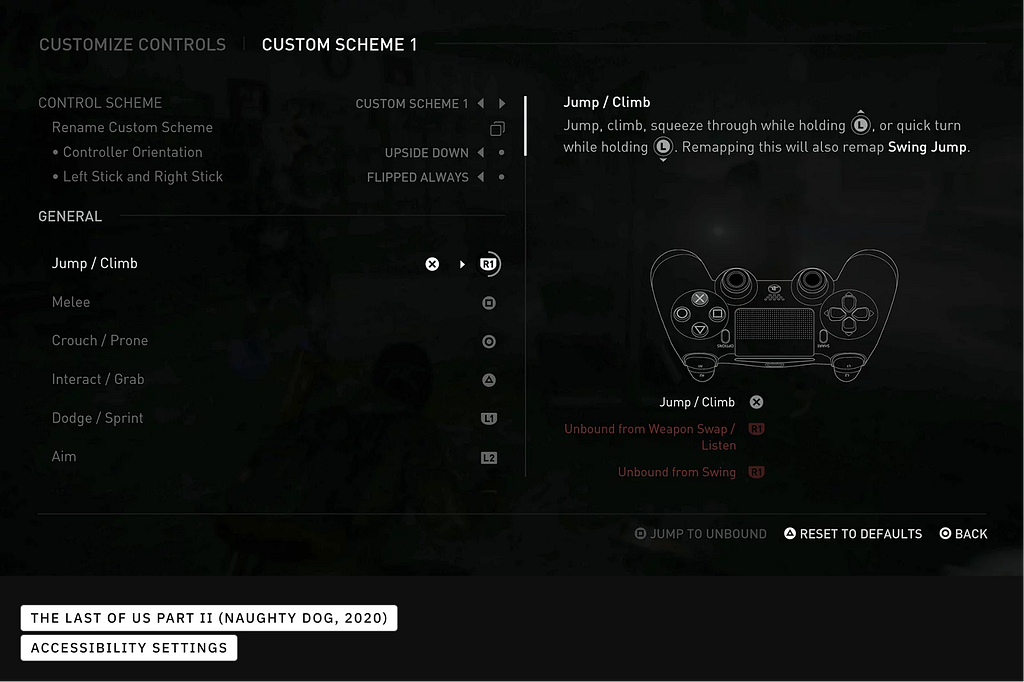
Accessibility standards raised the floor in a way that looks permanent. The The Last of Us Part II (Naughty Dog, 2020) winning the first Game Awards Innovation in Accessibility category in 2020 made navigation quality publicly visible in a new way. Platform certification requirements from Sony, Microsoft, and Nintendo tightened around navigation consistency.
The Xbox Adaptive Controller and PlayStation Access Controller — both built around discrete inputs — sent a clear signal about where hardware design is heading. When hardware, certification, and industry recognition all point the same direction, UI practice tends to follow.
Portable gaming
Portable hardware changed the conditions on the ground. Handheld gaming went mainstream (team Deck, Nintendo Switch (141 million units sold), ASUS ROG Ally). Smaller screens, variable lighting, ergonomics that shift constantly. All of these amplify cursor problems.
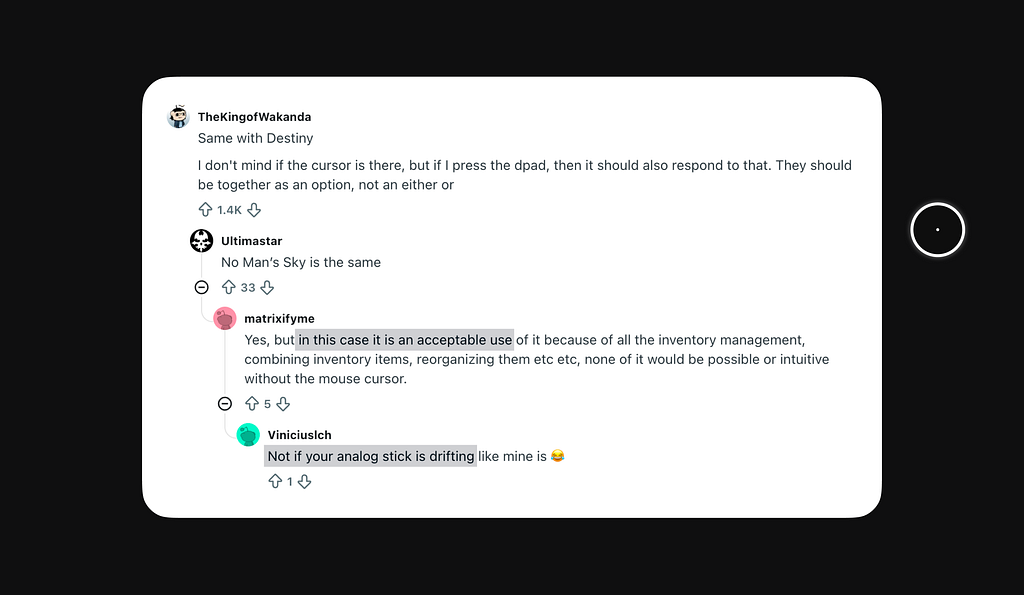
Stick drift at couch distance is annoying. On a portables, with a device tilted slightly in your hands, it becomes a real barrier. Focus navigation is just less sensitive to these variables.
UX Maturity
UX maturity inside studios is real: dedicated player research roles are now embedded in most mid-to-large teams, navigation friction is measurable rather than a matter of opinion, and tools like Figma with gamepad prototyping mean problems can be caught before implementation. Moreover, quick AI-assisted prototypes is making the capability to do this work much more widely available than it was a decade ago.
But here’s the honest part: none of this is automatic. The 2024 peak (44% of western releases) is a clear reminder that even with all these forces in play, individual production cycles carry old decisions forward for years. The correction happens in studios that treat navigation as a system-level decision made explicitly, early, with someone accountable for it end-to-end. It doesn’t happen as a side effect of industry trends.
The conversation about cursor hasn’t ended in 2026. It’s ongoing.
What I’m left with
Ten years of data gives me a specific picture, not a simple one.
Forced cursor is not an industry epidemic because 14% of releases over a decade is meaningful but not dominant. It is, however, concentrated: in western multiplatform studios, in Live Service products, in genres with complex PC-heritage UI systems, and in specific years when large studios with shared codebases released simultaneously.
The East-West gap is the most structurally significant thing in the dataset. 0% Forced Cursor among non-western studios across a decade isn’t a design philosophy preference. It’s what happens when console navigation is treated as a first-class deliverable from the start of production. The Trails example matters because it shows this holds even for studios that started PC-first. The constraint isn’t where you begin. It’s whether gamepad navigation is something you design, or something you adapt.
The Live Service finding is the most practically actionable one. The forced cursor rate is three times higher in those titles, pointing directly at organizational structure — shared codebases, siloed teams, service infrastructure that was never designed controller-first. In many of these games, the cursor isn’t a decision. It’s the absence of one.
And the player data adds the nuance that keeps this from being a clean verdict. Players aren’t asking for the cursor to disappear. They want it to be meaningful. Placed where it helps (the spatial skill web, the drag-and-drop inventory, the detective board), absent as a default where it doesn’t (the settings screen, the mission select, the item list). The 95 requests for optionality aren’t rejection. They’re a pretty accurate description of what good contextual design actually looks like.
For me, this was never about proving one system right and the other wrong. It’s about understanding when each approach earns its place. The cursor is not universal. The industry knows this, mostly. The harder part, and what the data keeps pointing back to, is building the conditions early enough in production that this knowledge actually shapes what ships.
When navigation is right, players don’t notice it. They just move through the game. That invisibility is the goal.
Everything in this article is backed by a structured dataset built over the course of this research. If you want to dig into the numbers yourself or use them for your own work it’s all available below. If you find it useful or spot something I’ve missed, I’d genuinely like to know.
Full dataset: Google Sheets — 235 games, genre classification, navigation type, year, studio origin, multiplayer model, Live Service flag
Also, huge thanks to Game UI Database. There’s simply no practical way for me to access that many games otherwise.
Game UX: the cursor that wasn’t supposed to be there was originally published in UX Collective on Medium, where people are continuing the conversation by highlighting and responding to this story.


