

For years, design system work lost the roadmap fight quietly. Config 2026 made the losing loud. That changes who has to care.
“Let’s revisit next quarter.”
You have heard it enough times to know what it means. It means never. You are standing in front of the planning board, and the design system work is pinned next to six feature requests, and you have just made the case you have made before. The tokens need restructuring. Components are drifting out of the library. Half the buttons in the product file are detached from their source. Someone with budget authority nods, says the line, and moves on. The features ship. The debt compounds. You lose, politely, again.
If you maintain a design system, you know this meeting. You have probably blamed yourself for losing it. Wrong deck, wrong metrics, wrong framing. The belief that if you could just present it better, you could make a maintenance backlog feel urgent to people who measure their quarter in shipped features.
The pitch was never the problem. The problem is that design system rot is invisible to everyone who is not the person maintaining it. You cannot make a leadership team feel a cost they cannot see.
That is the thing Config 2026 actually changed. Not the tools. Who feels it when the tools fail.
Everything Figma shipped reads from your design system
Look at the lineup, not as features, but as dependencies.
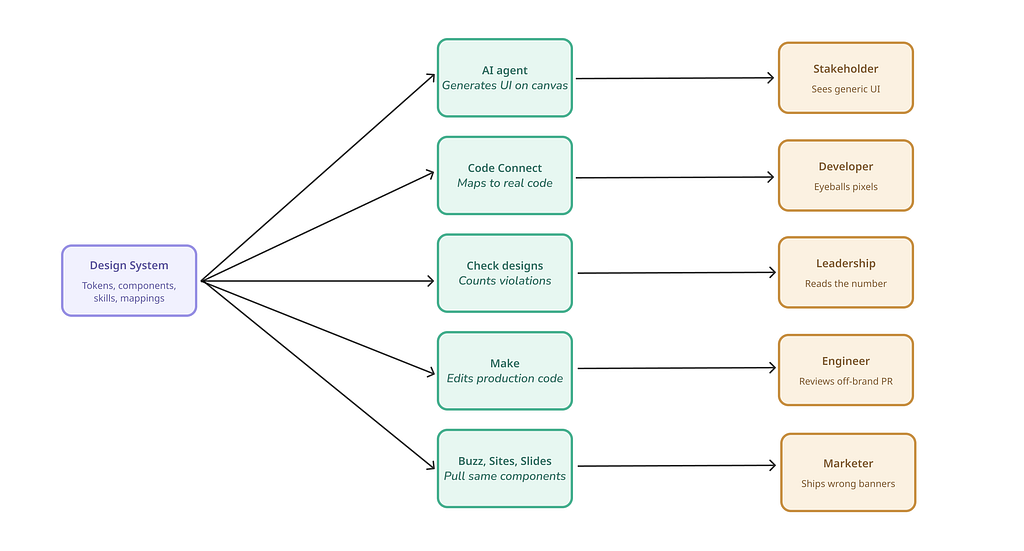
In the first half of 2026, before Config even opened, Figma shipped a native AI agent that generates and remixes UI on the canvas (May 20). It opened the canvas to third-party agents like Claude and Cursor through its MCP server, governed by “skills,” markdown files that encode your team’s conventions so an agent knows to use Button/Primary and never a raw hex value (March 24). It launched the Code Connect UI, which maps Figma components to their real code counterparts so Dev Mode shows a developer your actual React import instead of generic CSS (March 4). It turned Make from a prototyping toy into something that edits a production codebase and opens a pull request (May 28). Then on June 4 it shipped Check designs. At Config itself came Figma Motion, agent-built WebGPU shaders, and slot guardrails that constrain what can go inside a component (Figma release notes, 2026).
Different surfaces. One input. Every single one reads from your design system, and every single one fails in public when that system is bad.
The agent asked to build a settings screen without a clean library and skill files produces something plausible and generic, using none of your components. Figma’s own launch post admitted agents without that context feel “unfamiliar and generic.” That generic screen does not stay in your file. A stakeholder sees it in a review and decides that is what your team produces. Code Connect with no mapping leaves the developer back where they started, eyeballing pixels, except now the gap has a name and the name is the empty mapping you never filled in. Make pushes an off-brand change into the repo, and the people who feel it are engineers reviewing the PR. Slot guardrails are only as good as the system defining the slot. A messy system does not just sit there quietly anymore. It propagates, fast, into code, into prototypes, into 200 templated marketing banners that all came out wrong from one bad template.
The number nobody can argue with
Check designs is the sharpest of these, and most Config recaps undersold why.
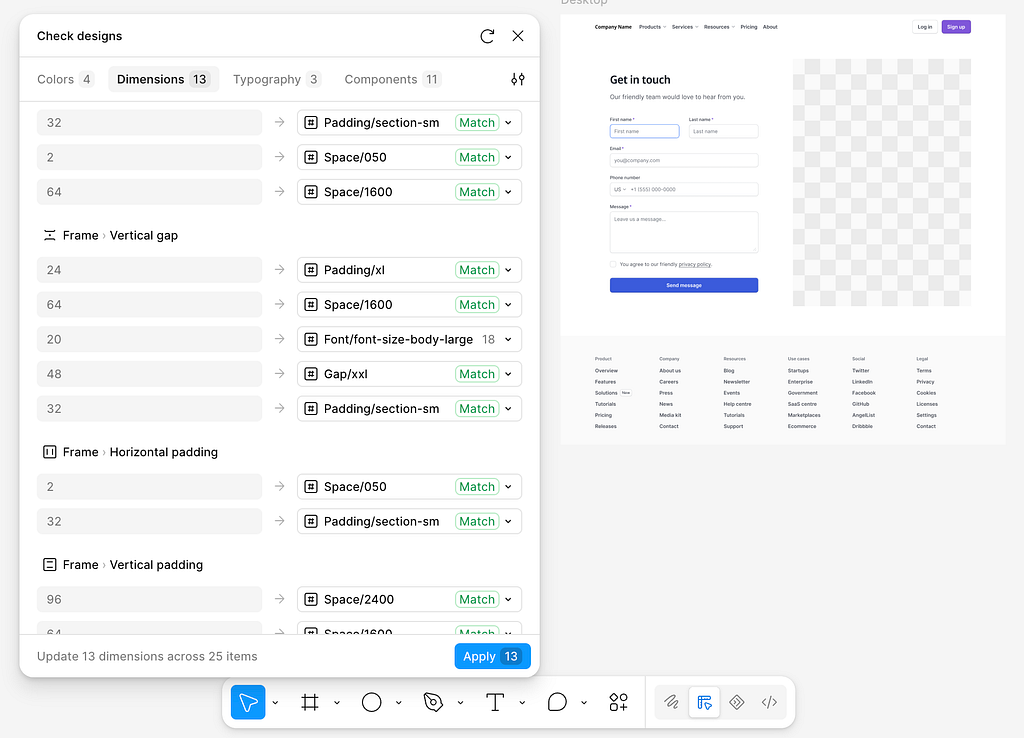
It compares a file against your design system and flags everything that does not match: hard-coded values that should be tokens, contrast that fails WCAG, detached components, tokens from libraries the file is not even subscribed to. And here is the part that matters: it does not use AI. It does not interpret or guess. It counts (Figma Learn). When it opens, a total sits at the top of the panel.
For years, “our design system has drift” was a sentence. Soft, deniable, easy to defer. Now it is a number on a screen anyone in a review can see. Forty-seven inconsistencies in one file. Then the next file. Then the file the contractor shipped last sprint.
A sentence loses the roadmap fight. A number that keeps climbing in front of stakeholders does not lose the same way.
This is the real shift. Design system debt used to be paid by one person, quietly, in files nobody else opened. Now it gets paid by the engineer whose generated component is wrong, the PM whose timeline slips because handoff broke, the marketer whose banners came out off-brand. The cost moved out of your corner and into theirs. Designers have argued for years that a design system is not a deliverable but a product that needs governance, funding, and an owner, with Nathan Curtis’s team models the usual reference point (Audrey Hacq, Everything you need to know about Design Systems). The argument was always correct and almost always lost, because the people who held the budget never felt the failure. Now they do.
The gap Config did not close
Here is where I stop being optimistic.
Visibility is not authority. The person who understands the system best is rarely the person who controls the roadmap. The parts of a design system that actually decide whether it survives are the invisible ones, the processes, the review and approval models, the question of who owns it, and those are exactly the parts that never show up in a demo (Teresa Mira, 7 requirements of a holistic Design System). You can run Check designs, screenshot the number, and walk into planning with the cleanest evidence you have ever had, and still watch a director decide the feature ships first and the cleanup waits. Evidence does not grant standing. It just removes one excuse.
And the tooling has its own honesty problem. Within days of launch, designers were on the Figma forum pointing out that Check designs flags intentional exceptions as violations: annotation colors, developer notes, disabled states that are not required to pass contrast (Figma Forum).
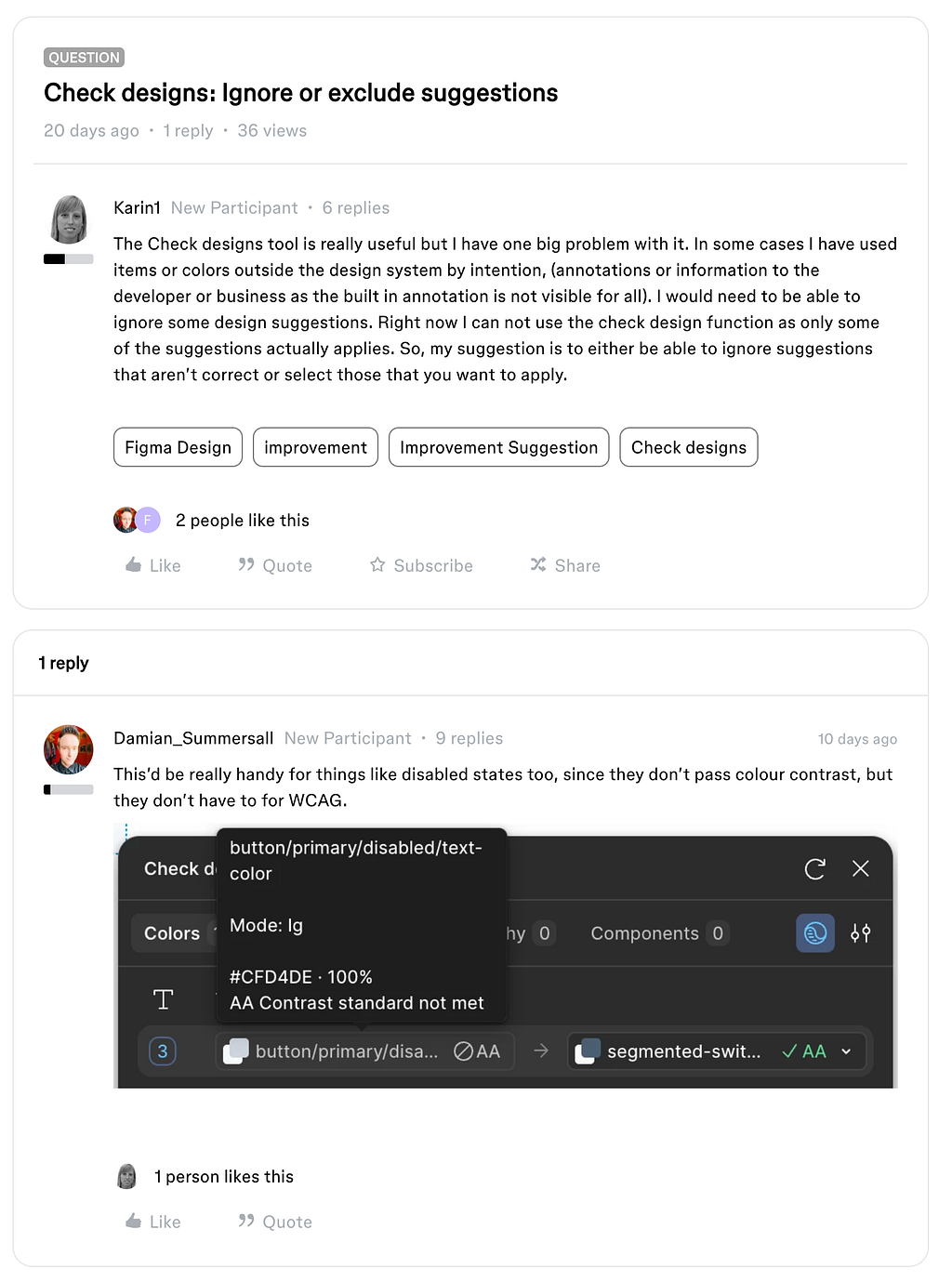
There is no clean way to mark “this one is on purpose.” So the number is real, but it is not pure. Hand a skeptical executive a count that includes false positives and watch them use the false positives to dismiss the whole thing.
A count is leverage. It is not a strategy. The work of separating signal from noise, of deciding which violations are debt and which are intent, still falls on the person who already could not get the time to do it.
What I would actually do with this
Stop pitching the design system as craft. Craft loses to features every time, because craft sounds like preference. Start pitching it as the dependency under every AI feature leadership just got excited about at the keynote. The agent, the code handoff, the production editing: none of it works on a broken system. That is not a design argument. That is a delivery argument, and delivery is a language the roadmap room already speaks.
Run Check designs on your worst file before the next planning cycle, not your best. Bring the number. Then bring the second number, from the file a non-design-system person shipped, so it is not your work on trial. Make the cost theirs, because now it actually is.
Then watch what happens. Because Config 2026 handed the design system lead something we never had: proof that the failure is shared. It did not hand us the authority to act on it. Figma gave you a seat at the table and a number to put on it.
Whether anyone in that room lets you spend it is a different question. And it is the one nobody at Config was on stage to answer.
Figma just made your design system debt everyone’s problem. Now use it. was originally published in UX Collective on Medium, where people are continuing the conversation by highlighting and responding to this story.


