

Productivity is the floor of AI’s value, not the ceiling. New McKinsey research on where the durable returns actually live, and what that means for teams deciding what to build.

At the end of 2025, almost nine in ten organizations surveyed by McKinsey in The state of AI in 2025: Agents, innovation, and transformation reported using AI in at least one business function. Ninety-four percent reported they were not yet seeing significant value from those investments.
That gap, examined in “Where AI will create value and where it won’t” in the April 2026 issue of McKinsey Quarterly, is not an adoption problem. It is a framing problem. Most companies are using AI to do their existing work faster, when the durable returns require a different kind of work entirely.
A team I spoke with recently had compressed their discovery cycle from six weeks to ten days using AI. They were proud, and the throughput was real. When I asked what the work had taught them that they did not already believe, the answer was: not much. Same questions, faster. Same answers, sooner.
Across the teams and founders I work with, the questions are getting smaller. From “what is worth building?” to “how can we test this faster?” From “Is this the right problem?” to “Can we synthesize these interviews more efficiently?”
Joe Smiley described the same dynamic in his UX Collective article, The Most Popular Experience Design Trends of 2026. AI, he wrote, “collapses the time between idea and artifact, which feels like progress. But when everything can be generated instantly, teams skip over the foundational parts of the design process: framing, research, and exploration.”
The strategic questions that once sat at the front of discovery have quietly moved to the back. Sometimes nowhere at all.
The Productivity Reflex
McKinsey argues that productivity gains are mostly defensive. Competition erodes them. Customers, not companies, capture most of the surplus.
Productivity resets the floor of industry performance, not the ceiling. It is real, and it is table stakes. Which means that if your AI strategy stops at productivity, you are running fast on a treadmill everyone else is on.
A Familiar Pattern, Extended
Readers may recognize the underlying parable. Ajay Agrawal, Joshua Gans, and Avi Goldfarb tell the story in Power and Prediction. I drew on the same parable in my earlier UX Collective article, When Building Software Became Easier With AI, Deciding Became Harder.
When factories first installed electricity, productivity barely moved. Manufacturers replaced steam engines with electric motors and kept the line-shaft layout. The breakthrough came later, when they redesigned the factory around what electricity made possible. The technology was only part of the answer.
McKinsey extends that parable into a model of three overlapping waves of AI value. The first is productivity, where AI accelerates existing work. The second is differentiation, where AI enables new offerings, business models, and customer experiences. The third is transaction-cost reduction, where AI reshapes market structures themselves: how customers discover providers, how intermediaries earn margins, and how value chains hold together.
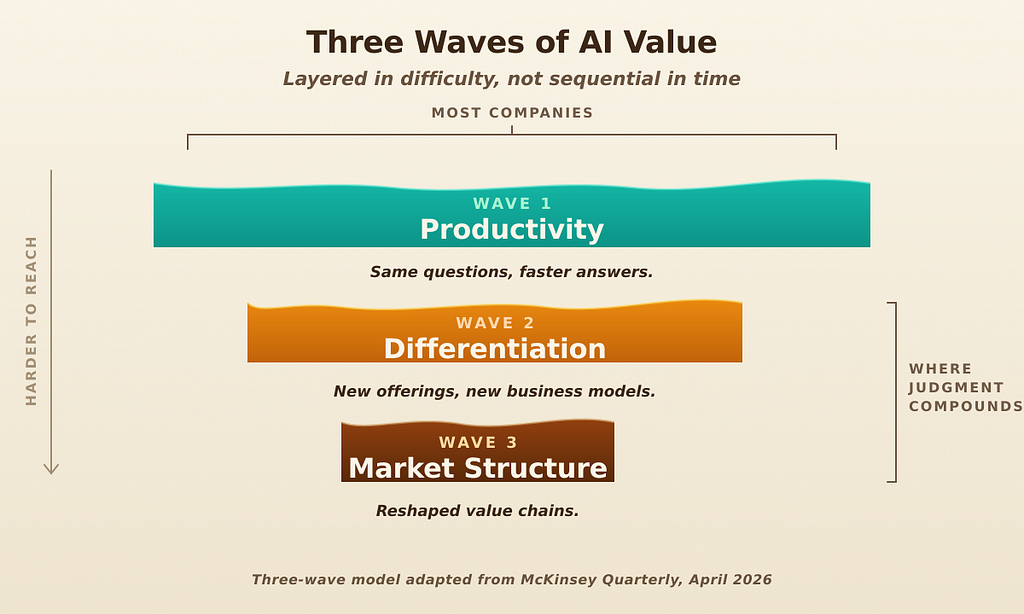
The waves are layered in difficulty. Productivity is easiest because you do not have to make any new decisions. Differentiation requires deciding what is worth offering at all. Transaction-cost reduction requires bets about how an industry will change.
The further you go, the more the question shifts from how to do the work faster to what the work should be.
Where Productivity-Thinking Fails Teams
Teams and founders are unusually exposed to this trap because discovery appears to benefit from productivity gains.
Interviews can be automatically transcribed and clustered. Assumptions can be mapped from notes. Opportunity trees can be drafted from a prompt. All of it is genuinely useful.
But there is a difference between doing discovery faster and doing discovery differently. The second is where the harder questions live.
José Torre wrote about the same dynamic in his UX Collective article, A Sharp Tool Can Still Ruin the Cut, in the context of design craft. AI, he wrote, “lets you move so fast that you skip the moments where attention and judgment matter most.”
The principle extends. Speed without changed questions does not produce changed answers.
Compressing a six-week cycle into ten days only matters if the team is asking different questions, considering different opportunities, or testing different assumptions than they would have before.
That is a different kind of discovery problem. It is not solved by faster synthesis. It is solved by changing what you are looking for in the first place.
The Framing Question That Comes First
Most teams and founders are asking some version of the question: “How do we use AI to make our discovery process more productive?” It is the natural question. It may also be the wrong one to lead with.
A more useful starting point: “What would we discover if AI changed what was worth building?”
That is a framing question, not a process question. It assumes that the offerings worth testing, the customers worth serving, and the business models worth pursuing may all look different from what they did three years ago. It treats AI as a force that reshapes the answer space, not just the search speed.
This is the difference between using AI to find better answers to existing questions and using AI to ask better questions in the first place. The first is a productivity practice. The second is a strategic one. They produce very different long-term returns.
Where Productivity Gains Actually Go
The same pattern shows up in workplace research. Erik Brynjolfsson, Danielle Li, and Lindsey Raymond studied more than 5,000 customer support agents who used an AI conversational assistant in their paper, Generative AI at Work.
The headline number was a 14% average gain in productivity. But the average hid the more interesting finding. Novice and low-skilled workers improved by 34 percent. Experienced workers barely moved at all.
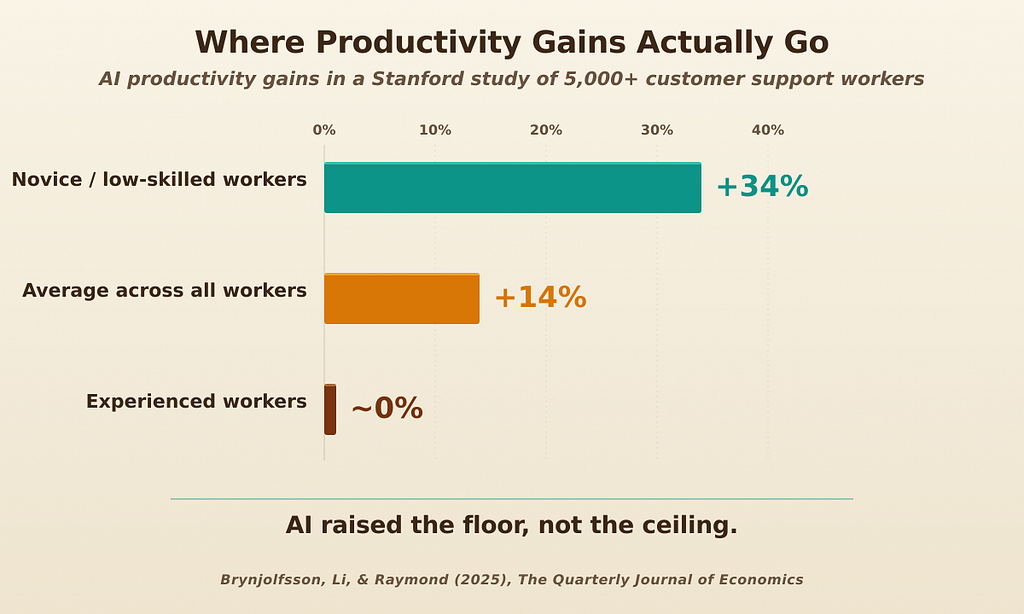
In that context, AI did not raise the ceiling for workers who were already strong at the work. It raised the floor for those who were not. That maps onto the McKinsey argument at a smaller scale: productivity gains often go to those closer to the floor than to the ceiling.
The durable returns come from a different kind of work. In my earlier UX Collective article, The Anatomy of Product Discovery Judgment, I described this as framing judgment: the work of asking, before any artifact is made, which problem is worth solving, which customer is worth serving, and which assumption needs to be tested first.
These decisions are upstream of every artifact a team produces. They are also where AI productivity gains help least, and where human judgment compounds the most.
The Competitive Reset
McKinsey closes with a line worth sitting with. “AI is not a productivity revolution. It is a competitive reset.” The companies that pull ahead will not be the fastest adopters but the clearest thinkers about where value is moving.
For teams and founders, this is a discovery problem before it is a delivery problem. The teams that will matter in three years are the ones that looked at their offerings, business models, and customer relationships and asked harder questions earlier than their competitors did.
Discovery has always been about what is worth building. AI raises the stakes by lowering the cost of being wrong about it.
Why This Matters Now
The pull toward productivity is not irrational. It is the easiest gain to measure, the easiest to celebrate, and the easiest to start.
But the work that creates a sustainable advantage is hardest to start. Asking whether the offering is still the right offering. Whether the problem is still the right problem. Whether the customer is still the right customer. AI does not answer those questions. It just makes them more urgent.
The teams and founders who will look back on this period and feel they used AI well are unlikely to be the ones who got the fastest at their existing work. They will be the ones who slowed down enough to make a good choice.
That has always been the discovery question. The window to ask it has narrowed.
Where to Start
If you want a single diagnostic this week, list the last three significant discovery decisions you made. For each one, ask whether AI’s role would have been the same five years ago. If the answer is mostly yes, you are using AI to do old work faster. Most teams cluster on the mostly yes end. That is the gap.
Two more questions before your next discovery cycle. Whose problem are we trying to understand more deeply? What would have to be true for our current offering to be the wrong one? The first sharpens the framing. The second creates room for the answer to surprise you.
Key Takeaways
• McKinsey’s 2025 State of AI survey found that 9 in 10 organizations use AI, but 94% are not yet seeing significant value, suggesting most are stuck in the productivity wave.
• McKinsey identifies three waves of AI value: productivity, differentiation, and transaction-cost reduction. The durable returns come from the second and third waves.
• Stanford research finds AI productivity gains are unevenly distributed. Novice workers gained 34 percent; experienced workers barely moved. AI raised the floor more than the ceiling.
• Faster discovery cycles only matter when the underlying questions change. The work that builds sustainable advantage is the framing stage of discovery.
• The right discovery question is not how to use AI to find better answers, but how to use AI to ask sharper questions about which problems, customers, and offerings are still right.
References
Agrawal, A., Gans, J., & Goldfarb, A. (2022). Power and prediction: The disruptive economics of artificial intelligence. Harvard Business Review Press.
Brynjolfsson, E., Li, D., & Raymond, L. R. (2025). Generative AI at work. The Quarterly Journal of Economics, 140(2), 889–942. https://doi.org/10.1093/qje/qjae044
Montard, A., Diedrich, D., & Catlin, T. (2026, April). Where AI will create value, and where it won’t. McKinsey Quarterly. McKinsey & Company.
Robins, G. (2025, November). When building software became easier with AI, deciding became harder. UX Collective. https://medium.com/user-experience-design-1/it-seems-anyone-can-build-software-now-how-do-you-build-the-right-software-182057dfa122
Robins, G. (2025, December). The anatomy of product discovery judgment. UX Collective. https://medium.com/user-experience-design-1/the-anatomy-of-product-discovery-judgment-0cb28b28cc7c
Singla, A., Sukharevsky, A., Yee, L., Chui, M., Hall, B., & Balakrishnan, T. (2025, November). The state of AI in 2025: Agents, innovation, and transformation. QuantumBlack, AI by McKinsey. https://www.mckinsey.com/capabilities/quantumblack/our-insights/the-state-of-ai
Smiley, J. (2026, January). The most popular experience design trends of 2026. UX Collective. https://uxdesign.cc/the-most-popular-experience-design-trends-of-2026-3ca85c8a3e3d
Torre, J. (2026, March). A sharp tool can still ruin the cut. UX Collective. https://uxdesign.cc/a-sharp-tool-can-still-ruin-the-cut-b1014292335d
Discovery is the work AI gives back was originally published in UX Collective on Medium, where people are continuing the conversation by highlighting and responding to this story.


