

Harder than you think. And higher stakes than most people building them realise.

If you work in product, you probably care about NPS. Customer satisfaction. Retention. The usual levers. A culturally misaligned chatbot will hurt all of those — and that’s reason enough to care.
But here’s a finding that makes it more complicated.
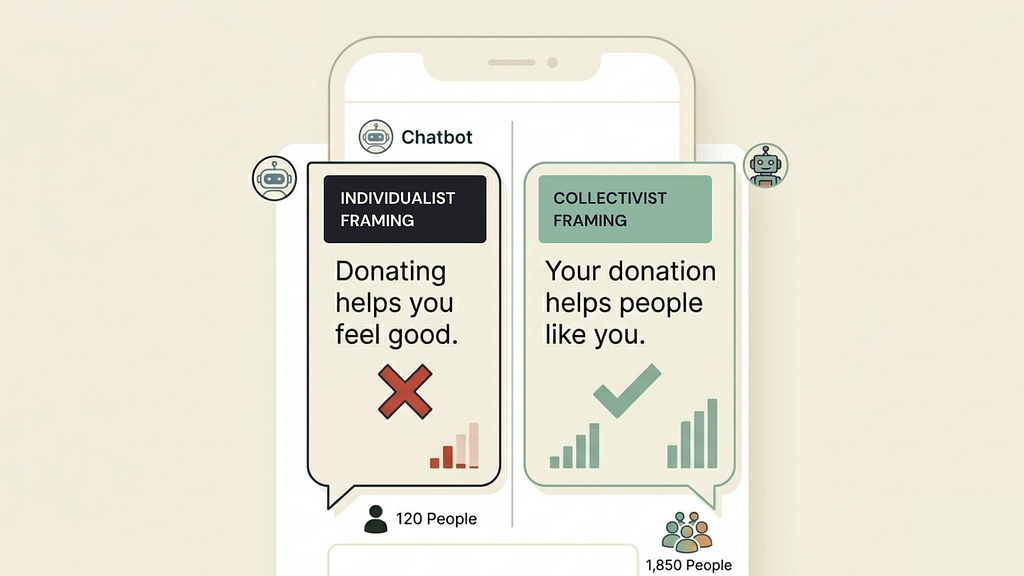
A study across Germany, South Africa, the USA, and India tested culture-tailored chatbot conversation styles in the context of blood donation. Users who scored high on horizontal individualism — where independence pairs strongly with equality rather than hierarchy — actually responded more positively to the collectivist chatbot framing than to the individualistic one.
Not what you’d expect.
The explanation: blood donation is a prosocial behaviour. People donate out of altruism, not self-interest. A chatbot that leads with personal benefit creates what the researchers call a contribution conflict — the framing actively works against the motivation for the behaviour. A collectivist frame (“your donation helps people like you”) fits the psychology of the act better, even for users who would describe themselves as individualistic.
The design implication is specific: when the product is asking users to do something for others, don’t frame it around personal gain. The user’s cultural background matters less than the behavioural logic of the action itself. A chatbot that can’t read that distinction will underperform regardless of how technically well-built it is.
This isn’t a conversion optimisation problem anymore. It’s a design problem with real consequences. Getting the cultural fit wrong doesn’t just reduce engagement. It actively undermines the thing the product is trying to do.
Culture shapes interfaces more than we design for
The evidence here is stronger than most practitioners account for.
A well-documented body of HCI research shows that culture shapes not just user satisfaction but how much mental effort an interface demands, how much users trust a system, and how they make decisions within it. The theoretical foundations go back to Hofstede’s cultural dimensions, Hall’s high- and low-context communication theory, and frameworks on individualism and collectivism. These aren’t abstract academic models. They show up in interface preferences, interaction expectations, and — critically — in whether users trust a product enough to keep using it.
A study on Gov.sg’s chatbot (N = 304) found a clear dependency between a user’s cultural orientation and what they actually needed from the product. High-context users — those who prefer relational, contextual communication — responded primarily to social presence: the sense that the chatbot felt human and relationship-aware. Low-context users responded primarily to performance: speed, accuracy, task completion. Same chatbot. Different things making it work.
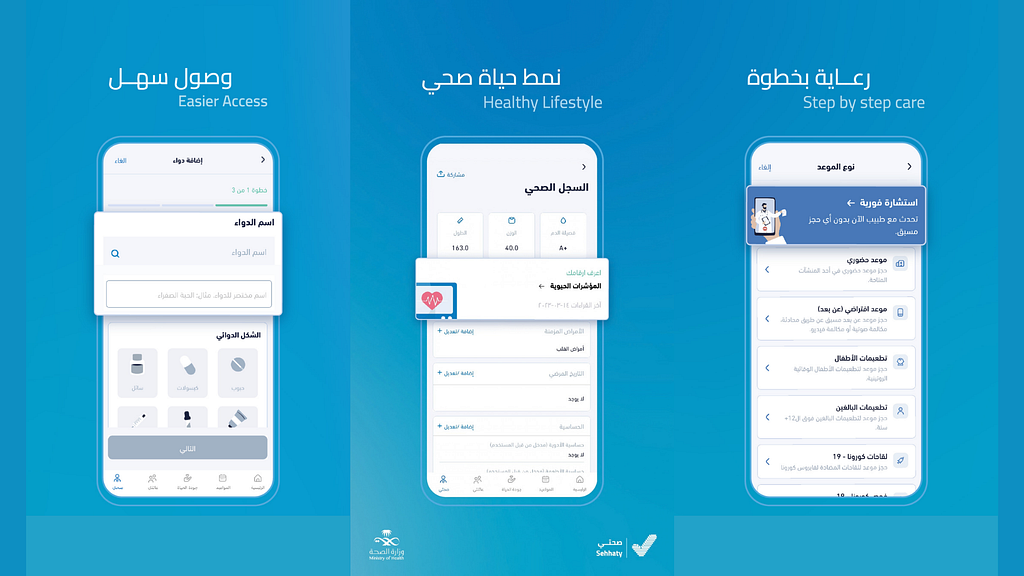
Research on Arab users found that integrating cultural context into mHealth app design significantly improved usability and satisfaction — with layout and icon-based communication outperforming text-heavy designs. Icons allow meaning to land faster than a label does. Font choices mattered less — personal preference and tech familiarity were stronger predictors than cultural background.
The most comprehensive framework to emerge from recent research — the Culturally Responsive AI Chatbot Framework (CRAIF-C),, tested across four interlinked studies — found that AI systems using culturally appropriate communication styles, narrative structures, and tonal patterns consistently produced higher trust and satisfaction across all studies. The conclusion: cultural fit should be a founding architectural principle, not something you bolt on at localisation. You don’t add culture at the end. You build for it from the start.
Hofstede as a set of design levers
Stop treating Hofstede’s dimensions as cultural theory. They’re interface decisions waiting to be made.
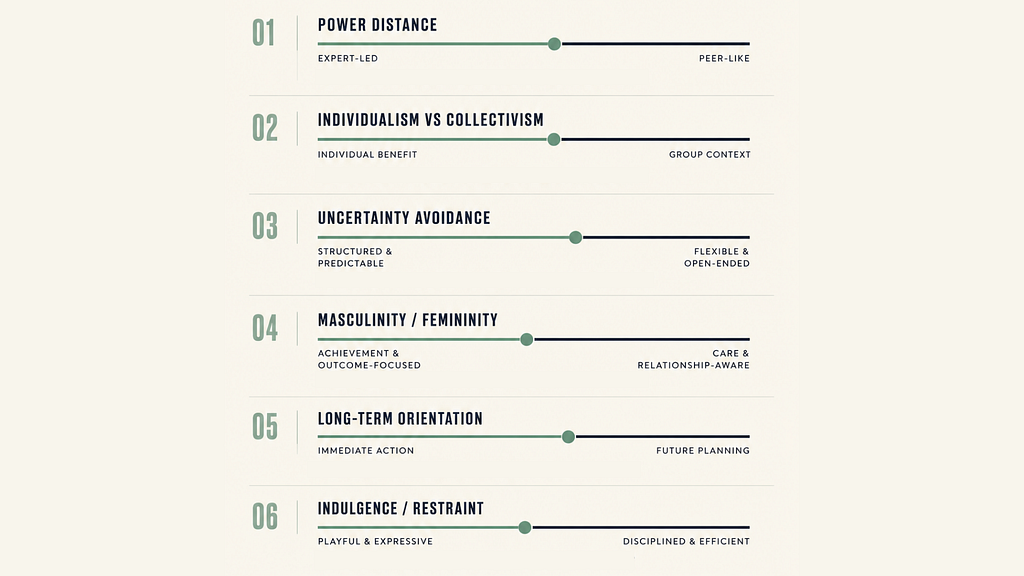
Power distance — how authoritative versus collaborative should the assistant sound? Users from high power distance cultures respond better to structured, expert-led interactions. Others prefer a more peer-like tone.
Individualism vs collectivism — does the interface emphasise personal goals and individual benefit, or group context and shared outcomes? The framing of the same offer can land completely differently depending on which lens the user brings.
Uncertainty avoidance — how much guidance, confirmation, and explanation should the chatbot provide? Users who are less comfortable with ambiguity want structured, predictable responses and explicit reassurance. Others find the same level of hand-holding patronising.
Masculinity / femininity — is the tone achievement-driven and outcome-focused, or care-oriented and relationship-aware? Both are valid. Neither is universal.
Long-term orientation — does the assistant frame advice as immediate action or future planning? Urgency framing lands very differently depending on whether a user’s cultural context prioritises near-term or longer-term outcomes.
Indulgence / restraint — is the interaction playful and expressive, or disciplined and efficient? This shows up in everything from emoji usage to response length to whether the chatbot uses humour.
These aren’t decorative choices. They affect whether the system feels right to the user — and whether they trust it enough to act.
When the stakes are low, misalignment is annoying. When they’re high, it matters.
A culturally misaligned help bot on a small e-commerce site is a friction problem. A user finds it slightly off, works around it, completes the purchase anyway. NPS takes a small hit. Fine.
The same misalignment in a mental health support tool or a public health chatbot is something else entirely.
Mental health: face culture, uncertainty avoidance, and the chatbot that shouldn’t challenge you
Cultural orientation doesn’t just shape preferences. In high-stakes contexts, it shapes whether the product does harm.
A study comparing Sweden and Sri Lanka on trust in AI-powered chatbots for everyday mental wellbeing — non-clinical users managing stress and low-level emotional difficulty rather than diagnosed conditions — found that cultural orientation significantly shaped what users needed from the product.
Sri Lankan users — from a culture with higher power distance, stronger collectivist norms, and a strong orientation toward face-saving — significantly preferred chatbots that avoid challenging user views. A chatbot that corrects or confronts in this context doesn’t feel like good support. It feels socially inappropriate. They also showed higher trust in chatbots that give structured, predictable responses — they want to know what’s coming. But they also, unexpectedly, preferred private interactions. Collectivist values and face culture interact in ways that don’t reduce neatly to a single dimension. You can’t just read the Hofstede score and call it done.
Swedish users showed higher trust in bots that follow strict guidelines — which partially contradicts what the theory would predict. Cultural dimensions are tendencies, not rules.
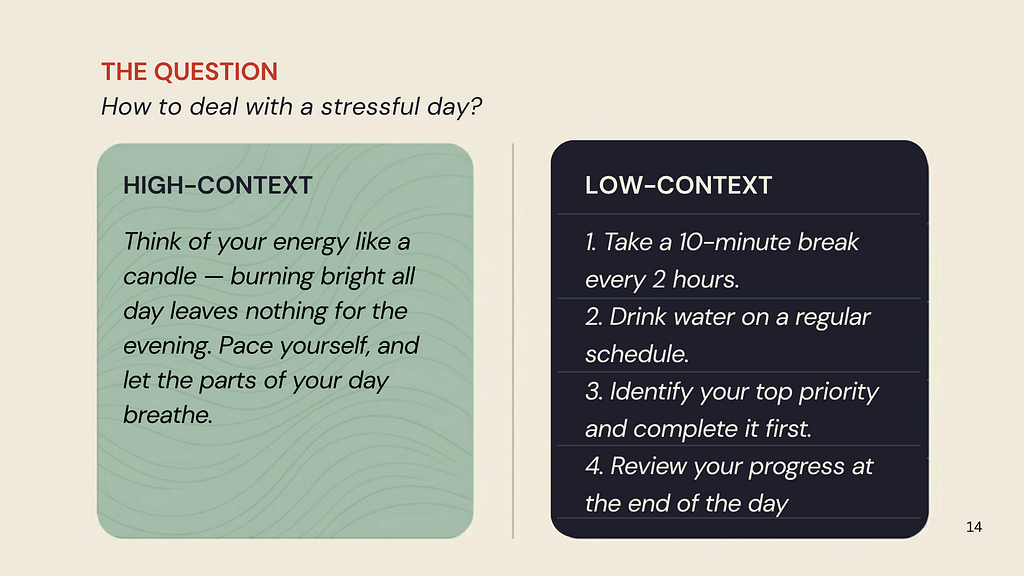
The CRAIF-C research adds a layer that held across twelve months of controlled and live environments: high-context cultures responded better to metaphorical or story-based explanations, while low-context cultures preferred step-by-step analytical formats. It’s not a preference. It’s a consistent pattern.
Getting this wrong in a mental health context isn’t a UX problem. It’s an ethics problem. A chatbot that confronts, challenges, or operates unpredictably when a user is already vulnerable isn’t just less effective. It’s potentially harmful.
Customer service: the universal truths and the cultural variables
Support bots are the most common application — and the one where assumptions about “good AI” are most deeply baked in.
A cross-cultural study ran across USA, Germany, and India on consumer trust in AI customer service found two things worth holding separately.
The universal finding: efficiency and availability were positive predictors of trust everywhere. Regardless of cultural background, users valued AI that was fast and accessible. That’s the baseline. Get that wrong and nothing else matters.
The cultural variables: users who are less comfortable with ambiguity were significantly more suspicious of AI agents and more concerned about oversight and control. More flexible users were more willing to trust automated systems. On warmth and personalisation — socially warm and respectful AI was more likely to be trusted in collectivist cultures, while individualistic cultures placed more value on technical accuracy and getting the issue resolved efficiently.
Same product. Completely different trust levers.
A single interaction model optimised for one cultural context will underperform in others — not because the technology isn’t good enough, but because what “good” means is doing different work in different places.
What this means for how you build
There are still unanswered questions and cultural nuances the research hasn’t fully resolved. But there’s enough to point to a few concrete directions.
Culture is a build decision, not a translation layer. Cultural fit needs to be embedded in the model’s interaction logic from the start — decisions about pacing, explanation style, tone, and how the chatbot handles disagreement or correction. Not added as a translation layer after the product is built.
Cultural dimensions are starting points, not labels. The research treats cultural orientation as something that shapes user behaviour — not as a fixed label applied to a national group. The goal is designing for likely user expectations, not reducing users to a score. Sri Lankan users preferring private interactions within a collectivist context shows that dimensions interact in ways that require judgment, not just a framework applied mechanically.
The stakes determine how deep you go. A slightly misaligned e-commerce help bot is a friction problem. A misaligned mental health chatbot is something else. The stakes should determine how deeply you invest in getting this right.
How you explain matters as much as what you explain. High-context cultures respond better to metaphorical or story-based explanations. Low-context cultures prefer step-by-step analytical formats. If your AI product explains itself — and it probably should — how it explains itself needs to adapt too.
The question worth sitting with
Most AI pipelines — from dataset curation and annotation to model training, deployment, and how the product explains its own decisions — are skewed toward Western mental models and behaviours. That’s not a provocative claim. It’s documented.
The chatbot you’re building probably has defaults. For tone, for directness, for how much it explains, for whether it challenges or defers. Those defaults came from somewhere. They reflect someone’s idea of what good communication looks like.
The question is whether that someone is your user.
Part of the culture, AI & design series.
References:
Dr. Aarti Tushar More: Consumer Trust in AI — Powered Customer Service: A Cross-Cultural Study.
Vik Naidoo, Karman Kaur Chadha: Culturally responsive AI chatbots: From framework to field evidence.
Linali Darsha S Arambewela Arambewelage: The Impact of Cultural Context on User Trust in AI-Powered Chatbots for Everyday Mental Health Support.
Alsswey, A. & Al-Samarraie, H. The role of Hofstede’s cultural dimensions in the design of user interface: The case of Arabic.
Luna Luan Haoyue & Hichang Cho: Factors influencing intention to engage in human–chatbot interaction: examining user perceptions and context culture orientation
Helena M. Müller, Nico Pietrantoni, Melanie Reuter-Oppermann, Reinhard Stefan Greulich: Does Culture Matter for the Design of Chatbots Promoting Blood Donation Behaviour? — The Difference in Perception of Culture-Tailored Conversation Styles
How difficult could it be to design a chatbot? was originally published in UX Collective on Medium, where people are continuing the conversation by highlighting and responding to this story.


