

Once an obscure job title, creative technology is becoming a new way of working, and a core capability inside modern product teams. Soon, many of us may be working this way.
As AI collapses the distance between idea and implementation, companies are looking for people who can move across design, code, systems, and storytelling.
Let us begin by disambiguating the Creative Technologist role. Everyone references it as though we all know what it means. But when I ask people to define it — with specificity — most cannot.
And it’s understandable, the role is legitimately hard to pin down. It has existed for decades, mostly in advertising agencies, research labs, and experiential studios. It has also gone by many names: UX engineer, design technologist, creative developer, UX prototyper, and design engineer. The taxonomy is a mess. Even people who hold the title admit it can sound entirely made up.
But the Creative Technologist is having a renaissance. The role is being pulled from the artistic margins into the center of the machine, and understanding its origin story and direction tells us something about where many creative careers are going.
So let me try to disambiguate it.
Instead of beginning with definitions, let me start with a person.
On a recent Google Flow creator community call, the guest was Tina Tarighian, a Senior Creative Technologist at Google Creative Lab in New York. Her first-person essay, “WTF is a Creative Technologist?”, published by Will Zimmerman’s 3rd Space, is one of the clearest accounts of the role I have read. If you read one other piece on this subject, make it that one.
Her path: a nationally ranked competitive debater in high school. A political science major who thought she might become the next Hillary Clinton. A computer science degree that made her “actually study, sob, and then study some more.” A hedge-fund internship in Tokyo that felt like wearing someone else’s shoes. A psychic who pulled her off the street to tell her she was in the wrong career.
Then a net artist in Greenpoint taught her JavaScript. She was broke enough to walk 45 minutes to his studio rather than take the train. She began cold-pitching companies with creative technology ideas. Her first paid project was a virtual try-on filter for a compression-underwear brand. She was paid almost nothing and remained, in her words, “insufferably giddy for weeks.”
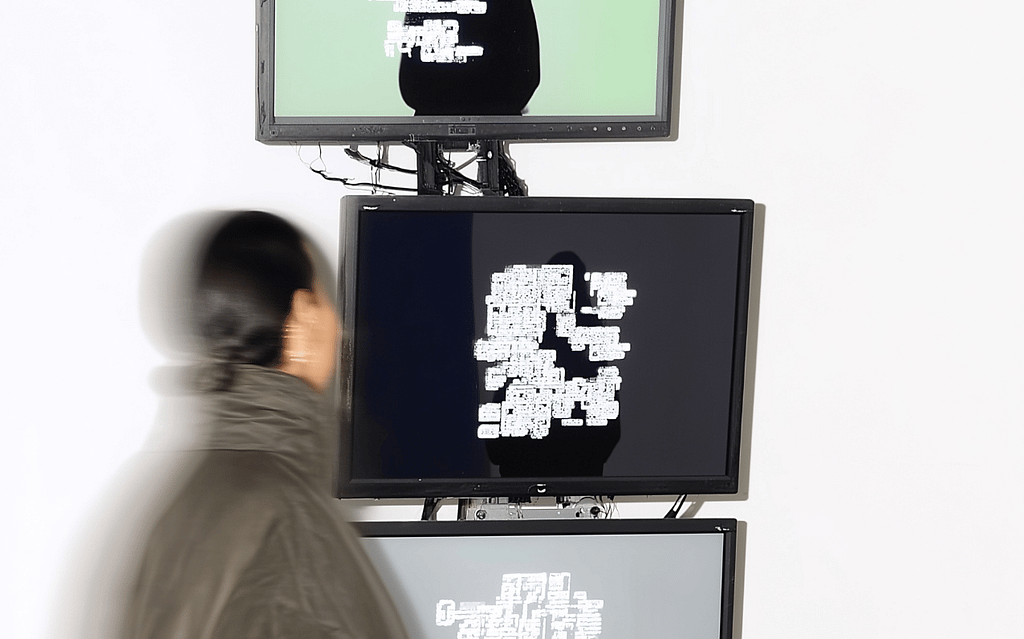
She cold-messaged a musician the day before he started a band and ended up live-coding visuals at its debut show. One project turned into ten: a New Museum residency, fashion-show installations, gallery work, and her own runway shows. When she missed her no-contact ex-girlfriend, she built an email lottery with a tiny chance of actually sending her note. Five million people saw it, and people in more than 100 countries used it.
Now she works at Google Creative Lab, demonstrating tools built over a weekend to arenas of thousands, collaborating with Paris Hilton on ADHD-friendly apps using Gemini, and presenting on the main stage at Google I/O.
Here is how she describes the actual work:
“We are writing the first draft of what a technology means, sitting with something new before the obvious use cases have had a chance to calcify, and trying to find something meaningful in it.”
That is the role: writing the first draft of what a technology means.
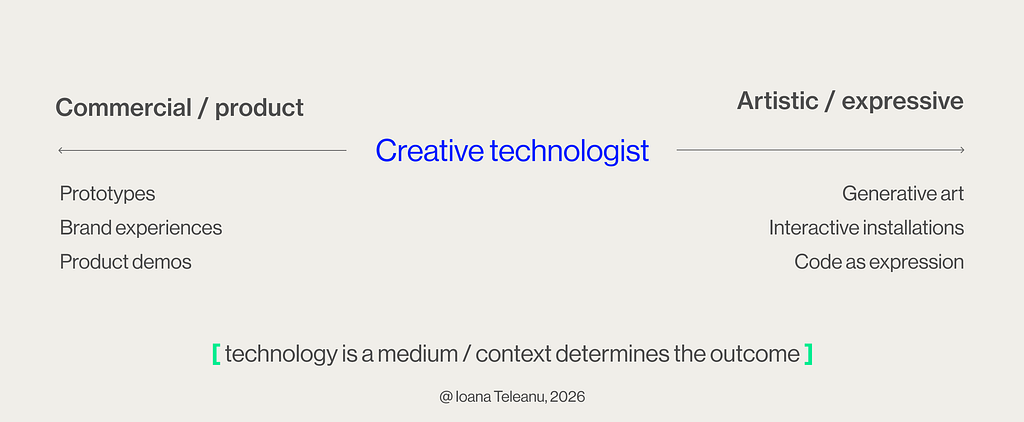
The two ends of the spectrum
Tina maps the field better than any formal taxonomy I have found.
On one end is the commercial version, shaped by the dot-com boom, when companies needed people who could “talk to people and computers with the same suavity.” Some lean toward hardware, some live in the browser, and some build strange physical objects that end up in advertising campaigns. The through-line, in her words, is that “they’re technical enough to build and perspicacious enough to know what’s worth building.”
On the other end are people using technology primarily as an artistic medium. Think of Refik Anadol turning data into large-scale immersive environments, generative systems that feel alive, or Tina’s email lottery: code used as emotional expression. “What we all have in common,” she writes, “is that we are using technology as our primary medium to say something, not to ship products.”

Blair Neal, a veteran of the field who spent years at the experiential studio Fake Love, has been documenting this territory for more than a decade. His “Advice for Creative Technologists” is canonical field reading, and his writing on creative technology inside organizations offers the explanation I would give my parents:
“I am an artist, and just like a painter’s medium is the full range of paint types and canvases, my medium is technology itself.”
Neal also created A Creative Technology Taxonomy, a large map of what a senior creative technologist might need to understand, from projection mapping and sensors to game engines and machine learning. Not everything needs to be mastered. The value of the map is that it provides a knowledge foundation for making informed choices about which technologies serve which experiences.
So when someone asks what a Creative Technologist is, the sincere answer is: someone whose medium is technology itself. Sometimes that medium is applied to commerce, sometimes to art, and often to an in-between space without a clean name.
A brief history: 60 years of the same person with different names
The thing that gets lost in the “hot new role” discourse is that this archetype is not new. Its origin story goes back six decades, and tracing it reveals something important about where it is heading.
1966: the founding moment. Bell Labs engineers Billy Klüver and Fred Waldhauer teamed up with artists Robert Rauschenberg and Robert Whitman to stage 9 Evenings: Theatre and Engineering at the 69th Regiment Armory in New York. Ten artists, including John Cage and Yvonne Rainer, worked with more than 30 Bell Labs engineers and scientists. The performances used closed-circuit television, infrared cameras, Doppler sonar, and other emerging technologies. The collaboration led to Experiments in Art and Technology, a nonprofit built around pairing artists and engineers. This is one of the clearest institutional origin points for creative technology.
1973: the academy takes over. Muriel Cooper co-founded the Visible Language Workshop at MIT, exploring how computation could transform graphic design, typography, and publishing. The workshop later became one of the founding research groups of the MIT Media Lab. The question moved from “Can artists use technology?” to “Is computation itself a design medium?”

1996–2001: the medium gets its language. John Maeda led the Aesthetics + Computation Group at the Media Lab and argued that designers should understand the computer as a medium, not just a tool. His Design by Numbers project taught programming to visual artists. Two of his students, Casey Reas and Ben Fry, later created Processing, a digital sketchbook where designers and artists could code. As documented in AIGA Eye on Design’s oral history of Processing, it became both a software environment and a worldwide creative-coding community. In parallel, the dot-com boom produced the commercial variant: companies needed people who could move between technical infrastructure and creative intent.
2005–2015: the agency golden age. Arduino made hardware experimentation more accessible. openFrameworks and Cinder gave creative coders professional tools. Flash turned the web into an expressive playground. Agencies such as R/GA and Wieden+Kennedy, alongside studios such as Fake Love, helped build the experiential-marketing industry around creative technologists. Interactive installations, projection mapping, and sensor-driven brand experiences made “Creative Technologist” a role people could apply for, even when few people outside the field understood it.
2015–2022: fragmentation. The role splintered as product companies absorbed parts of it. Amazon used Design Technologist. Google used UX Engineer. Startups used Creative Developer. Product-focused branches moved toward what the industry now frequently calls Design Engineer. The artistic branch continued independently, from large-scale data sculpture to small experimental internet communities.
2022–now: the AI renaissance. Companies suddenly hold technologies whose cultural and experiential meaning has not yet been written. The capability that Experiments in Art and Technology cultivated in 1966 — sitting with a new technology before its use cases calcify and finding something meaningful in it — has become scarce again.
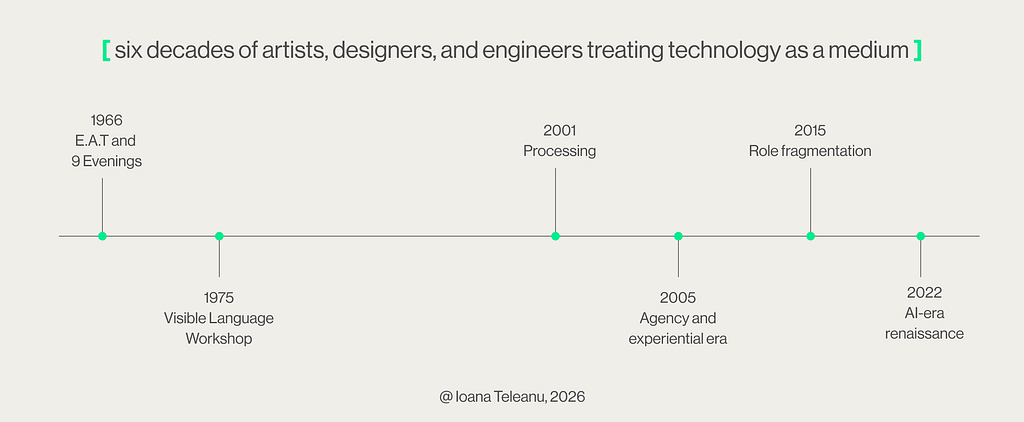
The pattern across these decades is consistent: every time a genuinely new technology arrives — video, computation, the web, physical computing, AI — the people who figure out what it means are often the ones who treat it as a medium rather than just a tool. The names change. The disposition does not.
How it maps against adjacent roles
Where does this sit relative to the other roles emerging around design and technology?
Here is my attempt at an ontology.
Creative Technologist: the broadest and most experimental role. It combines technology, creativity, and strategy across hardware and software, installations and browsers, art and advertising. It is comfortable with the question, “What could this technology mean?” before anyone knows what to build. Google Creative Lab is one archetype: its roles have described work translating early-stage technologies into tangible, engaging experiences.
Design Technologist: the product-focused version. Companies such as Amazon and eBay have used this title for roles involving heavy prototyping, design systems, and UX engineering. It is generally more structured and less open-ended.
Design Engineer: the most production-oriented version. It combines product design, front-end code, and the craft of shipping interfaces. Companies such as Vercel, Stripe, Cursor, and Lovable have helped make the title increasingly legible in product teams.
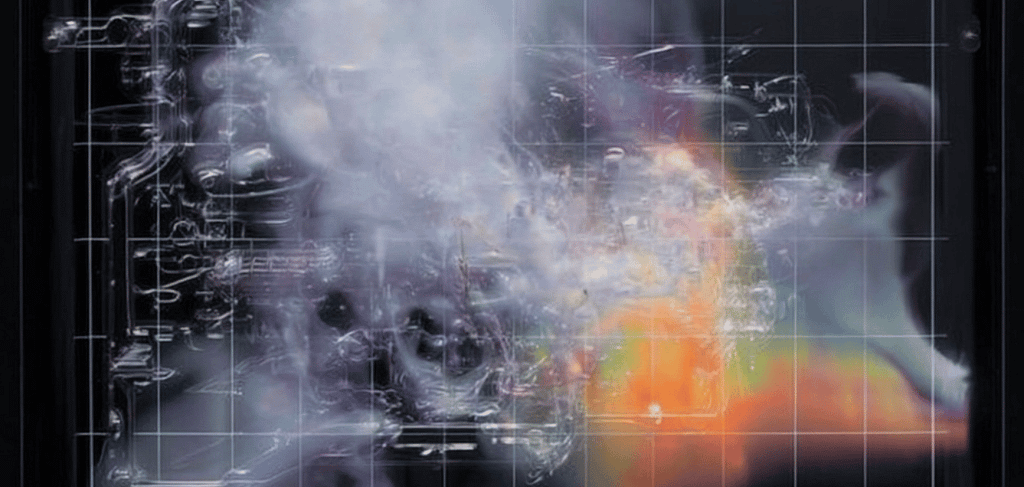
The boundaries are porous, but the orientation differs. The Creative Technologist asks, “What could this mean?” The Design Engineer asks, “How do we ship this well?” One writes the first draft of a technology’s meaning; the other makes sure the final draft is crafted.
Compensation is difficult to compare because the titles describe inconsistent scopes. A Google Creative Lab listing, for example, advertised a US base salary range of $162,000–$247,000, while broad salary aggregators combine very different kinds of Creative Technologist roles. The more useful conclusion is not that one title is inherently more valuable than another, but that organizations pay more consistently for roles whose production responsibilities are already legible.
But I think that’s about to change.
Why this role is having a moment
Three things are converging.
First: AI needs first drafts. Every company suddenly has access to technologies whose obvious use cases haven’t calcified yet. Models drop monthly. Capabilities shift weekly. And the question inside every organization is exactly the one Creative Technologists are trained to answer: what does this mean for us? Tina describes the actual brief at Google: a new model drops internally, and the ask is some version of “help people feel something other than dread about this”. That is the job now, at every company.
Second, AI has lowered parts of the technical barrier, democratizing the technical layer. The earlier Creative Technologist often needed Processing, openFrameworks, C++, custom shaders, and hardware expertise. Those barriers kept the role relatively niche. A new generation can prototype with coding agents and generative models, although expertise still determines whether those prototypes become robust, responsible experiences. Adobe’s recent report, “The evolving role of the Creative Technologist,” describes the role as connective tissue across creative, engineering, marketing, and other teams — and as a missing layer in many enterprises.
Third: the doing is being celebrated. Tina again: “My fellow CTs are being flown out to give talks, poached mid-job with huge pay bumps, and inundated with DMs from startups begging them to find a use for their product.” The people who were building weird internet art for years are suddenly the most in-demand profile in tech. Product teams at Google. Design systems at Apple. Experimental storytelling at A24 in partnership with DeepMind.
The margins moved to the center.
Will we all become Creative Technologists?
Here is the question behind the question, and my current answer: not necessarily in title, but increasingly in how we relate to technology.
Tina makes an observation that stays with me:
“Today, kids are building entire worlds in Roblox like it’s a normal extension of playing. People are making little tools for their friends, their classrooms, or their own weird niche problems. No one waits for permission or funding or someone to translate their idea into code. Coding just feels like… a thing people do now.”
Her conclusion is that “Creative Technologist” may become less of a mutant profession that requires explanation and more of a way of relating to the most pervasive medium on earth.
That’s the real thesis. The Creative Technologist was never really a job title, it was an early name for a relationship to technology that’s now becoming universal: technology not as an industry you work in, but as a medium you think with.
If you’ve been following this newsletter, you’ll recognize the pattern. The vibe-coded portfolio issue: designers shipping real products as self-expression. The Design JD issue: companies asking designers to “stay close to the models” and “invent patterns that feel native to AI”. The Forward Deployed Designer issue: designers embedding with teams to write the first draft of a solution. All of these are the Creative Technologist archetype leaking into every creative role.
A widely cited Gartner finding reported that 41% of employees already function as “business technologists,” creating technology or analytics capabilities outside traditional IT departments. The category is broader and more operational than creative technology, but the underlying trajectory is indicative: making with technology is no longer confined to a specialist enclave.
What this means for you
You don’t need to change your title. You need to notice whether you’re relating to technology as an industry or as a medium.
The industry relationship: you follow the tools, learn what you must, wait for the use cases to be defined, and then execute within them.
The medium relationship: you sit with new technology before its meaning has crystallised. You build small things to understand it viscerally. You ask what it could mean, not just what it does. You use it to say something.
The second relationship is what Tina found through nightclubs and net art. It’s what Blair Neal describes as choosing technologies “in thoughtful ways that honor the person experiencing something”. It’s what I keep trying to practice with every experiment I run and every “unsolicited” prototype I build.
It is learnable. It can start with one small project in which you use technology to say something, instead of simply shipping something.
That is the whole practice. The title is optional.

further reading
- WTF is a Creative Technologist? — Tina Tarighian, 3rd Space / the essay this issue is built around, read it in full
- Advice for Creative Technologists — Blair Neal / the canonical field guide from a veteran
- A Creative Technology Taxonomy — Blair Neal / the map of everything the field touches
- Creative Technology and Organizational Structures — Blair Neal / how CTs fit inside companies
- The Evolving Role of the Creative Technologist — Adobe / the enterprise perspective
- How to Become a Creative Technologist in 2026 — Ayca Turan / a practitioner’s guide
- What the Heck is a Creative Technologist? — John Evanofski / the in-house product version at Gap
- The Best Paid Emerging Creative Roles in 2026 — Creativepool / the market data
- aesthetic.computer — Jeffery Alan Scudder / the collaborative web art platform where Tina learned to build
- Experiments in Art and Technology (E.A.T.) / the 1966 origin of it all
- Processing: the Software that Shaped Creative Coding — AIGA Eye on Design / how the medium got its language
Are you relating to technology as an industry or as a medium, and do you see the Creative Technologist disposition emerging in your own practice? Would love to read everyone’s thoughts.
Originally published at https://aigoodies.beehiiv.com.
Creative Technologists are moving from the margins to the center was originally published in UX Collective on Medium, where people are continuing the conversation by highlighting and responding to this story.


