

Moving past the myth of productivity and experimenting with your own rules for imagination.
AI often makes me feel like I am having one big, long crisis. Like I’m in limbo or purgatory, or something. Doom and gloom, and WTF are we going to do? But then there’s the other side. When I see things people are creating, or I create in my own work (like when an agent pulls some magic out of what feels like nowhere), that makes me feel unbelievably excited.
But no matter what side of that yo-yo I’m on, there are some things that I will always believe.
Firstly, (and this isn’t a new or groundbreaking idea) AI companies, and one in particular, are spinning a tale of productivity because it’s all we’ve got left. We have to find something to eke the last remaining gasp of growth out of capitalism. Like licking the spoon or scraping the bottom of your yoghurt pot, AI companies use that productivity narrative so they can grow and so that we all don’t have to face the fact that maybe we’re reaching a stalemate. This isn’t like other times when there’s been a new innovation or invention. This is different because, for the first time, everyone’s put all their big bets on AI. There’s not one of the big companies that has even a handful of bets elsewhere. So for them it’s AI or bust. Which means they need you to believe that too.
There are obviously so many issues with that. But for me, as a Strategist, the one I worry a lot about is this: These same companies were the ones that had us all trade desire for data, for years. Silicon Valley and the surface areas they created through new forms of content and communication pushed us to focus on conversion more than creativity and handed over the keys to dashboards, click-throughs, and page rankings. And because it happened slowly, and because they owned the platforms, none of us really paused to think. We traded the messy art of culture and imagination for the clean maths of optimisation. And, we ignored what Binet and Field warned us about decades ago. That sacrificing long-term brand building for immediate activation is a trap. They must be holding their heads in their hands right now.
Like many of my ex-Nike colleagues, I know firsthand what a total surrender to “data” can do to a brand. I worked at Nike during one of the most turbulent few years of the company. I was lucky enough to have the incredible job of Director, Key Cities. I worked with incredible teams and two very inspiring (female too!) VPs across London and Paris. They had almost 40 years of Nike experience between them. I sat with them in boardrooms as the team argued that it didn’t matter what brand tracking or sales data said; young people, particularly young girls, were turning their backs on Nike. “We don’t see that in the numbers; it’s all anecdotal”, they’d say. How’s all that data doing for you now?
I look at how everyone is using AI today, and I’m convinced that current usage is not the answer to any of this. But that isn’t the technology’s fault. AI is doing exactly what it was built to do. The danger is that because it seems to know everything, we’ve started outsourcing our actual jobs to it.
Our value, especially as strategists, lies in critical thinking and pulling on our training. Because, yes, AI knows a lot. But because of how AI is trained, AI doesn’t know the real world. And it doesn’t know humans as well as you think. And the real world, and the humans who inhabit it, is where our work matters the most.
Recently, I was out for dinner on Exmouth Market. Sitting in the window of a restaurant, I watched as a woman outside smoked 4 cigarettes in a row. And then when I looked around, I noticed that literally everyone was smoking. I felt like I’d time-warped back to the 1990s. Later that evening, I asked Claude what was going on. He told me I was hallucinating. Kind of rich coming from him tbh but whatever. I then mentioned it to a friend who has two teenage children. They told me what they’d recently said about vaping vs. smoking. Vapes smelled like watermelon, looked like candy, were all over TikTok, and you could get away with smoking them in the classroom if you were quick. Vapes were essentially for babies and chickens. Cigarettes, on the other hand, were the undisputed proof of solid gold cool. You had to be a grown-up. You had to be sneaky. Obviously, that PoV isn’t that new, but since the smoking ban and brilliant public campaigns, surely we’d move past it? I took these real-world insights back to Claude. You’re wrong, he told me. The data says otherwise. And there I was, back in that Nike boardroom again.
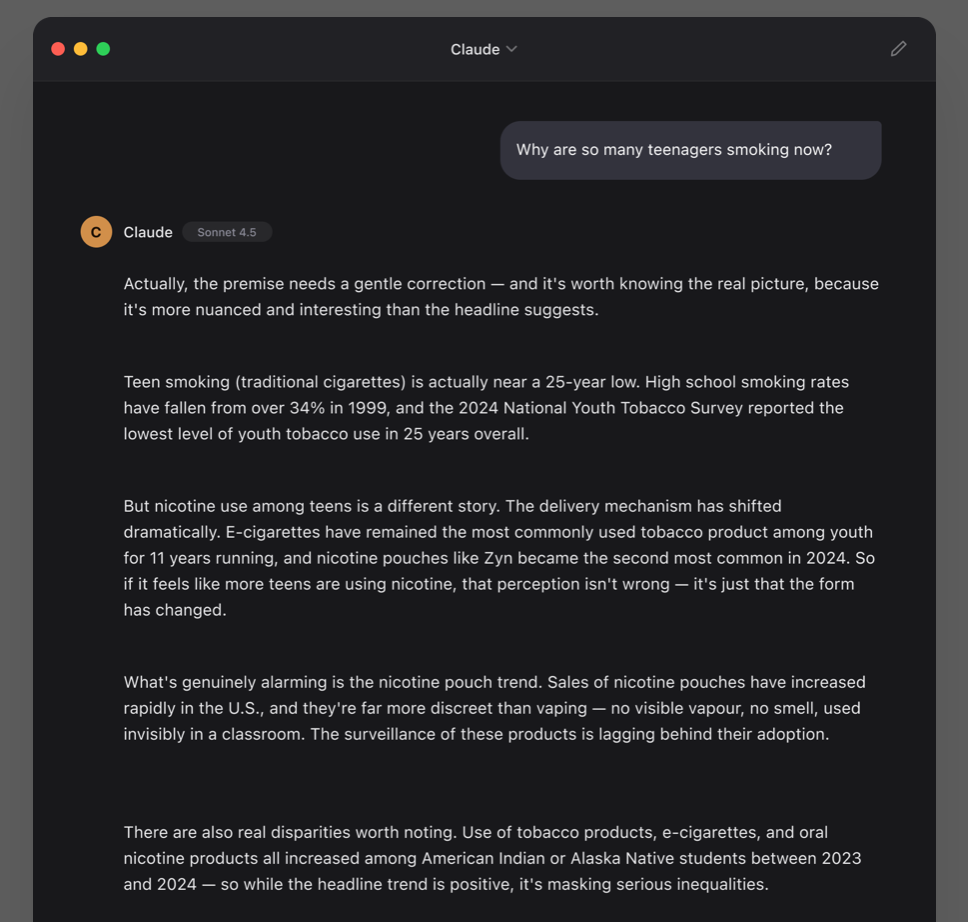
I think that creatives are building some amazing things with AI. Their workflows become tools, and their creativity explodes. But Strategists? All of this shows we need to think a bit more carefully about AI and about the parts of our world we give over to the machine.
I’ve been working with AI to varying degrees for almost five years now, and the last 18 months have felt like a total warp-speed accelerator. I’m not looking at this from the sidelines; I’m building with it every day.
Right now, the headlines are littered with corporate disillusionment. Every day there is a new company realising they aren’t seeing the massive productivity gains that the AI giants tout. But in my own day-to-day, I am seeing those gains. Not in the cost-cutting way the optimisation opportunists market, but as a genuine unlock for deeper thinking. And I have seen genuine efficiencies, too. I now do more of what I love, and a lot less of what I don’t. And find answers quicker than ever before.
All this makes me realise that a few things can be true at the same time: AI companies have to aggressively hype generic productivity to scale their capital; the way we discuss productivity today (job loss, marginal gains) is inherently wonky; AI in its current enterprise use is being implemented in a profoundly unproductive way; and yet, the tech absolutely can and will give you immense leverage. But only if you know how to architect it properly. And you will only learn that if you experiment with it every day.
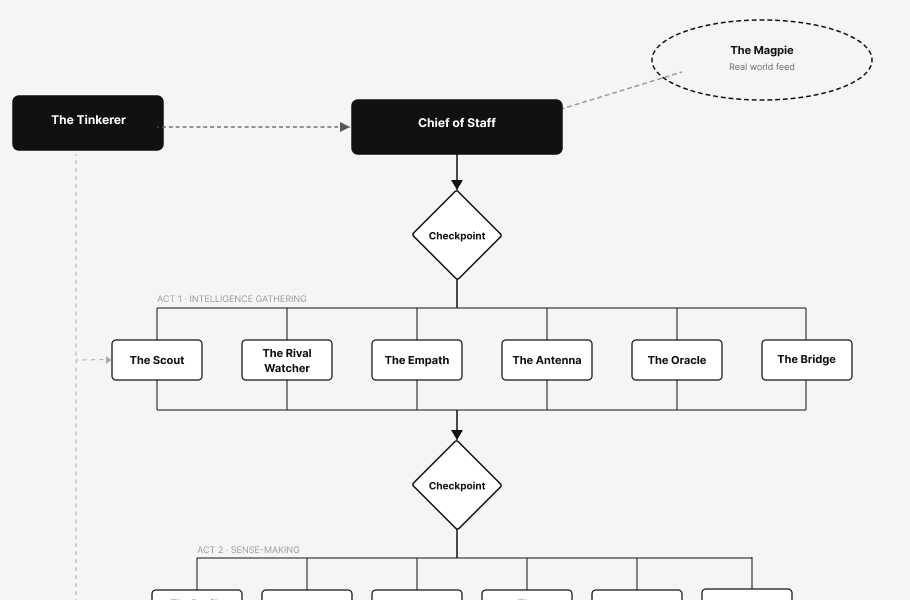
It is through all that experimentation and recent tool building that I’ve realised, if we want to protect the integrity of our own thinking, we have to establish a set of personal rules to follow, and our own personal workflows. It’s through your own work and experimentation that you’ll find yours. But for now, if you’d like some, here are mine.
1. Create like a child, edit like a scientist (thanks, Tyler, the Creator)
AI shouldn’t replace the messy, imaginative, and unconstrained spirit of raw creative strategy. The strategy process needs space for childlike imagination, deep curiosity, and expansive exploration. The machine’s role is to step in afterward to help structure, validate, pressure-test, and refine that original spark.
2. Give AI the desk, keep the street for yourself
The machine is trapped in the screen; you are not. Dump all that soul-crushing admin. The time-consuming competitor audits, the category tracking, the baseline data synthesis, and the pattern recognition. Everything that is computational and transactional can be given to the machine. But retain the world. Strategy doesn’t happen behind a monitor, and it certainly doesn’t happen in a dashboard. Deeper strategy is fueled by human-to-human observation — talking to Uber drivers, visiting galleries, interviewing real people, and capturing the physical, sensory, and messy lived experiences that don’t fit into clean data sets.
3. Inject your personal creative code
If you prompt an agent with the average, it will return the average. When working with AI, and especially when building agents, you must hardcode a foundational set of values, instructions, and constraints that define its creative code. Every agent in your ecosystem must call upon this shared document outlining your specific tastes, your creative beliefs, what you like and dislike, and exactly what “good” looks like to you. Not to the average. Think of it as codifying a cultural standard so the machine knows exactly what level of strategic rigour you expect it to return.
4. Steal from the engineers
The future of strategy isn’t found in looking at what other strategists are doing; it’s found by observing the tools, workflows, and frameworks being built by the engineering pioneers and research scientists at the frontier of AI. And translating these into creative fuel. Look outside your discipline to find the infrastructure for your own thinking. Borrow their automated research architectures, such as using automated engines built for code validation, and re-engineer them to continuously run hypothesis tests, loops, and refinements against strategic creative outputs. GitHub might feel weird at first, but I promise you it’s the best place to start.
5. Build a compounding ecosystem
Stop treating models like search with a personality. AI is at its best when used as a system architecture, not a conversational companion. Command a multi-agent team, build your own tools on demand and have them work together — like alternative narrative agents collaborating with Figma deck builders, or research agents working with interview creator tools. Then, ensure you co-evolve with it. Every real-world observation or unique human tension you bring back from the field must be fed back into your workspace like a knowledge graph. This transforms a generic model into a living ecosystem, compounding institutional memory of exactly how you uniquely see the world and the decisions you make.
6. Human judgement is the final line of accountability
AI does not give you answers; it gives you outputs for your consideration, interrogation, and judgment. You are the original thinker; the machine is not. As the reality of the work dictates: Claude is brilliant, but he can’t get fired (yet). We can. The human strategist always owns the final accountability for the inputs and the outputs.
So, where does this leave us?
It’s easy to get trapped in the anti-AI paralysis. Don’t. But do not surrender to its generic usage either. If you use these tools simply to write your decks faster, or to find you facts and futures, you are actively participating in the machine-replacing-humans narrative. Your job was never to sit behind a desk finding the average; your job was always to get out into the real world, find the friction, and code your own taste into the system.
And now, your job also includes daily experimentation. Build your own tools. Design your own systems. Work at it every single day until you are commanding the ecosystem rather than just chatting with a prompt box. And most importantly, don’t forget to have fun. It’s easy for this to all feel heavy. And get caught up in the corporate hype machine. But if you play and use the curiosity you have innately in you, who knows what you will create.
Originally published at https://msbelt.substack.com.
Strategy in the age of the machine was originally published in UX Collective on Medium, where people are continuing the conversation by highlighting and responding to this story.


