

But not the sort of conflict you usually see on the news

The ever-evolving conflicts in the Middle East, the prospect of more inflation, the persistent threat of A.I. destroying the future of work — oh, and the ever-worsening climate emergency.
There is a lot to be genuinely worried about in 2026.
In the context of all this bad news, there is one specialized method of information delivery that you should know about. I’ll resist the urge to call it ‘a silver lining’ or a ‘little bit of good news’ in a sea of doom-and-gloom.
It’s called ‘solutions journalism’ (I’ll use the acronym sojo in this essay). The idea with sojo is to vigorously challenge conventional news reporting’s focus on problems — on all that’s wrong, broken, hopeless, failing. That’s the ‘disease model of the world,’ and as any regular news reader knows, the way journalism usually goes.
In these trying, depressing, seemingly hopeless times, sojo sounds great. At least on paper. But it’s had a hard time finding uptick among many mainstream news organizations. In my view, the reason isn’t because of sojo’s emphasis on solutions. Counterintuitively, it’s because sojo’s not focused enough on conflict. I’ll unpack this argument here.
The need for sojo
For starters, why do we need to think about sojo as an alternative to conventional news reporting? One reason is obvious. For at least two decades, social media has been fragmenting and splitting audiences. It’s not like the 1970s and 80s, when most people got their news and information from a handful of sources (e.g., CBS News, NBC News, ABC News). These days, what we believe is not just a function of where we get that information from, but from whom.
The other reason we need to think about different ways of producing journalism is simply that all the depressing news and information around us is pushing more news audiences away from news. The latest report from the Reuters Institute at the University of Oxford found that four out of 10 potential news readers avoid the news, up from 29 percent of respondents who said the same thing 10 years ago. The main reason for skipping out? The negative impact of news reporting on their mood.

Why did this style of news reporting come about?
So what is sojo and why can it help heal some of the wounds inflicted upon news audiences from this algorithm-curated, doom-scrolling information landscape?
First, let’s clear up some misconceptions. The name solutions journalism suggests an emphasis on positive stories, happy news, and uplifting information. But fluff pieces are exactly what sojo is not. Solutions journalism is modelled on hard-hitting news. It’s just hard-hitting news that’s supposed to focus on what’s working and who is leading the way. These most certainly are not stories about teddy bears and fluff.
It’s no secret to the news-reading public that journalists write mostly about things that are not working: problems, wars, crises, conflicts, disease. Yes, death and destruction, and that tired adage of ‘if it bleeds it leads.’ This emphasis on ‘bad news’ (for lack of a better term) is partially about psychology. We are naturally drawn to stories about deviation and disorder. If beef prices are in step with people’s expectations, that’s not a news story; if they’re 15 per cent higher than they should be, then the news hook is obvious.
But the choice to report on what’s not working is also baked into the biases of conventional journalism itself — the way journalism came about as a practice. It’s a choice by news editors to report on failure. In the book News: The Politics of Illusion, journalism researcher W. Lance Bennett describes four news biases, of which disorder, and the effort to bring back some semblance of order (usually by experts and authority figures) is one of those biases (the other three are about the emphasis on personalities, on dramatization, and on reporting about individual events as opposed to unpacking larger systemic issues or describing underlying causes).
What’s more, journalism, in most of the world, and certainly in the way it’s taught in journalism schools is, focused on monitoring and sounding the alarm when something’s fallen out of step with the ‘normal.’ This approach is described as the ‘monitorial’ or ‘watchdog’ role, in the foundational book Normative Theories of the Media: Journalism in Democratic Societies. The monitorial role — the standard approach to news reporting — is built on the standard of journalistic objectivity, the holy grail of journalism. Journalists are supposed to be passive, detached, unbiased observers, watching from the sidelines and reporting on what’s going on. They don’t get involved in solving conflicts, challenging status quos, much less activating for change.
They monitor and report. The challenge with that approach is that the news tends to become a ‘stenographic’ account of the world.
The idea with sojo is to flip the equation around the principle of leading with problems, all the while staying true to journalism’s monitorial role and the principle of objectivity. The concern in journalism circles — unfounded in my view — is that telling the audience about solutions to problems is somehow automatically tantamount to advocacy (i.e., many journalists feel that reporting on solutions is for non-governmental organizations, not news outlets).
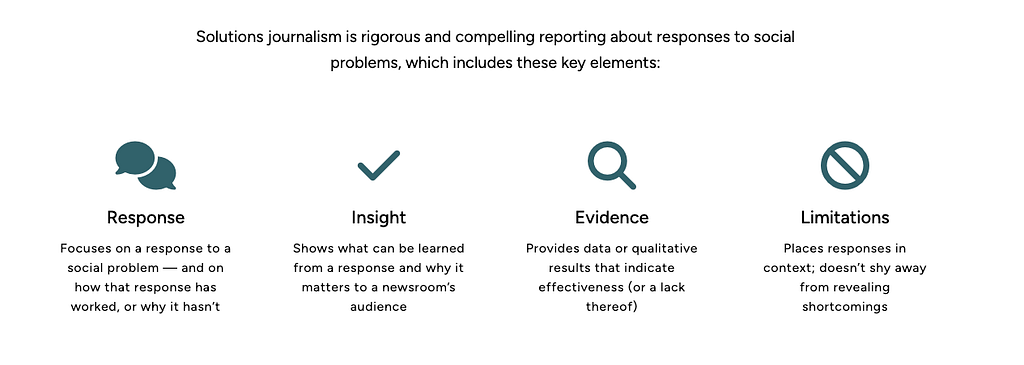
The Solutions Journalism Network, a U.S.-based organization that trains reporters and editors in solutions reporting, takes great pains to emphasize the delicate equilibrium between ‘monitoring’ and ‘reporting on solutions.’ On its homepage, SJN defines sojo “rigorous reporting about how people are trying to solve problems.” In other words, lead with the solution, but keep it firmly in the journalism camp, not the activist camp or the op-ed column.
To do that, SJN emphasizes the need for sojo-minded reporters to include plenty of evidence about how, where and why a particular solution is working (i.e., keep it the journalism column) and to reflect up on the limitations to that solution’s implementation (i.e., keep it out of the activism column).
This delicate tightrope is, in large measure, happening because conventional, mainstream newsrooms have long been opposed to, if not suspicious of solutions reporting. I know because I worked in one for close to 25 years, and have, over those years, spoken with dozens of reporters and editors whose eyebrows were firmly cocked every time I brought up the issue of solutions reporting.
But, to challenge the misperception of sojo as somehow tantamount to ‘activist’ or ‘advocacy’ work is, as I’ve discovered, uphill climb. That’s not to say there isn’t some really good sojo happening in some quarters, and some great reporters doing sojo. There is, for example, lots of evidence of sojo finding purchase in parts of the world that are less focused on the conventional journalistic tenets of monitoring, objectivity and conflict orientation. Here, I’m thinking of post-conflict states primarily in the developing world, places like subsaharan Africa, Indonesia, Colombia, etc. (SJN maintains a helpful and healthy database of sojo stories).
Still, among many journalists, and the journalism academy, there’s a nagging perception of sojo as somehow less robust then ‘actual’ journalism. To me, the way to address that concern is to abandon the idea of sojo as a response to social problems. Instead, emphasize the conflict frame (journalism’s natural posture), and do that using a model facilitation, instead of the conventional journalistic model of monitoring. Basically, conflict mediation applied to news reporting.
How would that work? Let me explain.
Conflict mediation is the aspect to emphasize. Not objectivity.
In practice, the conflict mediation approach might require abandoning the name ‘solutions journalism.’ That would make this type of journalism less about foregrounding solutions (which, to a lot of journalists, feels like activism, even though it’s not), and more about drawing out nuance, explaining underlying trends and patterns and, ultimately, presenting news as less of a duelling joust between ‘two sides’ (e.g., Democrats want x, Republicans want y, and there’s zero daylight between them), and more about facilitating conversations between different perspectives with a view on finding ways to move forward (solutions).
In short, conflict mediation, or facilitation.
In fact, facilitation is one of the four ‘roles’ for journalism described by the authors of Normative Theories. What’s more, journalism-as-facilitation has been tried in the real world before.
In the 1990s, when sojo was still an embryo of a concept (mostly used as kickers to close television newscasts on an uplifting note, something that still happens today,), a group of U.S. journalists, led by Jay Rosen, Davis “Buzz” Merritt Jr. and the late Cole Campbell promoted the idea of ‘public journalism’ (sometimes known as civic journalism) to newsrooms around the country. The primary role of journalists, in this tradition, is to facilitate conversations and dialogue within the community, and to create a public forum of sorts for ideas through that reporting. (It might not be advertised as such, but a lot of local news reporting is essentially public journalism).
To its credit, the Solutions Journalism Network is largely implementing the conflict facilitation frame in sojo. The group calls the approach ‘Complicating the Narratives,’ a term coined by journalist Amanda Ripley, who has spent years studying how conflict mediators think and work. Here’s a video in which she summarizes the approach:
https://medium.com/media/9f1d4ac70b7ab23626cb378f03031cda/href
The trouble is, sojo still gets stuck with a whiff of advocacy and activism. So, short of a name change (which feels performative), how do we go about challenging that?
Deliberative democracy
One approach is going back to journalism’s foundational relationship with democracy. Journalism and democracy are often thought of two sides of the same coin. But as the journalism scholar Michael Schudson convincingly argues in the 2008 book Why Democracies Need an Unlovable Press, journalism does not necessarily need democracy (though, arguably, democracy needs journalism). For instance, there are plenty of places where good journalism happens in the absence of any real democracy.
The point is not to parse out whether journalism and democracy go together or not. Let’s assume that they do, that they both need each other. Rather, the point is to think about what kind of democracy allows journalism to live up to its full potential?
Democracy is a catch-all term. Unfortunately, we rarely stop and think about the different types of democracies that can take shape. In the western world, most democracies nowadays are administrative. Citizens vote in elections every few years, the news media reports on that process (mostly as political entertainment, not news), and governments, which come and go with election cycles, manage the affairs of the city, state or country. It’s democracy for the people (and to line the profits of corporate media), not democracy by the people.
But democracy goes much deeper than just voting in elections every two or four years. Deliberative democracy, as the name suggests, is about the public — citizens — deliberating over matters of public concern, not necessarily during in an election cycle, but continously. In the context of journalism, it means writing stories about ordinary people showing up at city hall to voice concern over certain policies, tenants rallying together to pressure greedy landlords, Indigenous nations working together to challenge giant resource companies that threaten their lakes and rivers.
Conflict is central to this project. But it’s not the type of conflict that pits a Democratic congressperson arguing about something with a Republican member. Instead, as Simon Fraser University journalism professor Shane Gunster argues, the conflict inherent in these stories is mobilizing: it’s about people standing up to protect the places they call home, the values they cherish.
Often, the conflicts are internal (within communities, cities, even strata councils!), hence the need for deliberation. If a city wants to eliminate a policy banning natural gas in new home construction, the conventional news approach is to report on what the governing administration at city hall is proposing, and why people are opposed to it. This is Lance Bennett’s authority-disorder bias. But a more deliberative approach would unpack the tensions underlying the policy’s implementation or repeal. For example, it would look at the impact of burning fossil fuels in buildings, or it would introduce readers to groups working behind the scenes to promote or repeal the existing policy(ies). This, as opposed to providing stenographic accounts of the machinations at city hall.
As journalist, getting our hands dirty by picking at the deliberative activities happening within our democracy is, essentially, the work of facilitation and of conflict mediation.
If I just write about why this group of people hates that group of people, it’s unlikely I’ll get to any resolution or understanding as to what’s going on. But if, as SJN’s Amanda Ripley suggests, I ask my sources why they think the way they do, what they want the other side to understand, what they think other people misunderstand about them — and a whole host of other questions that come straight out of the handbook of conflict resolution– then I might get a handle on what’s really going on, and what people are (or could be) thinking about to fix it…without sounding like an activist or advocate.
That’s just good journalism.
This is also solutions journalism. But it’s solution journalism that puts the conflict and the deliberation — the messy work that’s happening behind the scenes (and that almost always gets lost in the noise of the journalistic ‘jousting’) — at the forefront of the journalistic discussion. It’s a totally different way of thinking about journalism.
By flipping the switch on journalism, and foregrounding conflict (with an eye on facilitation and mediation), we can not only do a better job cutting to the underlying reasons for why things are the way they are but, importantly, we can help come up with new questions and perspectives to investigate — which might help our sources (and ourselves, as journalists) reflect upon solutions.
https://medium.com/media/6bebcd85ddc811545b9817f8229b3b23/href
That’s not advocacy. That’s research, investigation, and just good journalism.
For more on what is and what is not solutions journalism, see here and here.
The Solutions Journalism Network is the biggest and most influential group. But for other organizations promoting sojo, here and here and here.
To learn more about how investigative journalism and solutions go hand in hand, see the work of The Catalyst Journalism Project at the University of Oregon, here.
Solutions journalism needs better conflict, not less of it was originally published in UX Collective on Medium, where people are continuing the conversation by highlighting and responding to this story.


