

AI is putting the future of UX designers in jeopardy, unless they are willing to become builders, makers, and system thinkers.
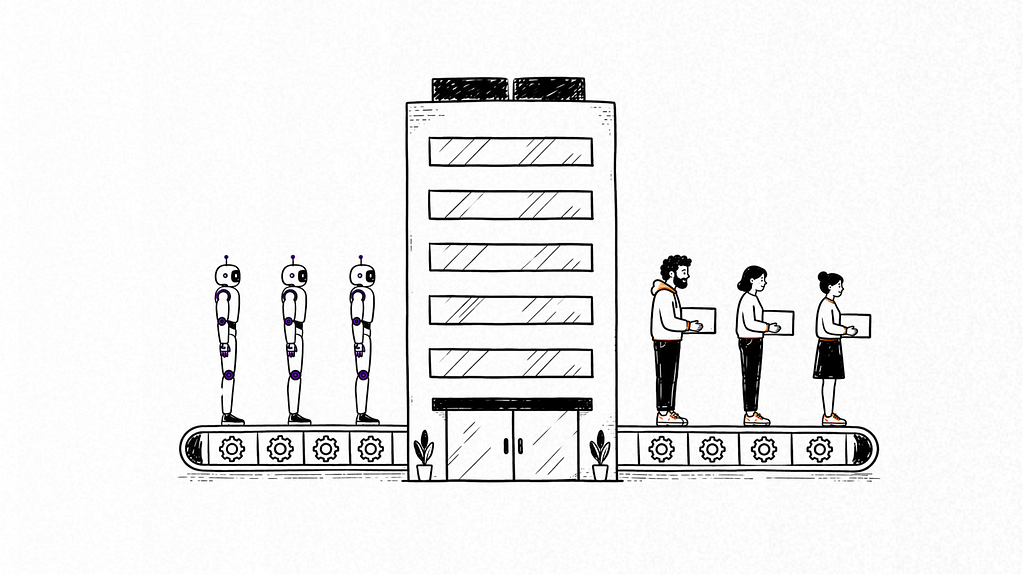
Every few weeks, another business leader recites the doomsday line: AI will replace all workers.
Their confidence is proportional to the capex. A company that just committed tens of billions to data centers has strong incentives to sound sure, and the memo goes out accordingly. They boast about leaner teams and a future where most of the work runs itself.
However, the reality looks different.
AI is making the designer’s job faster and easier, but it doesn’t hold business context or understand why a strategic decision was made. At least not yet.
As AI reshapes product development, design leaders are reassessing what the role of a designer actually means. Responsibilities are converging. The lines between what a designer does and what a PM or a coder owns are blurring. In that blur, the designers who can’t articulate their value beyond their craft will lose strategic relevance.
How can designers stay relevant in a world where AI is executing tasks meant to be ‘human’?
The hiring boomerang is here
AI-driven layoffs are no longer surprising. Now the ones that cut roles fastest are already scrambling to rehire.
Since 2022 Klarna, the popular Swedish fintech, has been the most aggressive AI adopter in tech, pausing hiring, cutting headcount in half, and replacing customer service with an OpenAI-built agent that did the work of 850 humans, its CEO Sebastian Siemiatkowski said.
Siemiatkowski told the world AI could do every job at the company, including his. “I had to pay a lot for saying that,” he admitted at Charter’s Leading with AI Summit in February this year. “People were very angry with me for saying that.”
Now Klarna is hiring humans back.
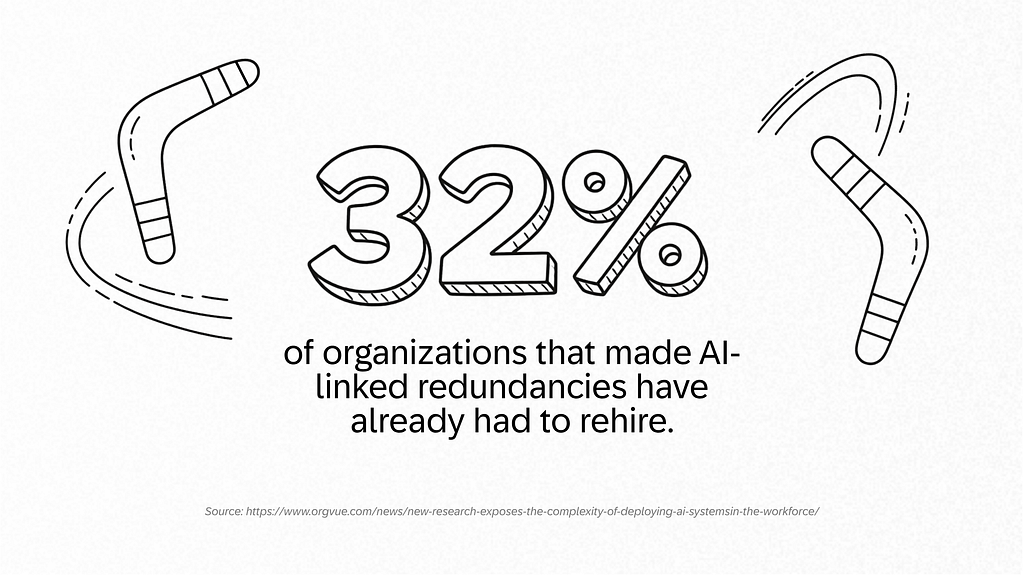
But this isn’t only a Klarna story. Gartner forecasts that by 2027, half of the companies that cut customer service staff citing AI will rehire for similar functions under different titles. Also, a March 2026 Orgvue study found that across industries, 32% of organizations that made AI-linked redundancies have already had to rehire staff because the cost savings never materialized.
Companies fired for a capability AI doesn’t yet have declared victory and are now spending more to bring back the people they let go, often at higher salaries and with permanent damage to institutional knowledge. Researchers are calling it boomerang hiring.
The design profession is on the same wave. The question is which designers will be on the right side of it.
How this affects designers at every level
I want to be direct with the early career designers reading this. Some of the prototyping and production work that used to be an entry ramp into the profession is being absorbed by tools, and that change is permanent. A first design job in 2026 assumes AI literacy on top of the traditional UX fundamentals. The bar has moved, and pretending otherwise is cruel to anyone graduating this year.
What I don’t accept is the conclusion that the profession is over. The UX designer role ranks eighth among the fastest-growing jobs through 2030 in the World Economic Forum’s Future of Jobs Report 2025. The ceiling is rising even as the floor shifts, which is a strange and uncomfortable place for anyone trying to break in, but it’s a very different situation from a dying field.
If you’ve been designing for more than a decade, you’ve seen this happening before. The move to mobile killed a generation of web-only portfolios, and design systems ended the era of artisanal one-off screens.
Each time, the designers who repositioned ended up with more leverage than they’d had before, and the ones who kept defining themselves by their output got left behind. The AI shift is the same event, moving faster. Seniors who lived through the earlier ones already know what to do.
For design leaders, the risk is breaking the talent pipeline. Companies hollowing it out today won’t have senior designers to promote in the next decade. Leaders who play the role of a mentor to entry-level designers will need to ask themselves whether they are teaching the right skills to their mentees.
Systems thinking: the skill every designer must develop in 2026
Systems thinking is the must-have skill for the designers of the future.
Designers must become builders, conceptualizers, and people who can decide what’s worth building. With AI in the product, the work extends to how the system is connected to parts around it, the inflow and outflow of data throughout disparate systems, how the system behaves: when it should answer confidently and what it tells the user when it’s wrong. Most of this design work happens in long meetings with machine learning engineers and data scientists.
Senior designers who spent 10 or 15 years getting good at the visual side of the craft are finding themselves in those meetings for the first time, arguing about aspects like confidence thresholds and failure modes, and many are struggling.
The Design Executive Council’s AI Shift report, which interviewed senior design leaders at JPMorgan, Cigna, Sephora, Amazon, and AT&T, highlights that designers today are being asked to think more like system architects and ecosystem orchestrators, building adaptable frameworks.
The future of design is no longer the creation of static interfaces. It is the orchestration of intelligent systems, human judgment, and machine behavior. The designers who thrive will not simply make product interactions usable. They will shape how humans and AI work together, end to end.
Arin Bhowmick (@arinbhowmick) is Chief Design Officer at SAP, based in San Francisco, California. The above article is personal and does not necessarily represent SAP’s positions, strategies or opinions.
One skill separates the designers who survive 2026 from the ones who don’t was originally published in UX Collective on Medium, where people are continuing the conversation by highlighting and responding to this story.


