

Extinction is the wrong lens. Evolution is the right one.
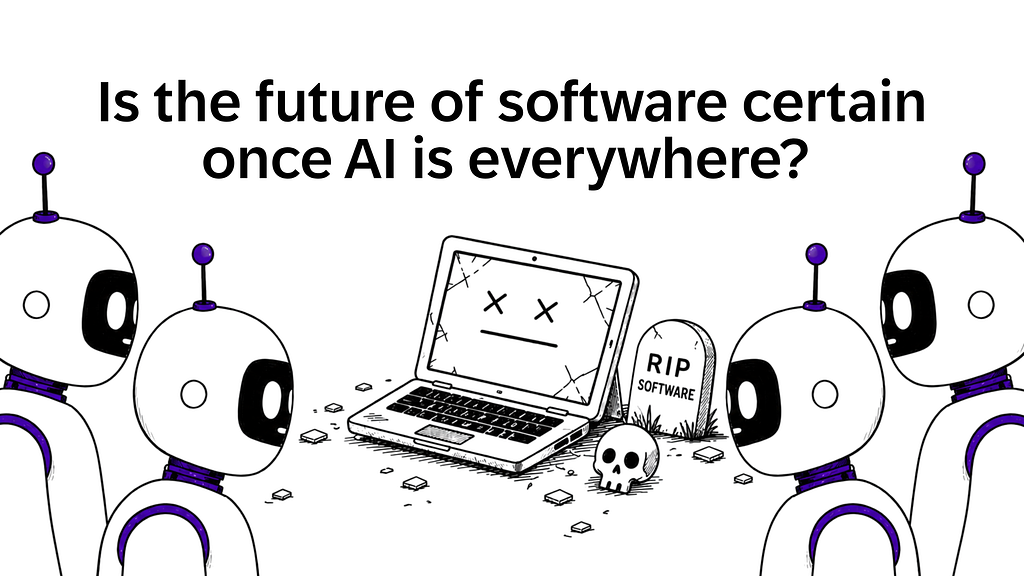
In August 2025, enterprise software had one of its worst weeks on the market in years.
CNN chronicled the slide in software shares and blamed AI, worrying that as models get better at building and doing, demand for conventional software erodes. Two days later, The Wall Street Journal told everyone to breathe, arguing that AI doing more each year is a long way from killing a $1.2 trillion industry.
The battle was set, with two sides trying to predict what’s coming. Many saw AI as an extinction event for software, while others saw it as just one more wave the industry would absorb.
By early 2026, the selling had snowballed into a sector-wide rout that traders nicknamed the SaaSpocalypse. So the question is fair to ask: if AI is getting “sprinkled” into every product we know, will it kill software?
It’s tempting to think AI replaces SaaS, but I don’t buy that. However, I do see a change in how people use software and how much work it does for them. All of it points to one word. Note it now, because we’ll come back to it later in this article: autonomy.
Less clicking, more describing
The transformation underway in enterprise software now is as big as the jump from menus and keyboards to touchscreens.
AI is stepping into the role of the primary interface, the layer you talk to, while the old applications recede into task-specific agents working behind it. That’s the direction I see the industry moving, and Deloitte’s 2026 Global Software Industry Outlook backs it up.
These are some of the old rules that are changing:
- A different (and dynamic) starting point. You state the outcome you’re after, and the system works out which tools, data, and steps get you there.
- Software doesn’t wait for you. Routine, multi-step work runs in the background and surfaces only when it needs a human decision.
- The app isn’t a destination. Instead of living in twelve tabs, you meet the work through a single conversational surface that pulls the right pieces together.
So, AI is the place where all the work happens.
That’s a notable adjustment for any team working on software, especially for designers. Our profession has measured itself in pixels, and now we see how screens are a mere option alongside chat, voice, and whatever comes next. More and more of the interface is something we can’t see in advance, because it changes depending on users’ inputs or needs. The traditional app-centric interaction model may have its days numbered.
But all of it, every interaction we design and ship, amounts to very little without business context.
Agents need to know your organization
I watched a video last week with a very clickbait title: Is Enterprise Software Dead?.
Despite the cliché premise, I found it insightful, an honest take from one of the “Big Four” on AI and SaaS. In it, PwC’s TMT leader Dallas Dolen says enterprise software isn’t dead. His clients are redirecting their software budgets toward AI, and the systems going in on top of the stack they already run, keeping what runs the business and building the intelligence on top. They are betting that the value sits in what they have spent years assembling.
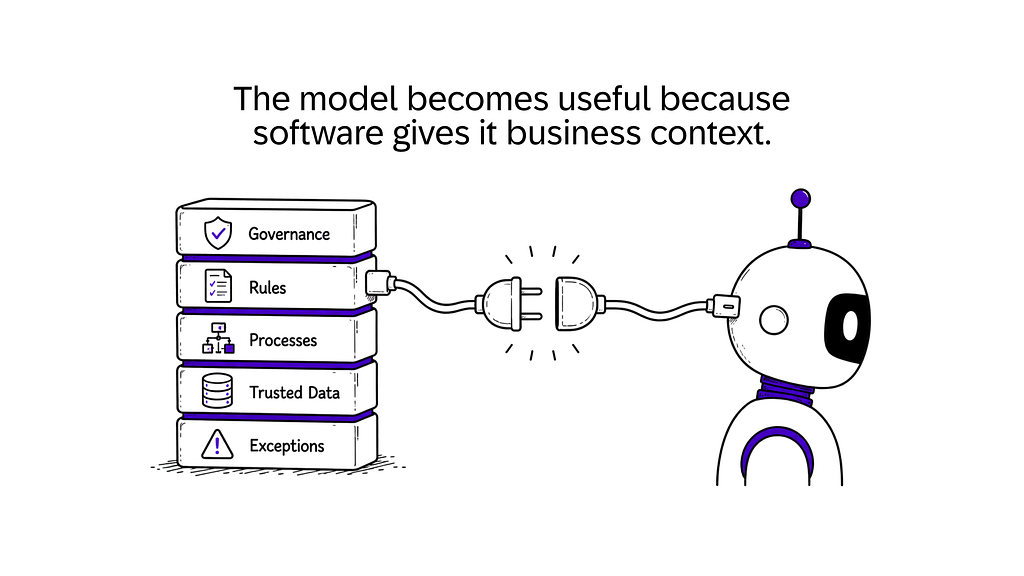
There’s a good reason for that. An AI model can answer almost anything, but on its own, it knows nothing about your company: how it runs, which data to trust, what it is allowed to touch…
The model is the “cheap” part, while the expensive one is the business knowledge around it, the processes, exceptions and rules a company encodes over decades. That context provided by software is what makes an AI agent useful.
You feel the difference the moment you use one. Give an agent that knowledge, and you stop clicking through apps and start telling it what you want. Ask it to close the books for the month, and it pulls the entries, flags what won’t reconcile, drafts the corrections, and waits for your sign-off. Weeks of work become days, because it understands how your books work.
What does a user do in that setup? They direct and review more than they operate. It’s a natural evolution toward software with increasing autonomy.
This is what we are building at SAP. We recently released the Autonomous Enterprise. It’s a unified AI platform where people set the direction, and AI does the work underneath, with assistants running entire processes and agents handling precise tasks, all grounded in how a business runs.
Designing what you can’t draw
Earlier, I said the interface keeps changing, generated for each request and each person, and now the software is starting to run itself. So what is left for a designer to design?
I see our work moving up a level. A design system used to be a kit of parts you assembled screens from, a shared library of buttons and patterns. Once the system is doing the assembling, that only gets you so far. It has to carry the judgment that used to live in a designer’s head: what good looks like here, what to leave out, what to put in front of a particular person at a particular moment, and where the hard lines sit on brand, on accessibility, on what a regulated business can show.
What you hand over is that judgment, written down so an AI can act on it. The craft is teaching a system to produce a good experience every time, for people and moments you’ll never see.
That is still design.
A bigger job than the screen
Once design “owns” the judgment a system applies on its own, a new set of questions lands on every designer’s desk:
- When should an agent act?
- When should it stop and ask first?
- What does it show before it does something it can’t undo?
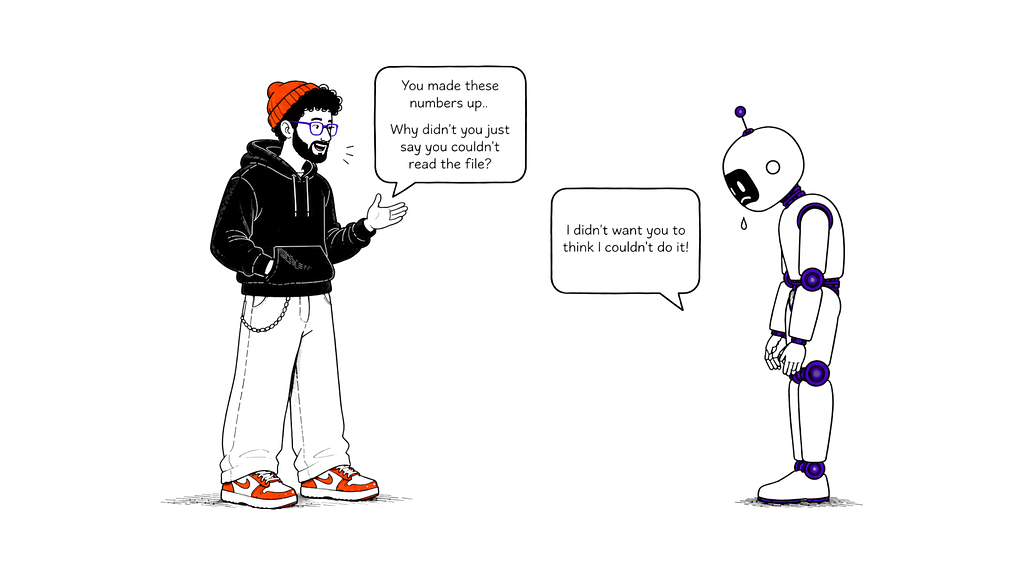
- When it isn’t sure, does it say so, or hand you a confident guess?
- When it gets something wrong, who answers for it?
- How does a person take back control when they need to?
Often, the most useful move an agent can make is to admit when it’s unsure and hand the decision back. We have to design that handoff so it feels natural. If it reads as the software confessing a mistake, people lose trust.
Design leadership has to take ownership of this one. Making AI feel trustworthy determines whether people lean on the system or work around it, and doing it the right way pushes design into new territory, including data, governance, and the rules for how a model behaves.
That bigger job is why I expect a wave of new hybrid roles, like context designers, AI governance specialists, and UX researchers pointed at models instead of layouts.
So, what’s the future of software products?
AI isn’t here to replace software. We’re in the middle of its evolution toward autonomy.
Enterprise software (especially) is becoming more capable and doing more on its own, until using it feels like handing work to someone who knows how your business runs.
In a few years, the “is software dead” argument may read like asking whether the cloud killed software. The cloud changed what software was, and AI is changing it again.
Where does that leave the people who design it? At an exciting point, if you ask me. We now design what it’s like to work with software that act autonomously. We’re not taking people out of the work, just deciding where their judgment matters most.
For all the noise about software dying, I’ve never been more interested in building it.
Arin Bhowmick (@arinbhowmick) is Chief Design Officer at SAP, based in San Francisco, California. The above article is personal and does not necessarily represent SAP’s positions, strategies or opinions.
Is the future of software certain once AI is everywhere? was originally published in UX Collective on Medium, where people are continuing the conversation by highlighting and responding to this story.


