

Your title and your actual level are two different measurements. I built an instrument, and nearly half of the designers came apart from their badge.
One of my designers was promoted twelve months ago. The promotion was correct. Their scope had been growing for two years before the title caught up: they owned a product area, ran discovery with stakeholders, made calls that used to land on my desk.
Six months after the promotion, something strange started showing up in our one on ones. The work was senior. The operating was not. Feedback still landed as a threat instead of as information. Every new project restarted from zero, as if no pattern had carried over from the last one. The scope had transferred. The maturity had not.
I have blurred the details, but you know this person. You may be this person. The title says one thing, the Tuesday afternoon says another, and everyone quietly agrees not to look directly at the gap.
For most of my career I had one word for this: mismatch. A designer is above their title or below it. Promote or coach accordingly. One line, one direction, one number.
I spent the last few months building a career assessment for designers, and the data from it convinced me that this model is wrong. Not slightly wrong. Structurally wrong, in a way that makes most career conversations less useful than they should be.
Seniority is not one line. It is two independent measurements that we have been forcing into a single number for twenty years. And the moment I stopped forcing them, almost half the designers I measured came apart from their titles.
Let me show you what I mean.
The old contract
The design career ran on a simple contract. Title equals level. Level equals scope. Scope equals pay. And somewhere underneath, unprinted but understood: pay equals worth.
The contract worked because the ladder was legible. Junior, mid, senior, lead, principal. You could locate yourself on it in one word, and so could a recruiter, a hiring manager, and your parents. When someone asked where you were in your career, the title was a complete answer.
Companies built their entire people infrastructure on this single line. Salary bands map to it. Promotion committees vote on it. LinkedIn’s Workplace Learning Report has found year after year that career growth is the number one reason employees stay, and career growth, in practice, means movement along that one line. Meanwhile 44% of HR leaders admit their organizations lack compelling career paths at all. So the line is both the most important structure in a designer’s working life and one that nearly half of companies maintain badly.
The people inside those companies feel the neglect precisely. When Todd Zaki Warfel surveyed designers back in 2019, lack of career path was already the second most common reason they quit. And DoorDash design chief Helena Seo, writing about building her team’s ladder, distilled the whole ask down to two needs:
“I want to understand where I stand currently. I want to know what I need to do to get to the next level.”
Two simple asks. The rest of this article is about why neither is simple anymore.
That was survivable when the line moved predictably. Do good work, wait, get the next rung. The contract had latency, but it cleared.
Then the latency stopped clearing.
The break
Two things happened to the ladder at roughly the same time, and they hit it from opposite ends.
From below, AI compressed junior execution work. The tasks that used to occupy the first three years of a design career, production screens, component variants, spec cleanup, first pass flows, are increasingly done in minutes by tools that cost less per month than a junior costs per hour. Over 100,000 design adjacent roles were cut in 2025. Forrester later found that 55% of employers regretted AI driven layoffs, which is a remarkable statistic and also cold comfort, because regret does not reopen a rung. The Nielsen Norman Group’s State of UX research noted that senior roles are recovering faster than junior ones. The bottom of the ladder is not disappearing, but it is thinning, and the reps that used to build maturity at that level are getting harder to accumulate.
And this is not a design problem. Aneesh Raman, LinkedIn’s chief economic opportunity officer, wrote in The New York Times that the first rung of the career ladder is breaking across knowledge work. Asked what to do about it, he starts with a demolition: “stop seeing jobs as titles.” Every job is becoming a set of tasks, and the tasks are being repriced one by one.
From above, scope started leaking downward without titles following. Teams shrank. The mid level designer inherited the senior’s product area when the senior was cut. The senior inherited the lead’s stakeholder map. Nobody got promoted, because promotion budgets froze while responsibility flowed. I watch this happen inside a European bank, and I hear the same pattern from designers in every industry I mentor in.
The result: mismatches multiplied in both directions at once. People operating above their titles because scope flowed to them. People holding titles above their operating because the reps that normally back a title never happened.
Figma’s State of the Designer 2026 report captured what this feels like from the inside. Asked whether design got better or worse, the profession split into near perfect thirds: 36% better, 35% worse, 29% the same. I wrote a whole piece about that split. What I did not understand when I wrote it is that the split is partly a measurement problem. When your only instrument is a one dimensional ladder, and reality has stopped being one dimensional, of course the profession cannot agree on where it stands. We are reading a two axis reality off a one axis gauge.
Two measurements pretending to be one
Here is the model that replaced the ladder in my head.
The first axis is Level. Level is the scope of the problem you own. A junior owns a function: add an item to the cart. A mid level designer owns a capability: the shopping cart. A senior owns a product area: the conversion funnel. A lead owns an undefined problem space: how do people complete a transaction at all. Level is about the size of the question you are trusted with. It is granted by the organization, because only the organization can hand you scope.
The second axis is Stage. Stage is your maturity as a practitioner, independent of what you own. How you take feedback. Whether patterns carry between projects. Whether you operate from principles or from checklists. Whether you generate judgment or consume it. The Nielsen Norman Group mapped this in 2021 in a study of 1,067 practitioners learning design thinking, describing a progression that runs from newcomer through early adoption into genuine mastery. Stage is not granted. It is accumulated, rep by rep, and no reorg can hand it to you or take it away.
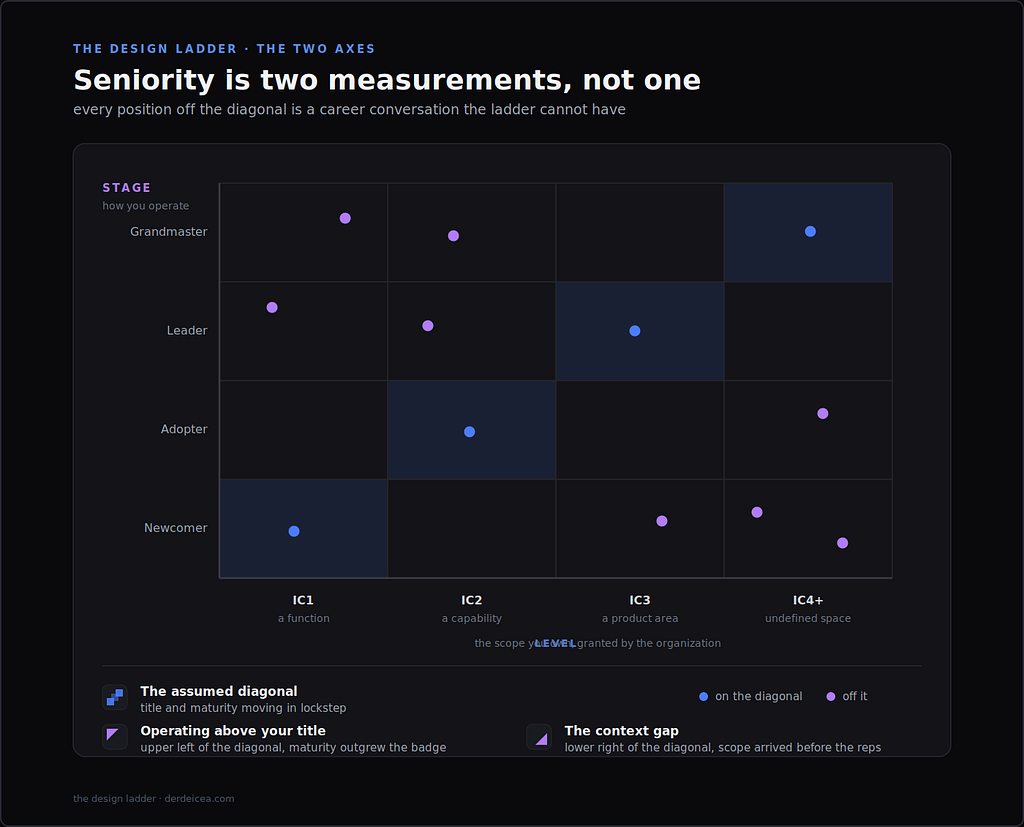
The critical property: these two axes are independent. The org can promote your Level overnight. It cannot promote your Stage. And your Stage can grow for years while your Level sits frozen in a promotion freeze.
The designer from my opening had a senior Level and an early Stage. Correct promotion, real gap. The opposite case sits in every large organization: the designer whose Stage matured years ago while their Level waited for a budget line. Same one word diagnosis under the old model, mismatch, but opposite problems needing opposite responses.
Once you see the two axes, you cannot unsee them. But seeing them is not the same as measuring them, and this is where I have data to show rather than theory to argue.
What one hundred designers taught me
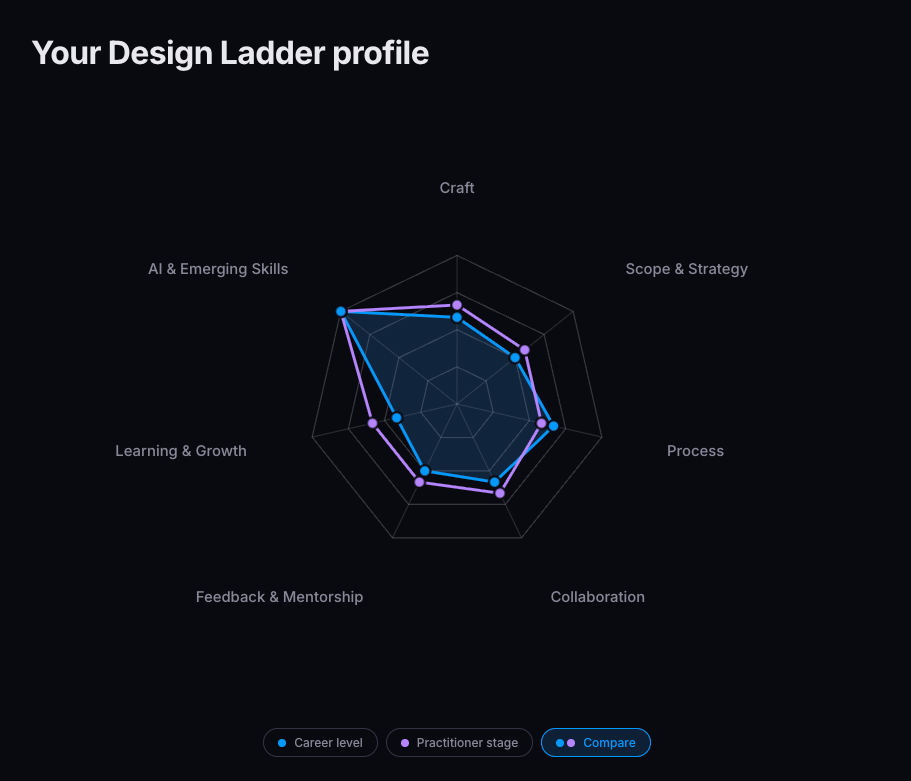
Earlier this year I built a self assessment around this model: scenario based questions, no self ratings, output as a profile rather than a grade. In practice the two numbers turn out to be a shape: the instrument reads both axes across seven skill areas, and almost nobody is flat. Around one hundred designers have completed it so far. I want to be precise about what that sample is and is not. It is small, self selected, and skewed toward my own audience. It is not a population study, and I will not pretend otherwise.
But the most important thing it taught me was not about the designers. It was about the instrument.
The first version of the question bank measured both axes, or so I believed. When I audited the results, roughly 96% of profiles landed on the diagonal: Level and Stage in lockstep, senior scope always paired with senior maturity, junior with junior. A near perfect diagonal should have felt like validation. It felt wrong instead. If two axes agree 96% of the time, you have not measured two things. You have measured one thing twice and drawn it on two lines.
So I rebuilt the bank. I rewrote questions so that scope signals and maturity signals could separate: shorter options, less jargon that lets people pattern match the answer that sounds senior, scenarios where an early stage practitioner with big scope would genuinely answer differently from a mature practitioner with small scope.
After the rewrite, diagonal agreement dropped to about 58%.
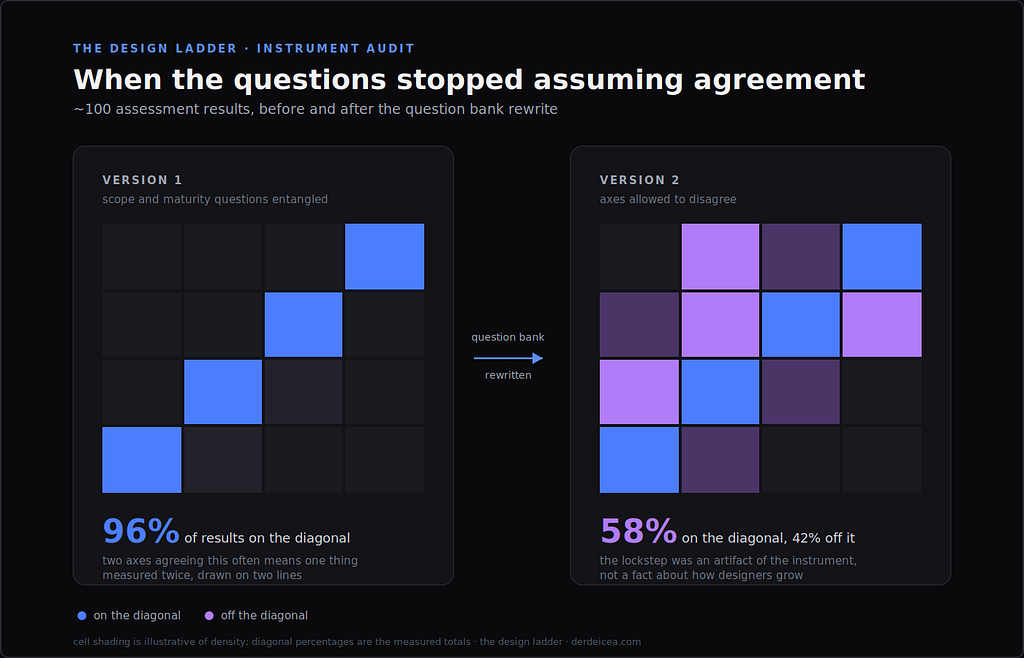
Read that carefully, because it is the entire article in one number. When the instrument stopped assuming that title and maturity move together, roughly four in ten designers came off the diagonal. Their scope and their maturity told different stories. Under the old one line model, those four in ten get a wrong diagnosis: either flattered by a title their operating does not yet back, or flattened by a title their operating outgrew years ago.
The aggregate numbers point the same direction. Nearly half of the people who start the assessment call themselves level 4, senior, while the assessed results center a full level lower and only a handful land at IC4 or above. One caveat before you quote that: the two numbers come from unmatched groups, everyone who starts versus everyone who finishes, so it is a shape comparison, not a per-person diagnosis.
I am not claiming 42% of all designers are mismatched. My sample cannot carry that claim. I am claiming something narrower and, I think, more useful: the lockstep between title and maturity is an artifact of how we measure, not a fact about how designers grow. Build an instrument that lets the axes separate, and they separate immediately.
Reading your own gap
So what do you do with two numbers instead of one? It depends entirely on which side of the diagonal you are on, and this is where the model earns its keep, because the two gaps need opposite moves.
If your Stage is above your Level, you are operating above your title. This is the most common story I hear from designers who inherited scope through layoffs and reorgs, and it is quietly one of the strongest negotiating positions in this market, if you can evidence it. The move is documentation, not patience. Titles lag operating by default; they lag forever if the operating is invisible. Keep a running record of the decisions you made that your title says you should not be making: the stakeholder calls you ran, the direction you set, the problems that arrived undefined and left shipped. That record is a promotion case internally and a level correction externally. Engineers figured this out years ago; there is an entire genre of advice about translating deflated big tech titles into real market levels. Designers, on average, still let the badge speak for them.
If your Level is above your Stage, the vocabulary matters enormously, and the default vocabulary is cruel. The old model calls this overrated, over promoted, imposter. I refuse that framing, and not out of kindness. Out of accuracy. Stage lags Level for structural reasons: you were promoted into scope before the reps existed, or the scope flooded toward you when a team shrank. That is a context gap, not a talent verdict. The maturity reps you skipped are specific and buildable: seeking feedback before it is imposed, closing the loop on every project so the pattern transfers, borrowing judgment deliberately from people one stage ahead. The single worst response is the most common one: performing seniority to hide the gap. Performance freezes Stage exactly where it is, because you cannot build reps you are pretending to already have.
And if your two numbers agree, do not relax yet. Ask whether they agree because you are genuinely on the diagonal, or because you have never been in a room that tested the difference.
Sideways is a direction
There is a third implication, and it is the one I most want mid career designers to hear.
The one line model has exactly two directions: up or stuck. If the rungs above you are frozen and the rungs below you are dissolving, the one line model says your career is over at the ripe age of, roughly, now. The average senior UX designer is 38. The average age of a career switch is 39. I no longer believe those two numbers sit next to each other by accident. That is the sound of a generation hitting the frozen middle of a one dimensional ladder and concluding the only remaining direction is out.
The two axis model opens a direction the ladder cannot see: lateral. I am not the first to notice the metaphor failing. Peter Merholz has spent a decade building leveling frameworks for design organizations, and he resists the ladder outright:
“I resist linear ‘career ladders,’ in favor of ‘trellis,’ as my experience with people in UX is that they seek a bushier, less-directed growth.”
What his trellis and my two axes share is a refusal to pretend growth is a single line. Level is granted by one organization, but maturity is portable across disciplines, across employment models, across adjacent crafts.
A Leader stage product designer does not restart as a newcomer when they move toward research, service design, or independent work. Their Level resets; their Stage walks straight through the door with them. The research on late career changes says most people who switch after 45 are glad they did, though more than half took a pay cut to get there. Both numbers are real. But I suspect part of that pay cut is a translation failure: people pricing themselves by the Level they are abandoning instead of the Stage they are carrying.
Lateral movement is not the consolation prize the ladder trained us to see. In a market where AI keeps compressing the vertical, range is a strategy. Maybe the strategy.
The part I will not resolve
I ended my last article by admitting I had not landed, and readers responded to that honesty more than to anything I have written. So I will not fake a landing here either.
The two axes do not tell you what your career should be. They do not resolve the identity question that sits under all of this, the one about what the word designer means when the work keeps changing shape. That question is still open on my desk, and I think it stays open for our whole generation for a while.
What the two axes do is smaller and more practical: they replace a verdict with a map. One number tells you what you are. Two numbers tell you where you are, and where you are is something you can move from. Up, if the scope is there to claim. Inward, if the maturity needs reps. Sideways, if the ladder in front of you is frozen but you are not.
The designer from my opening is doing the inward move now. We stopped talking about whether the promotion was deserved, a question with no good answer, and started talking about which specific reps were missing, a question with several. The title never changed. The Tuesday afternoons did.
That is what a second axis buys you. Not a better grade. A better conversation.
I turned this model into a free self assessment: scenario based, about ten minutes, and the output is a profile shape rather than a badge, because a badge is a verdict and a profile is a conversation starter.
You can take it at assessment.derdeicea.com. These articles are also becoming a book later this year, chapter by chapter.
This is Part 4 in a series about what design careers actually look like in 2026. If you think I am wrong about any of this, tell me. The best corrections to this model have come from readers, not from me.
Resources cited:
- Figma State of the Designer 2026
- Nielsen Norman Group, Design Thinking: The Learner’s Journey.
- Nielsen Norman Group, State of UX
- Forrester on AI layoff regret (via Computerworld)
- LinkedIn Workplace Learning Report
- Zippia UX designer demographics
- Layoffs.fyi
- Todd Zaki Warfel, designer career survey (2019, via Peter Merholz)
- Helena Seo, “Designing” a Career Ladder for Product Design (DoorDash)
- Aneesh Raman, “I See the Bottom Rung of the Career Ladder Breaking” (NYT op-ed; discussed on PBS NewsHour)
- Peter Merholz, From Ladder to Trellis
- AIER, New Careers for Older Workers (2015)
The promotion that didn’t take was originally published in UX Collective on Medium, where people are continuing the conversation by highlighting and responding to this story.


