

Search once returned a page of options. Now it delivers a verdict. That looks like convenience, but it is also a transfer of judgement, from us to a system we cannot inspect.
A few years ago, buying an office chair meant suffering for it. You opened a dozen tabs, read strangers bickering about lumbar support, squinted at star ratings of dubious origin, and eventually committed to something while quietly suspecting you had chosen wrong. The work was tedious. It was also, in its small way, yours. You did the comparing.
Now you type a sentence into a chatbot and a chair surfaces at the top of the reply, already picked, with three tidy reasons attached. No tabs. No bickering strangers. No low hum of doubt that a better option is buried two pages down. The weighing-up has happened somewhere unseen, performed by something you cannot easily question, and returned to you as a single confident answer.

This is not a niche habit. In a January 2026 survey of US shoppers by Clutch, seven in ten said they now use AI somewhere in the buying process, and 65% turn to it to research a product before they spend a thing. Most still want the final tap to be their own: only 4% said they would let the AI go ahead and buy the item for them. We have handed over the digging, then, without quite handing over the wallet.
That difference is the interesting part. We are not delegating the purchase. We are delegating everything that comes before it, the part where we used to sift and second-guess and form a view. The more that slips offstage, the more it matters who is waiting in the wings.
Because somebody is. The same shift has already begun reshaping the work of the people who make the content. They now have to write and build as much for the crawler as for any human landing on the page. Those at the other end of it, the ones still doing the buying, are changed too, just less visibly.
A whole industry has grown up around shaping what the machine suggests. The reasons we trust a neat conclusion more readily than a messy list of links are oddly specific to how our minds work. The line between a helpful recommendation and a paid placement, meanwhile, grows fainter by the month. Worth knowing, surely, what we signed up for when we stopped opening tabs.
Where the legwork went
For three decades, searching meant being handed a list. You typed a few words, the engine served up its ten blue links, and the sorting was left to you. The ranking was a suggestion rather than a ruling. You could distrust it, scroll past it, open the fourth link because the first three smelled of advertorial.
A generated answer removes that step. Ask which cordless vacuum to buy, and you get a recommendation, not a directory. The shortlist you would once have assembled yourself arrives ready-made, and often it holds just one name. The same has happened to reviews. Wading through them to reach your own opinion used to be part of the ritual; now the machine boils them down for you.
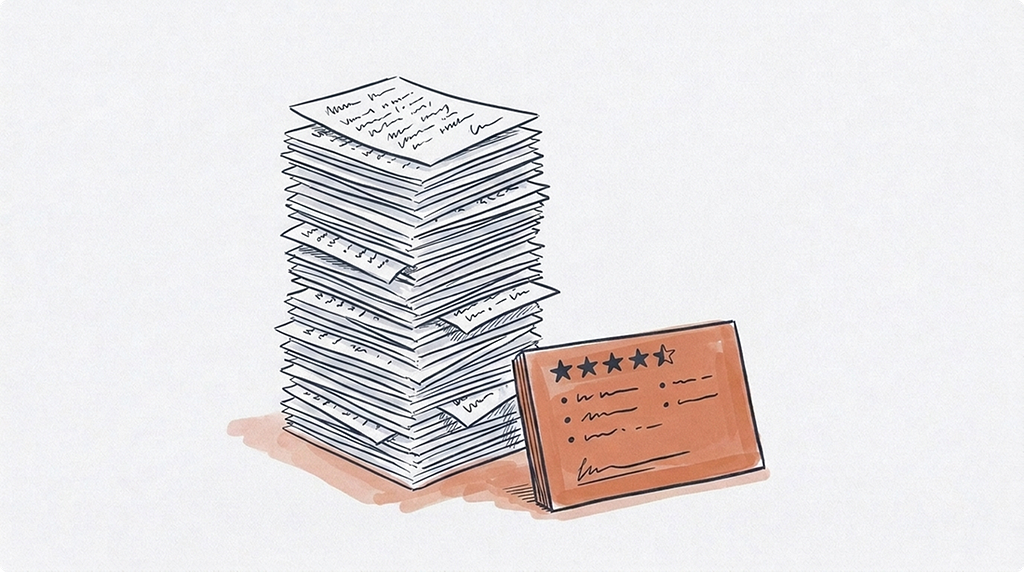
The behaviour has moved faster than almost anyone predicted. Klaviyo’s survey of nearly 8,000 consumers across eight countries late last year found that 41% had bought something an AI recommended in the previous six months, with a further 27% nudged towards a product they then went away to research. A separate study by the fraud-prevention firm Riskified, covering more than 5,000 shoppers worldwide, put the share now using AI somewhere in their shopping at close to three-quarters. The tool has stopped being a curiosity at the edge of the process. It is becoming the front door.
Retailers have followed the traffic. Amazon’s assistant, used by more than three hundred million people last year, no longer merely answers a question about a product but runs searches, balances your budget against your constraints, and returns a favourite. A growing list of other brands now lets customers browse and order from inside a chatbot rather than on their own sites. The shopfront is migrating into the chat window, which often replies with a verdict.
The comfort of being told
A single answer lands easily for reasons that have little to do with whether it is any good.
Comparison is work. Holding several options in your head, scoring each against the rest, accepting that you might still be wrong: all of it costs effort, and we are built to spend as little of that as we can. A confident recommendation settles it for us. It folds a sprawling problem into one line, and the relief is immediate, whatever the merits of the pick.
There is a long line of research suggesting that abundance does not just tire us, it can keep us from choosing at all. In an experiment that has become a touchstone, two researchers set up a tasting table in an upmarket California grocery and stocked it on some days with six jams and on others with twenty-four. The larger spread drew the bigger crowd: 60% of passers-by stopped, against 40% for the smaller one.
Yet of those who paused at the big display, only 3% bought a jar, while almost a third did at the small one. Those faced with fewer were happier afterwards with what they took home.
Later work has shown the effect is not universal and depends on the setting, but the core finding has held up well enough to change how shops lay out their shelves. Seen in that light, an algorithm that returns one option does more than spare you the bother. It lifts the paralysis that an excess of choice can bring, and sets the decision in front of you already made.
Facing fewer options is one half of the comfort. The other is how much we defer to the source. Psychologists have a blunt name for that pull: automation bias, the habit of rating a system’s output above our own because a machine produced it. The snag is that the certainty a clean answer brings is no guarantee the response is correct. It is proof the question has stopped feeling difficult.
Julie Geller, a research director at Info-Tech, put the brakes on adoption neatly when she told CX Dive the real barrier was “psychological, not technical.” We hold back not because the tool cannot choose for us, but because some part of us is not ready to stop choosing.
The snow shovel and the scarf
When we do extend that trust, we are surprisingly particular about it.
The clearest map of this comes from Chiara Longoni and Luca Cian, whose work in the Journal of Marketing named what they called the “word-of-machine effect.” People lean towards an algorithm’s pick when a purchase is practical and measurable, and pull away when the choice is sensory or personal. We will take the computer’s word on a snow shovel, to borrow the usual illustration, while bristling at its view on a fashionable scarf. The belief underneath is that AI is sharp on function and deaf to feeling.

That instinct runs alongside a broad, level-headed scepticism. None of this means we have handed over our discernment wholesale. Confidence in these systems is patchy, and on the evidence fairly clear-eyed. A YouGov survey last summer found two in five Americans place no faith at all in AI shopping assistants.
Gartner, in research that September, put it more bluntly for AI search in particular: about half do not trust the answers and summaries on offer. The Clutch figure is the sharpest of the three, with just 17% of shoppers willing to act on a recommendation without checking it for themselves. This caution is widely held. Yet it has not dented the habit, because the people who would balk at a machine spending their money are quite happy to let it draw up the shortlist.
The contradiction gets stranger still. We are growing warier of words we suspect a chatbot wrote, while becoming more relaxed about products it tells us to buy. One person can hold both reflexes at once. The doubt that clings to AI’s prose seems to spare its shopping advice, perhaps because it reads as a service rather than a voice, and we do not scan it for sincerity the way we scan a sentence.
A thumb on the scale
If the answer carries this much weight, who gets to shape it? No longer the search engine alone.
A new craft has formed around being the name the machine mentions, traded under acronyms as ungainly as generative engine optimisation (GEO) and answer engine optimisation (AEO). The mechanics belong to another discussion, but the gist is that the prize has changed. Ranking first matters less than being the source a generated reply draws from. A 2025 study of AI search found these systems lean heavily on third-party, authoritative coverage rather than a brand’s own marketing, which shifts the work of persuasion from selling yourself to being vouched for by others.
For most of its short life, the chatbot reply has carried no advertising, which is a large reason it felt trustworthy. That is ending. In early 2026, OpenAI began showing labelled sponsored messages beneath ChatGPT’s responses, with rival assistants doing likewise, while insisting the paid content leaves the actual answer untouched. Perhaps it does. The deeper problem is that a sponsored suggestion and an honest one sound exactly alike. Both arrive in the calm, authoritative tone we have been trained to trust.
We spent two decades learning to discount the search ad, mostly because it announced itself as one. A recommendation that reads like considered advice offers no such tell.
When it buys for you
All of this still assumes one step belongs to you. You read what it offers, decide whether to trust it, and act on it or not. That step is the one the industry is now trying to absorb.
OpenAI tried the boldest version first. Late in 2025 it built a checkout into ChatGPT, so a recommended item could be bought on the spot. It did not take: few merchants signed up, shoppers barely used it, and within months the company pulled back to focus on discovery instead.
But the direction is not really in doubt. In January, at the National Retail Federation’s annual show, Google launched a commerce standard of its own. Behind it are retailers like Walmart and Target, payment firms like Stripe and Visa, and a couple of dozen others besides. The card networks have gone further still, building the rails so that an agent can settle up on your behalf, your authorisation granted in advance. Amazon’s assistant, the same one already narrowing your options, now buys as well: set a price, and it will purchase the moment the item falls to it. McKinsey reckons this kind of trade could be worth three to five trillion dollars a year by 2030.
Earlier, there was a hint that the final tap would stay ours. That expectation is being designed out. The infrastructure now assumes the agent will act, and asks only that you set the terms once, ahead of time. The question is shifting from whether you would let it buy to whether you would notice that it had.
Here the thumb on the scale becomes hardest to spot. When the pick and the purchase are a single motion, there is no list to set against it, no alternatives to see, no pause in which you might have looked twice. You cannot compare what you were never shown, and before long you may not be the one pressing buy.

The muscle we stop using
The commercial worry is not the only one.
Each time the shortlist arrives finished, a small piece of deliberation goes unrehearsed. The chance discovery of the fourth result, the thing you find while looking for something else, the slow education of sorting options yourself. None of these is a feature the machine is trying to strip out, yet all of them thin when the middle of the job is done for you. A 2025 systematic review in the journal Electronic Commerce Research noted that the speed AI brings to buying can carry a felt loss of control, a sense of the decision slipping slightly beyond reach.
There is a market-level echo too. When millions of shoppers are funnelled towards whatever the model names, spending pools around a shrinking set of winners. The brand that gets cited gets bought, and the one left unmentioned drops from view, not because it lost a fair contest but because no contest took place. Variety tends to dwindle once the choosing is centralised.
This is not a plea to return to a dozen open tabs and a war of conflicting reviews. It is a note about what a convenience costs once we forget we lean on it.
Back to the chair
The office chair, in fairness, is precisely the sort of purchase the machine handles well. It is practical, comparable and faintly dull, the snow-shovel end of the spectrum, and outsourcing it frees attention for choices that deserve more of it. Used that way, an AI tip is a gift, not a threat. The argument was never that we should do everything the slow way again.
The point is finer than that. A recommendation feels like advice, yet it is more and more often a position someone has paid for, or at least one moulded by an industry straining to be the answer. Holding that in mind, and keeping our own judgement in working order for the purchases that earn the effort, is the whole of the task. A shortlist of one is a fine thing to be handed. It is a poorer thing to mistake for the only list there ever was.
If you enjoyed this, follow me on Medium for more on design, psychology and technology.
References & Credits
Amazon. (2025). Amazon’s next-gen AI assistant for shopping is now even smarter, more capable, and more helpful. https://www.aboutamazon.com/news/retail/amazon-rufus-ai-assistant-personalized-shopping-features
Amazon. (2026). Meet Alexa for Shopping, your personalized, agentic AI assistant on Amazon. https://www.aboutamazon.com/news/retail/alexa-for-shopping-ai-assistant
Brady, M. (2025). AI search and summaries distrusted by about half of consumers: Gartner. CX Dive. https://www.customerexperiencedive.com/news/ai-search-summaries-distrusted-consumers-gartner/759373/
Chen, M., Wang, X., Chen, K., & Koudas, N. (2025). Generative Engine Optimization: How to Dominate AI Search. arXiv. https://arxiv.org/abs/2509.08919
Clutch. (2026). 65% of Consumers Use AI to Research Products Before Making a Purchase. https://www.businesswire.com/news/home/20260122526477/en/Clutch-Report-65-of-Consumers-Use-AI-to-Research-Products-Before-Making-a-Purchase
CNBC. (2026). OpenAI revamps shopping experience in ChatGPT after struggling with Instant Checkout offering. https://www.cnbc.com/2026/03/24/openai-revamps-shopping-experience-in-chatgpt-after-instant-checkout.html
Electronic Commerce Research. (2025). The impact of artificial intelligence on consumer behavior towards brands: a systematic review. Springer. https://link.springer.com/article/10.1007/s10660-025-10063-7
Goldman, S. (2026). ChatGPT tests ads as a new era of AI begins. Fortune. https://fortune.com/2026/01/16/openai-to-begin-putting-ads-in-chatgpt/
Google. (2026). New tech and tools for retailers to succeed in an agentic shopping era. https://blog.google/products/ads-commerce/agentic-commerce-ai-tools-protocol-retailers-platforms/
Iyengar, S. S., & Lepper, M. R. (2000). When Choice is Demotivating: Can One Desire Too Much of a Good Thing? Journal of Personality and Social Psychology, 79(6), 995–1006. https://business.columbia.edu/faculty/research/when-choice-demotivating-can-one-desire-too-much-good-thing
Klaviyo. (2026). Consumers are turning to AI to discover and buy products. https://www.klaviyo.com/newsroom/ai-persona-research
Longoni, C., & Cian, L. (2022). Artificial Intelligence in Utilitarian vs. Hedonic Contexts: The “Word-of-Machine” Effect. Journal of Marketing, 86(1), 91–108. https://journals.sagepub.com/doi/abs/10.1177/0022242920957347
Mastercard. (2025). Mastercard unveils Agent Pay, pioneering agentic payments technology to power commerce in the age of AI. https://www.mastercard.com/news/press/2025/april/mastercard-unveils-agent-pay-pioneering-agentic-payments-technology-to-power-commerce-in-the-age-of-ai
McKinsey & Company. (2025). The agentic commerce opportunity: How AI agents are ushering in a new era for consumers and merchants. https://www.mckinsey.com/capabilities/quantumblack/our-insights/the-agentic-commerce-opportunity-how-ai-agents-are-ushering-in-a-new-era-for-consumers-and-merchants
Mosier, K. L., Skitka, L. J., Burdick, M. D., & Heers, S. T. (1996). Automation Bias, Accountability, and Verification Behaviors. Proceedings of the Human Factors and Ergonomics Society Annual Meeting. https://journals.sagepub.com/doi/10.1177/154193129604000413
OpenAI. (2025). Buy it in ChatGPT: Instant Checkout and the Agentic Commerce Protocol. https://openai.com/index/buy-it-in-chatgpt/
Perez, S. (2026). ChatGPT rolls out ads. TechCrunch. https://techcrunch.com/2026/02/09/chatgpt-rolls-out-ads/
Walk-Morris, T. (2025). AI shopping assistants have a trust problem. CX Dive. https://www.customerexperiencedive.com/news/ai-retail-shopping-assistants-consumer-trust/753705/
Wassel, B. (2025). Consumers embrace AI for research, but few have allowed it to make purchases. CX Dive. https://www.customerexperiencedive.com/news/consumers-ai-research-few-purchase/803156/
A shortlist of one: how AI became our shopping adviser was originally published in UX Collective on Medium, where people are continuing the conversation by highlighting and responding to this story.


