

Vibe design with intention, eyes open.
Andrej Karpathy, former Director of AI at Tesla, coined “vibe coding” in early 2025, saying there’s a new type of coding “where you fully give in to the vibes, embrace exponentials, and forget that the code even exists.”
Predictably, vibe design was next. Google’s Stitch introduced a Vibe Design mode last March and popularized the term. With the new functionality, anyone can describe a business objective or a desired user feeling, and the model generates multiple high-fidelity directions.
The aforementioned Stitch, Figma Make, Lovable, Cursor, and Vercel turn weeks of work into an afternoon. Talk about a productivity hack.
However, vibe design has its limits. There are aspects it can’t replicate, and those are where a skilled designer’s work is irreplaceable. Here are seven of them.
1. Taste and judgment
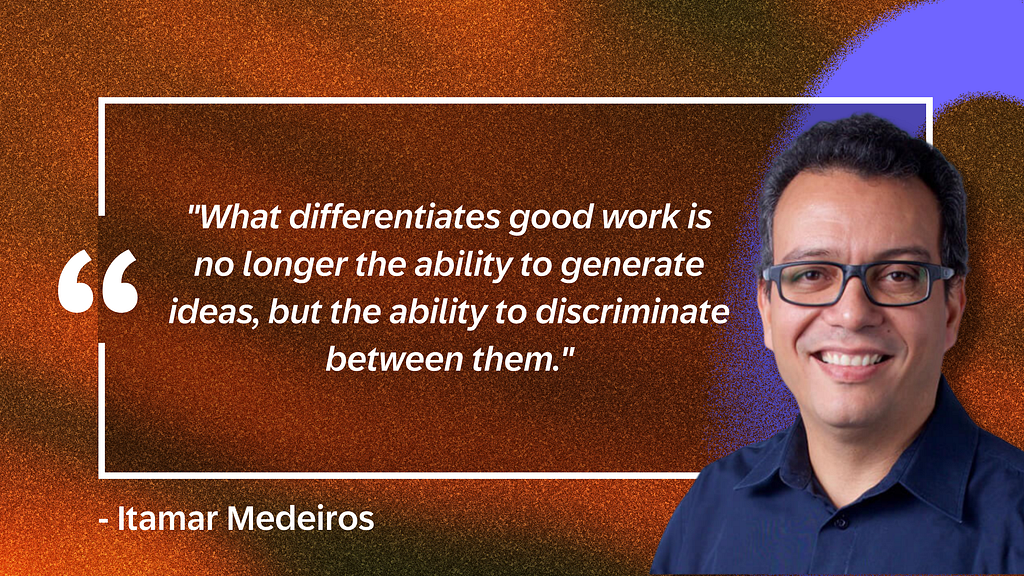
As Itamar Medeiros recently argued in his recent article, taste has become the new bottleneck.
He defends that “what differentiates good work is no longer the ability to generate ideas, but the ability to discriminate between them.” With unlimited plausible options on tap, knowing which one to ship is “the” job.
In this year’s Designlab State of AI in UX and Product Design live panel, Christian Eckels, Product Designer at CNN, shared a strong opinion on this topic: “AI can make weak UX look polished; judgment, taste, and accountability are the responsibility of the designer.”
It’s hard to put taste into words. Designers may know what they want, but when they prompt the tool, what comes back often feels generic or unlike their own work, even when it technically matches the brief.
Taste is not innate. It is developed through repetition, critique, and exposure to excellent work over time. Most of the designers I’ve worked with built theirs through years of looking at their past work and finding elegant, creative solutions to improve it.
I am not saying that designers are the only ones with taste or judgment. Designers, however, carry the professional obligation to exercise it, to hold the bar, name what’s missing, and advocate for the people who will ultimately live with the decisions.
2. Words that sound like you
Most vibe-designed products use the same UX microcopy. They’re filled with expressions like “Continue your journey,” “Let’s go,” “Almost there”…
This microcopy does the job, no doubt about that. It goes straight to the point but misses memorability.
What makes your brand unmistakable (think Apple historically, or more recently Duolingo) lives in the wording, and the vibe design tool of the moment isn’t going to replicate it. You are the only one who understands your product’s soul and what makes it special.
Design and product teams have the raw material in old tone-of-voice docs that were written way before we had vibe design tools. These guides capture the nuances that make a brand recognizable, from cadence and sentence structure to communication principles. They also define which words to use to make the experience feel consistently like your brand.
3. A design system that holds together
Vibe design struggles with design systems. These tools can be wired up to your tokens and components. For example, Figma Make can pull from your Figma library, v0 and Lovable can be configured with custom themes.
However, the output they generate drifts. Pretty much all vibe design tools are powered by some form of AI model. In most cases, that means LLMs or multimodal foundation models. LLMs are probabilistic, so a “rounded button” prompt produces slightly different results. Over time, the drift compounds and the design system erodes from the inside.
The drift is one of the many headaches these tools can give you. The study Qualitative Evaluation of LLM-Designed GUI tested three leading models (GPT o3-mini-high, DeepSeek R1, and Claude 3.5 Sonnet) by generating UI mockups for a chat system, a technical team panel, and a manager dashboard. The expert evaluation concluded that while the models were good at producing structured layouts, they struggled with accessibility standards and with providing interactive functionality.
Accessibility standards and interactive states are part of what any design system specifies (contrast ratios, focus indicators, keyboard handling, component states), and the models don’t honor them by default.
So, is the vibe design tool you are using meeting your design system’s specs to the letter? Probably not.

4. Talking to the people who’ll use your product
The vibe design tool you may be thinking of using has opinions about a generic SaaS user. Just not your end user .
Designers and UX researchers spend most of their time figuring out who the user is and what they need, and that work isn’t something they’ll give up to a prompt (or to the “vibes”).
According to Maze’s The Future of User Research 2026 report, 69% of researchers now use AI in their work. Researchers are using AI to handle repetitive execution work, while focusing their energy on the things only a human can do: framing sharper questions and interpreting nuance.
An AI model can’t account for what’s not in its training data. For instance, the user with the unusual workflow is invisible to the vibe design tool. None of it shows up in the AI’s output until a designer or researcher puts the work in front of a real user and watches what happens.
5. Who’s designing
The barrier to producing something that looks shippable has collapsed. Anyone can generate a UI now, but can they (really) design a product?
Vibe design hands to non-designers the means of production. The discipline itself is harder to automate . That discipline begins after the first output appears. It involves choosing a specific layout over three others, or deciding why a hierarchy on a particular screen should be used for this user at this point in the funnel.
A vibe-designed screen often resembles what used to be the starting point of the design process: an interface direction before the difficult decisions behind it have been tested and resolved.
The designer’s job was to take that starting point through the trade-offs that occur once a product meets reality, like defending decisions with engineering and adapting flows based on user feedback. The AI skips straight to the artifact.
In that jump, you lose the reasoning process that turns an interface into a product decision. Vibe design just compresses execution.
6. The reasoning and documentation
When a designer builds something manually, the labor produces traces. In other words, the work generates documentation as a side effect of the work being done.
On the contrary, when vibe design generates the output in a single leap, many of those intermediate layers disappear. The artifact exists, but its provenance is incomplete or fragile.
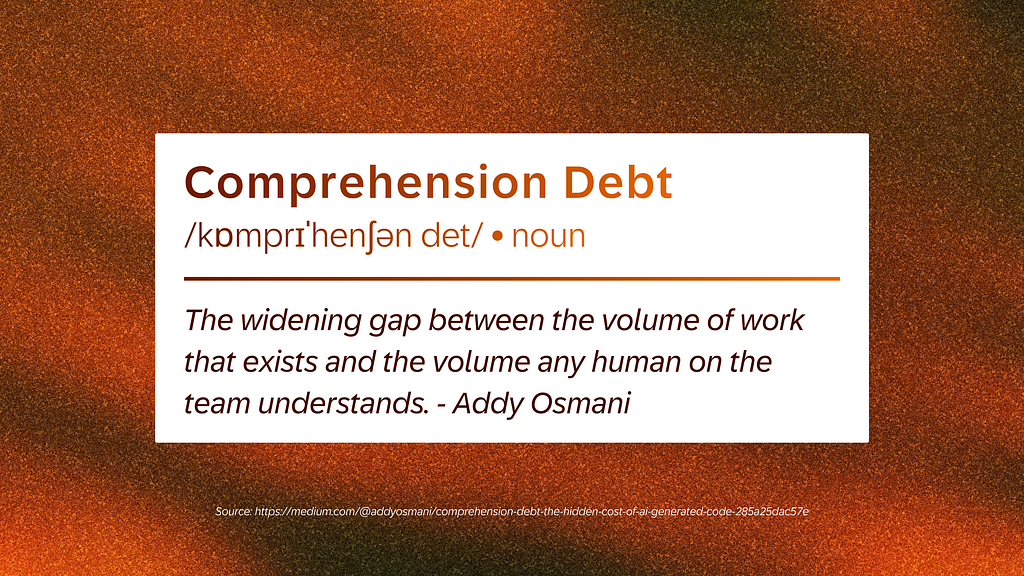
Addy Osmani, Director at Google Cloud AI, calls this comprehension debt: the widening gap between the volume of work that exists and the volume any human on the team understands.
He coined the term “comprehension debt” for code, but we can extrapolate it into design. Think about a situation where, six months after shipping a vibe-designed flow, someone in your team asks why the cancellation flow has three confirmation steps, and the upgrade flow has one. The designer who built it may not remember, because the reasoning wasn’t recorded or surfaced by the tool. The interface exists, but the reasoning behind it may not.
Vibe design accelerates production faster than teams can preserve understanding.
7. Teaching the next generation of designers
Junior designers learn by doing the hard, sometimes “ugly” work. They may struggle through fifteen versions of a layout, get feedback, and slowly build the eye that becomes the foundation of taste and judgement.
That work is the curriculum. There’s no other way to develop the judgment (see section 1) that is irreplaceable and belongs to designers.
The repetitive work that builds judgment is the apprenticeship that produces the next round of senior designers. If there’s a tool that removes steps from the learning loop, seniors and design leads have to reintroduce it through critique, trade-off explanations, slowed-down reviews, and making decision-making visible again. Not everything needs to be sped up.
Vibe design has its place in a senior workflow, but the pipeline to senior runs through repeated practice and reflection.
Vibe design with intention
This article is far from being an anti-vibe design manifesto. AI is making me a better designer and leader, and I’m excited (as well as intrigued) about what this new wave will bring to the industry.
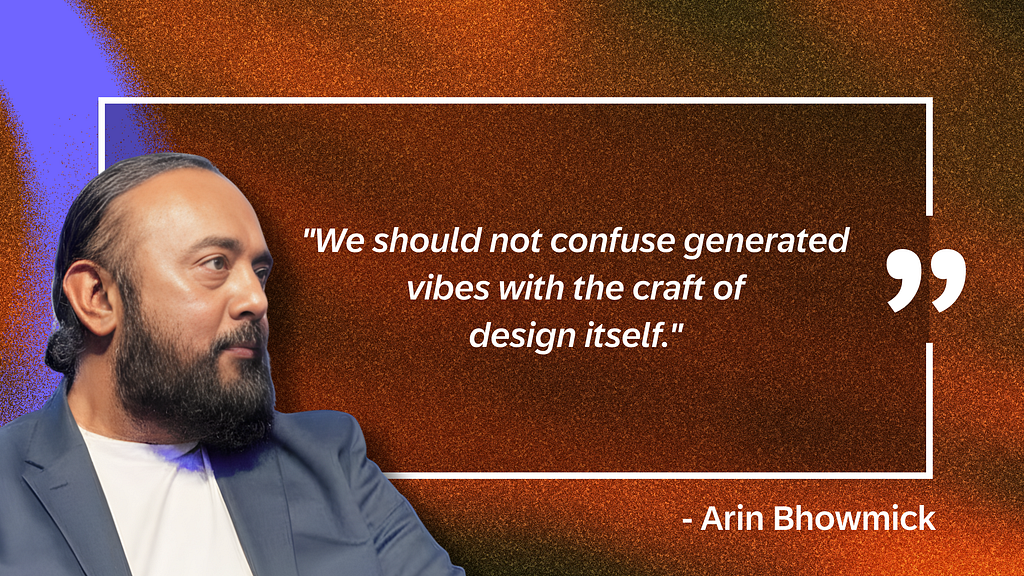
The tools I’ve tried are excellent, and they’ve reminded me why I fell in love with design in the first place. So, while I fully embrace vibe design, we should be careful not to confuse generated vibes with the craft of design itself.
The enduring value of design lies in judgment, systems thinking, language, research, accountability, and the ability to translate ambiguity into coherent experiences.
The teams that thrive in the age of vibe design will not be the ones resisting AI. They will be the ones using it deliberately while protecting the human capabilities that make products meaningful in the first place.
Arin Bhowmick (@arinbhowmick) is Chief Design Officer at SAP, based in San Francisco, California. The above article is personal and does not necessarily represent SAP’s positions, strategies or opinions.
7 things that Vibe Design can’t replicate was originally published in UX Collective on Medium, where people are continuing the conversation by highlighting and responding to this story.


